
HKSI Paper 9 Mock Questions with Answers: Practice Derivatives Questions (2026)
Practise with HKSI Paper 9 mock questions covering derivatives markets, generic products, equity derivatives, interest-rate derivatives, and trading/clearing/settlement. Each question includes detailed explanations.
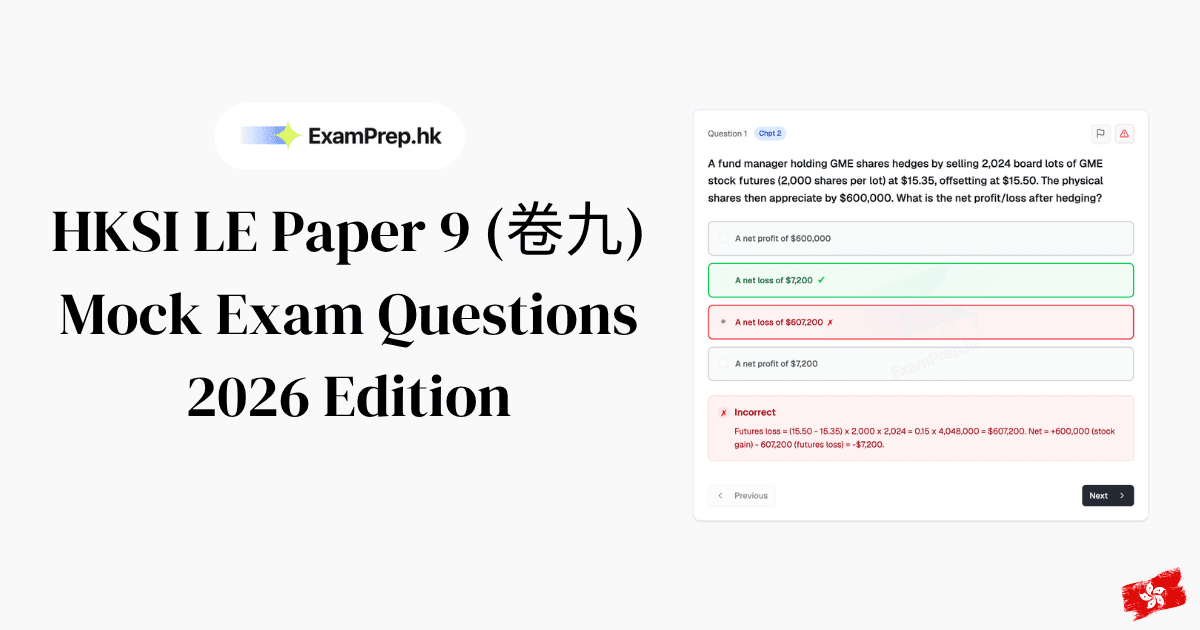
Looking for HKSI Paper 9 practice questions? We've put together sample questions from Chapters 1, 2, 3, 4, and 6 to help you prepare for the Derivatives exam.
Not sure what the exam looks like? Read our HKSI Paper 9 Passing Score & Format guide first.
Each question below includes the correct answer and a detailed explanation — exactly what you need to understand the concepts, not just memorise answers.
📝 About These Questions
- Questions cover Chapters 1, 2, 3, 4, and 6 (representing the bulk of the actual exam)
- Includes both theory and calculation questions — just like the real exam
- Format matches the real exam: 4 options, choose 1 correct answer
- You may use an approved calculator during the actual exam (Papers 7–12)
- Detailed explanations help you understand the underlying concepts
Chapter 1: Overview of the Derivatives Markets
Question 1:
An investor closely follows the AUD because he expects to fund his children's overseas studies. Believing AUD will rise, he buys AUD futures. He is most likely a:
- A: Hedger
- B: Trader
- C: Speculator
- D: Arbitrageur
Show Answer & Explanation
Answer: A
He locks in a future AUD price to cover a known future expense — a hedge, not speculation.
Chapter 2: Generic Derivative Products
Question 2:
A call bull spread is set up by buying the 22,000 call for 150 points and selling the 22,400 call for 30 points. The net cost and break-even are:
- A: Net cost 180; break-even 22,180
- B: Net cost 120; break-even 21,880
- C: Net cost 30; break-even 22,030
- D: Net cost 120; break-even 22,120
Show Answer & Explanation
Answer: D
Net cost = 150 − 30 = 120 points; break-even = lower strike + net cost = 22,000 + 120 = 22,120.
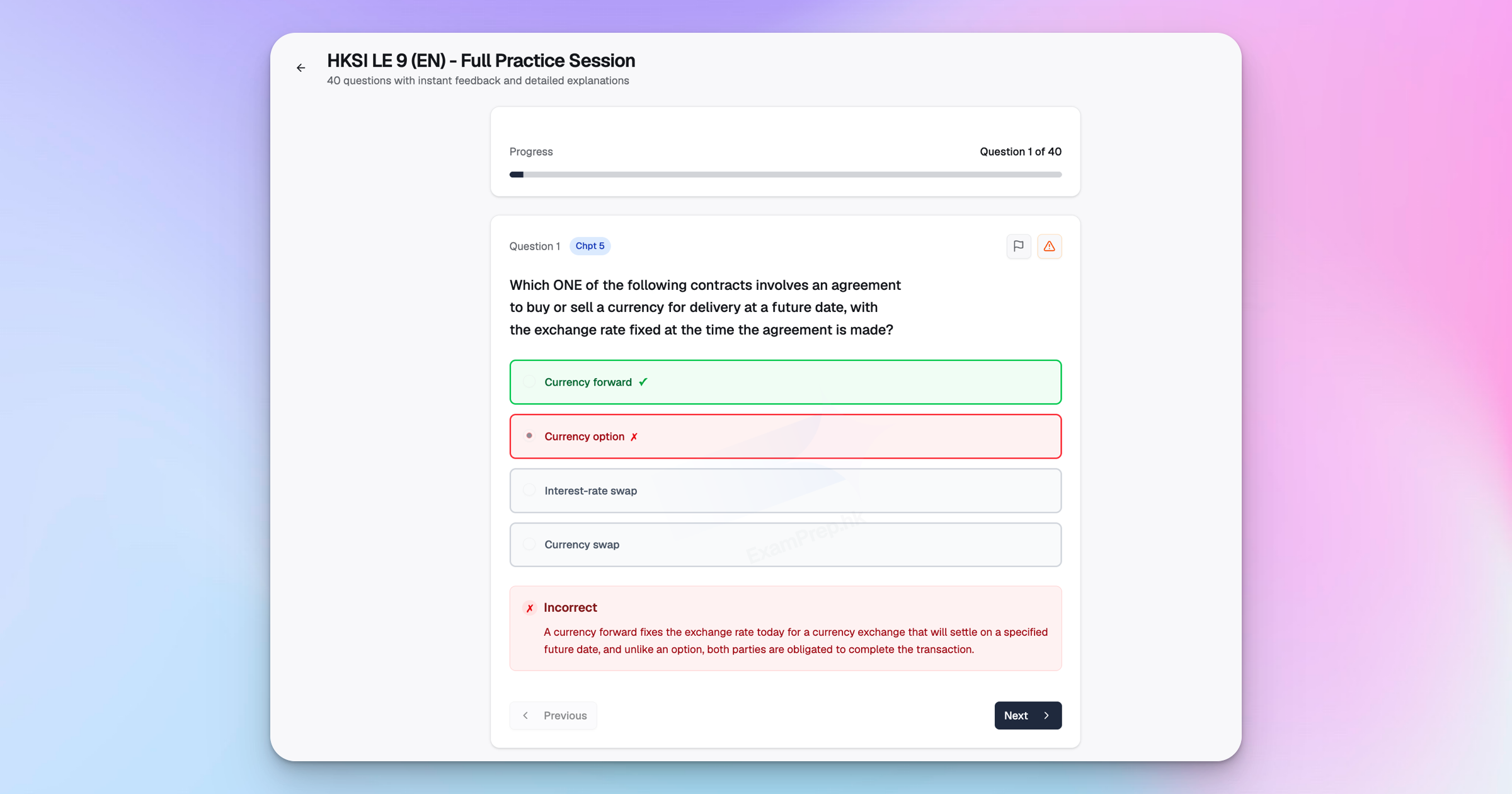
ExamPrep.hk provides instant feedback with detailed explanations for every question.
⚠️ Chapter 2 Alert
Chapter 2 (Generic derivative products) carries 12 out of 40 questions (~30%) on the real exam. Combined with Chapters 3 and 6, these three chapters account for 28/40 = 70% of the exam. This is where most candidates lose marks. Read our full difficulty analysis.
Chapter 3: Equity Derivatives
Question 3:
Having sold 494 XY December futures at HKD12.85 (1,000 shares/contract), the manager buys them back at HKD10.60. The futures profit is:
- A: HKD61,500
- B: HKD1,050,000
- C: HKD2,250
- D: HKD1,111,500
Show Answer & Explanation
Answer: D
Profit = (12.85 − 10.60) × 1,000 × 494 = 2.25 × 1,000 × 494 = HKD1,111,500.
Pssst.. ExamPrep.hk has instant feedback and explanations to help you easily digest and understand the logic and concept behind each question.
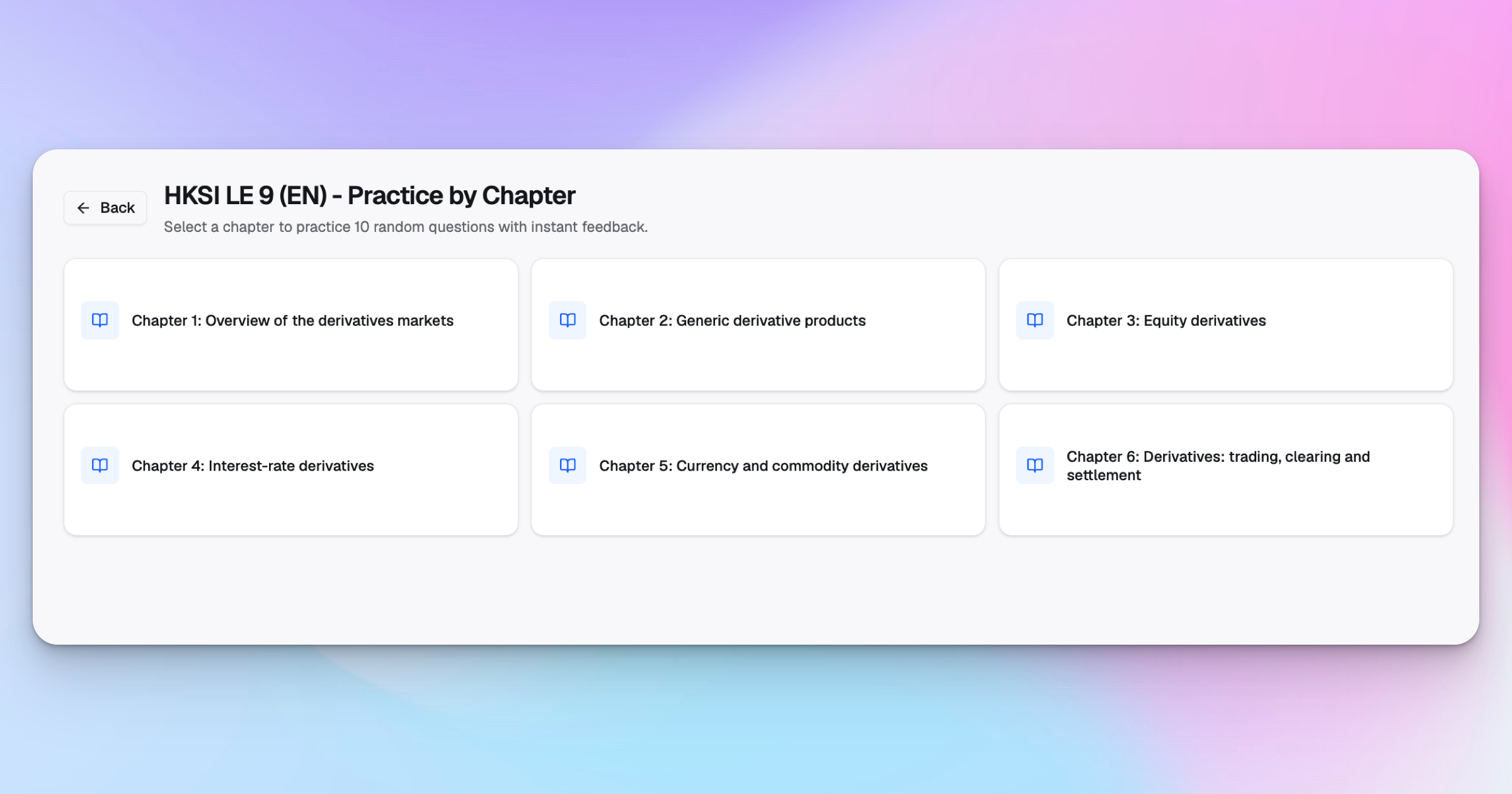
ExamPrep.hk's Practice by Chapter feature helps you focus on specific chapters and track your performance.
Chapter 4: Interest-Rate Derivatives
Question 4:
Company ABC hedges a future HKD100,000,000 investment; interest at 2.8% for a quarter is HKD700,000 and the futures trade adds HKD100,000. The effective annualised return locked in is:
- A: 3.2%
- B: 0.8%
- C: 2.8%
- D: 4.0%
Show Answer & Explanation
Answer: A
Effective return = [(700,000 + 100,000) / 100,000,000] × 4 = 0.032 = 3.2%.
Chapter 6: Derivatives — Trading, Clearing and Settlement
Question 5:
Which ONE of the following is the MOST appropriate way for a broker to handle client accounts traded on the Hong Kong Futures Exchange?
- A: Monitor each client's ability to meet margin calls.
- B: Decide whether to accept non-cash collateral on an ad hoc, inconsistent basis for each client.
- C: Maintain a single combined ledger account covering all clients.
- D: Maintain one shared bank account for both client and house money.
Show Answer & Explanation
Answer: A
A broker should actively monitor each client's ability to meet margin calls, since this is essential to managing counterparty risk; commingling client and house funds, or applying inconsistent collateral policies, would breach proper client-money and risk-management practices.
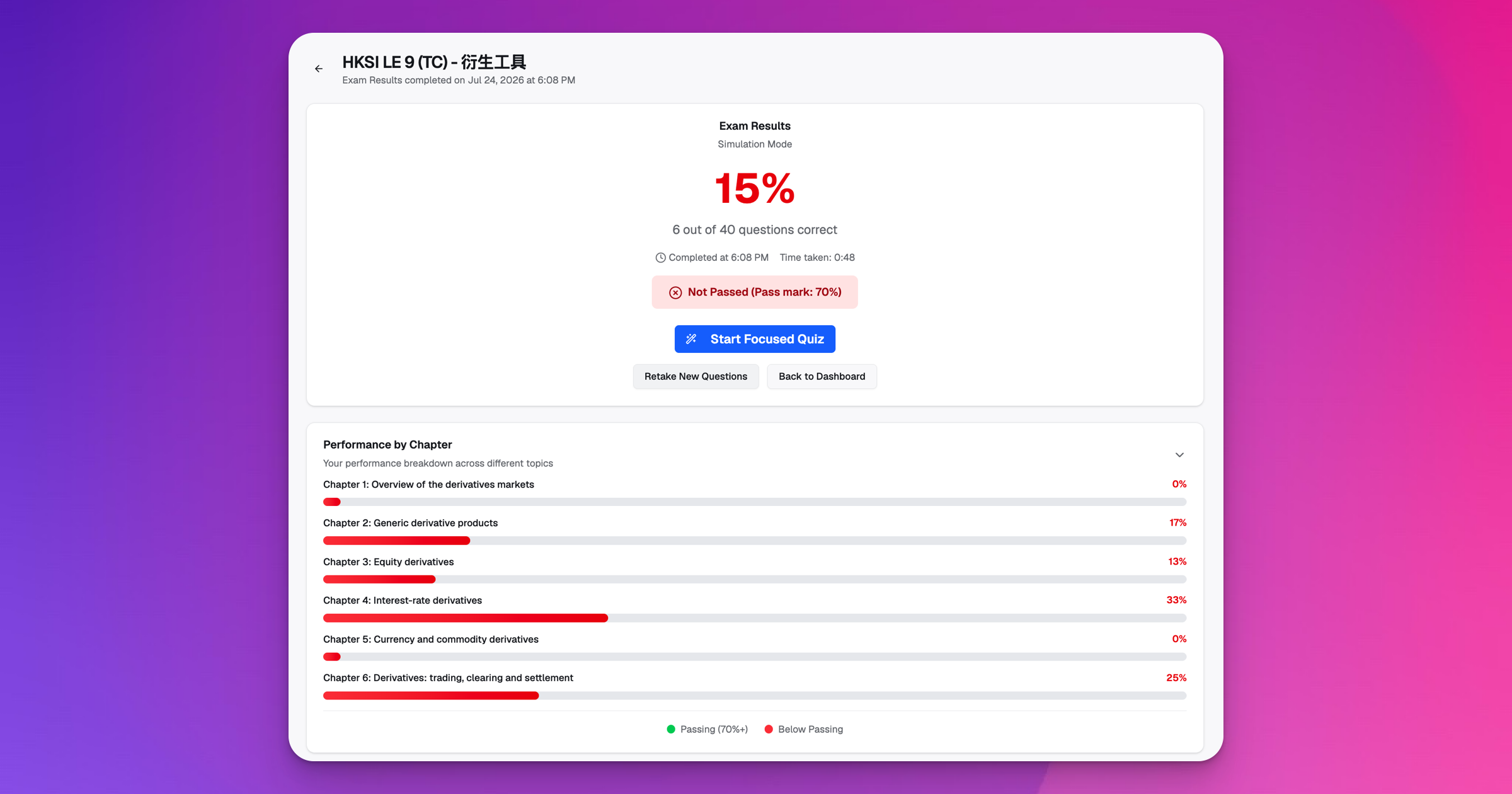
ExamPrep.hk's Performance by Chapter feature tracks your performance by chapter and highlights your strengths and weaknesses.
How to Use These Questions Effectively
💡 Study Tips
- 1. Don't just check answers — Read the explanations to understand the underlying principles, especially for calculation questions.
- 2. Note the chapter weightings — Chapters 2, 3, and 6 carry 70% of the exam. Prioritise them.
- 3. Master the formulas — Option spread break-evens, futures multiplier P&L, and annualised hedge returns appear frequently.
- 4. Practise under time pressure — In the real exam, you have 1.5 minutes per question (40 questions in 60 minutes).
What to Study Next
Now that you've tried these sample questions, here's how to build a complete study plan:
- Read our complete HKSI Paper 9 Study Guide — includes a focused study plan and chapter-by-chapter breakdown
- Understand the difficulty breakdown — learn why Chapter 2 is the killer chapter
- Check the passing score & format — everything you need to know about the exam structure
- Register for your exam — step-by-step guide to booking your slot
- Compare study resources — find the right tools for your preparation
Also preparing for Paper 1, Paper 7, or Paper 8? Check out our HKSI Paper 1 Study Guide, HKSI Paper 7 Study Guide, and HKSI Paper 8 Study Guide.
Want More Practice Questions?
These 5 questions are just a sample. The actual HKSI Paper 9 exam has 40 questions covering all 6 chapters — including calculation questions on option spreads, futures P&L, and interest-rate hedges.
ExamPrep.hk offers 500+ HKSI Paper 9 practice questions with:
- Detailed explanations for every question
- Chapter-by-chapter practice mode
- Performance tracking by chapter
- Full mock exams under timed conditions
- Both theory and calculation question coverage
HKSI Paper 9 Mock Questions — FAQ
Ready to Put This Strategy Into Action? 💯
Join thousands of successful candidates who have passed their HKSI Paper 9 exam using our proven study methods.