
Is HKSI Paper 9 Difficult? Chapter Breakdown & Difficulty Analysis (2026)
HKSI Paper 9 has a ~55% pass rate — harder than Paper 8 (~66%). Chapter 2 alone accounts for ~30% of the exam and the paper is calculation-heavy. Learn the real difficulty breakdown and how to prepare.

"Is HKSI Paper 9 difficult?"
This is the first question most candidates ask before sitting the Derivatives exam. The answer depends entirely on how you prepare.
With an average pass rate of around 55%, roughly one in two candidates fails. That's notably harder than Paper 8's ~66% pass rate — and Paper 9 brings its own unique challenges: a killer Chapter 2 at ~30%, plus a heavier calculation load across futures, options, and interest-rate hedges.
(Haven't registered yet? Check our step-by-step registration guide.)
📊 HKSI Paper 9 at a Glance
- Pass Rate: ~55%
- Questions: 40 MCQ
- Time: 60 minutes (1.5 min per question)
- Passing Score: 70% (28/40)
- Chapters: 6
- Key Challenge: Chapter 2 alone ≈ 30%; Ch2+Ch3+Ch6 = 70%
Why HKSI Paper 9 Is Challenging
1. One chapter dominates — and three chapters decide the exam
Chapter 2 (Generic derivative products) carries 12 out of 40 questions — about 30% of the exam. Combined with Chapter 3 (Equity derivatives, 8Q) and Chapter 6 (Trading, clearing and settlement, 8Q), these three chapters make up 28/40 = 70%.
If you underperform on this trio, it's mathematically very difficult to pass.
2. It is calculation-heavy
Unlike pure regulation papers, Paper 9 expects you to compute option spread costs/break-evens, futures P&L with multipliers, and annualised interest-rate hedge returns — all under time pressure. Calculators are allowed (see the approved calculator list), but you still need to know which formula to apply.
3. Derivatives breadth in a 40-question exam
Paper 9 covers market overview (Chapter 1), generic products (Chapter 2), equity derivatives (Chapter 3), interest-rate derivatives (Chapter 4), currency and commodity derivatives (Chapter 5), and trading/clearing/settlement (Chapter 6). The product and process breadth is substantial for a one-hour exam.
⚠️ The Math Behind the Killer Chapter
Chapter 2 = 12 questions. If you score only 50% on Chapter 2 (6 correct), you'd need 22 out of 28 on the remaining chapters just to reach the passing score of 28. That's a 79% score on everything else — a very thin margin. Focus on Ch2+Ch3+Ch6 instead.
Chapter-by-Chapter Difficulty Analysis
| Chapter | Topic | ~Questions | Weight | Difficulty |
|---|---|---|---|---|
| 1 | Overview of the derivatives markets | 6 | ~15% | ⭐⭐ |
| 2 | Generic derivative products | 12 | ~30% | ⭐⭐⭐⭐⭐ |
| 3 | Equity derivatives | 8 | ~20% | ⭐⭐⭐⭐ |
| 4 | Interest-rate derivatives | 3 | ~7.5% | ⭐⭐⭐⭐ |
| 5 | Currency and commodity derivatives | 3 | ~7.5% | ⭐⭐⭐ |
| 6 | Derivatives: trading, clearing and settlement | 8 | ~20% | ⭐⭐⭐ |
Chapter 2: Generic Derivative Products — ⭐⭐⭐⭐⭐ (Hardest)
Chapter 2 is the undisputed heavyweight of the Paper 9 exam. It covers an enormous breadth of generic product knowledge:
- Forwards & futures — standardisation, marking to market, pricing basics
- Options — calls, puts, intrinsic/time value, European vs American style
- Option strategies — bull/bear spreads, straddles, break-even calculations
- Swaps — interest-rate and other generic structures at syllabus level
- Payoff diagrams — reading and constructing profit/loss profiles
Why it's hard: The sheer combination of product knowledge and calculation questions makes this the most difficult chapter. At ~30% of the exam, you simply cannot afford to be weak here.
Want to see what Chapter 2 questions look like? Try our sample mock questions.
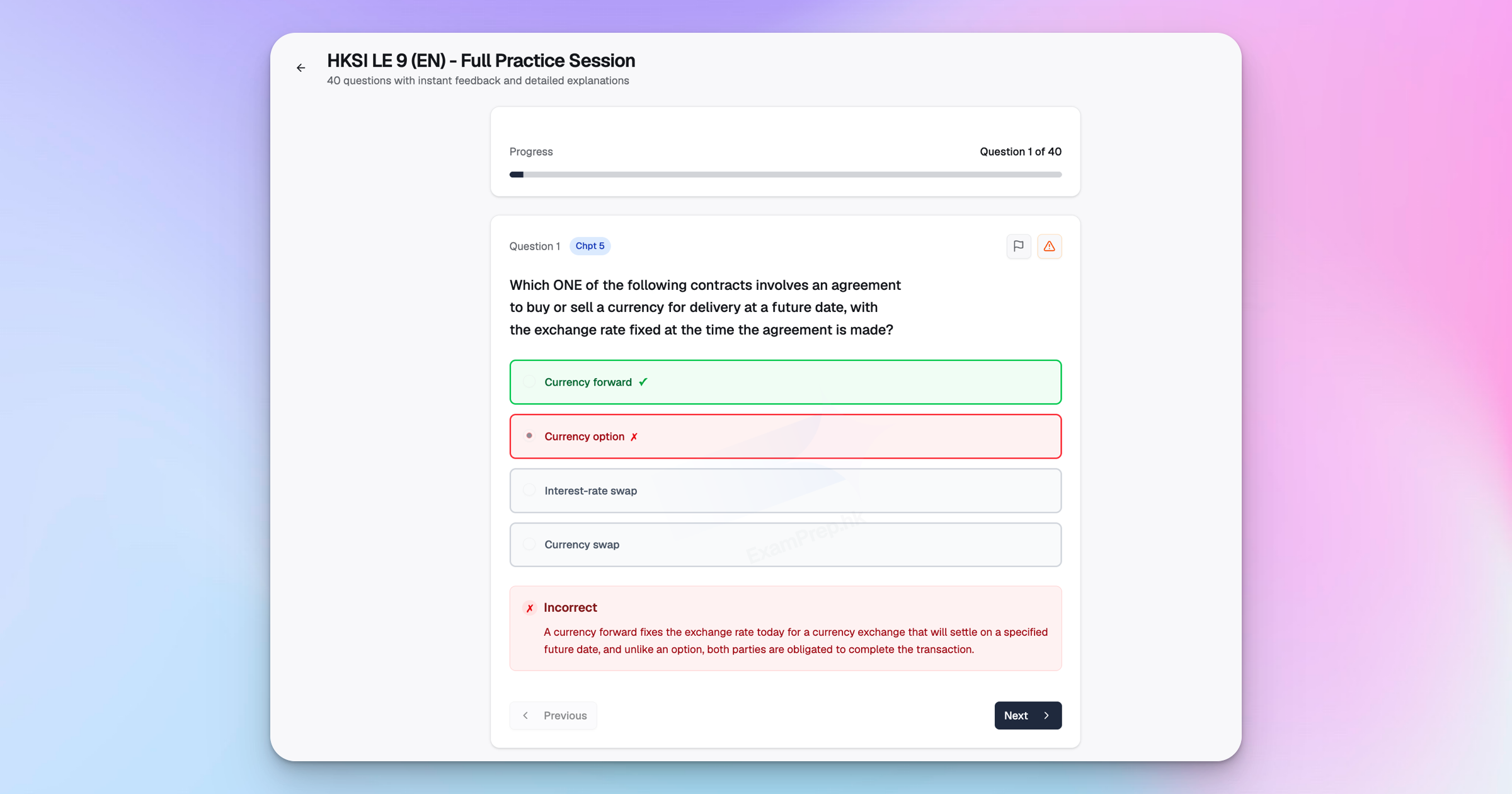
ExamPrep.hk provides instant feedback with detailed explanations for every question — essential for mastering Chapter 2's calculations.
Chapter 3: Equity Derivatives — ⭐⭐⭐⭐
The second major scoring chapter applies derivative concepts to equity underlyings:
- Stock and index futures/options mechanics
- Contract multipliers and futures P&L
- Equity portfolio hedging with index futures
- Warrants and related equity derivative products
Why it's hard: Multiplier-based calculations under time pressure trip up candidates who understand the concepts but haven't drilled the arithmetic.
Chapter 6: Trading, Clearing and Settlement — ⭐⭐⭐
Process-heavy but high weight (8 questions / ~20%):
- HKATS trading on HKFE
- DCASS clearing/settlement and novation
- Margin calls, client money segregation, broker obligations
Why it's moderate: Mostly factual, but the volume of rules and systems means careless candidates leak easy marks.
Chapter 4: Interest-Rate Derivatives — ⭐⭐⭐⭐ (small weight, hard maths)
Only ~3 questions, but often calculation-heavy (e.g. effective annualised return after combining interest income and futures P&L). Worth mastering for "free marks."
Chapters 1 and 5: Overview & FX/Commodity — ⭐⭐ to ⭐⭐⭐
Chapter 1 (~15%) is mostly conceptual (hedgers vs speculators vs arbitrageurs). Chapter 5 (~7.5%) covers currency and commodity applications. Important, but not where the exam is decided.
How Does Paper 9 Compare to Paper 1, Paper 7, and Paper 8?
Many candidates take multiple HKSI papers. Here's how they compare:
| Feature | Paper 1 | Paper 7 | Paper 8 | Paper 9 |
|---|---|---|---|---|
| Questions | 60 MCQ | 40 MCQ | 40 MCQ | 40 MCQ |
| Duration | 90 minutes | 60 minutes | 60 minutes | 60 minutes |
| Passing Score | 70% | 70% | 70% | 70% |
| Pass Rate | ~52% | — | ~66% | ~55% |
| Content Type | Pure regulation | Theory + calcs | Theory + calcs | Theory + heavy calcs |
| Killer Chapter(s) | Ch3 + Ch6 | Multiple chapters | Ch4 (~35%) | Ch2 (~30%); Ch2+3+6 = 70% |
| Exam Fee (HK) | HK$1,630 | HK$1,470 | HK$1,470 | HK$1,620 |
Key takeaway: Paper 9 is harder than Paper 8 on pass-rate terms (~55% vs ~66%), largely because it is more calculation-heavy and concentrates marks in Chapters 2, 3, and 6. Candidates who've passed Paper 8 will recognise some derivatives overlap, but should still drill Paper 9-specific calculations. Those preparing for Paper 1 or Paper 7 should treat Paper 9 as a distinct skill set.
Strategies to Overcome the Difficulty
1. Make Chapters 2, 3, and 6 your top priority
Allocate ~70% of your study time to Chapters 2, 3, and 6 — they are worth 28 questions combined. Within that, put the largest share into Chapter 2.
✅ Recommended Time Allocation
- 35–40% of study time: Chapter 2 (generic derivative products — futures, options, swaps, strategies)
- 15–20% of study time: Chapter 3 (equity derivatives — multipliers, P&L, hedges)
- 15–20% of study time: Chapter 6 (trading, clearing, settlement, margin)
- 20–25% of study time: Chapters 1, 4, and 5 (overview, IR, FX/commodity)
2. Drill the formulas until they're automatic
For each calculation type, you should be able to recall and apply the formula within 30 seconds:
- Call bull spread — Net cost = premium paid − premium received; break-even = lower strike + net cost
- Futures P&L — Price difference × multiplier × number of contracts
- Effective annualised return — [(interest + futures P&L) / notional] × periods per year
- Options intrinsic value — Call = max(0, spot − strike); Put = max(0, strike − spot)
3. Use chapter-by-chapter practice mode
Don't just take full mock exams from day one. Isolate Chapter 2 and drill it until you consistently score above 75% before moving on.
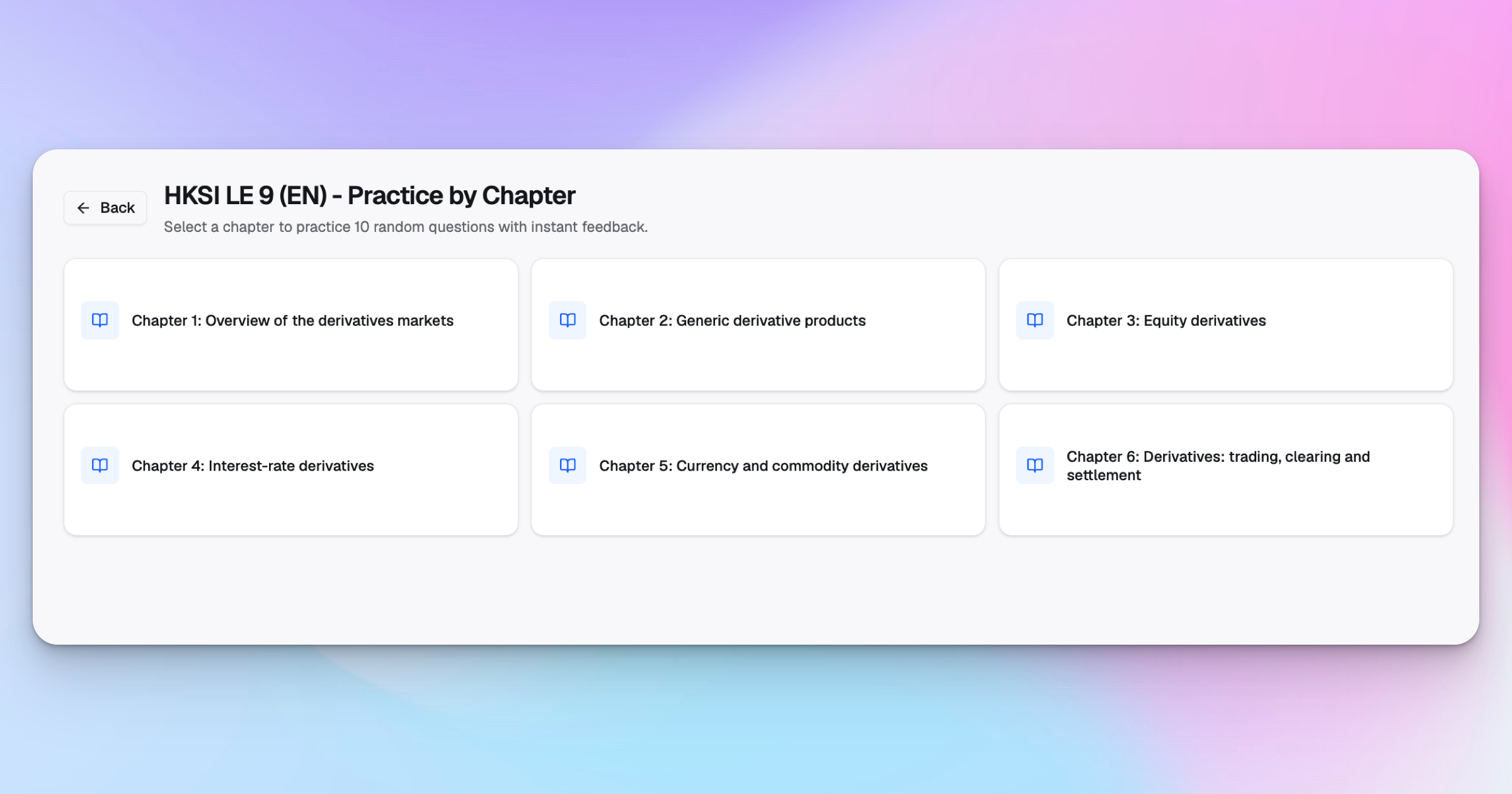
ExamPrep.hk's Practice by Chapter mode lets you drill individual chapters until you've mastered them.
For a complete study plan, read our HKSI Paper 9 Study Guide.
4. Take timed mock exams
Once you're scoring well by chapter, switch to full 40-question mock exams under timed conditions (60 minutes). This builds exam stamina and helps you manage time when calculation questions slow you down.
Try our sample mock questions to get a feel for the exam format.
5. Understand, don't just memorise
Paper 9 tests understanding of how derivatives are used and how markets operate, not just factual recall. For theory questions, make sure you understand why someone is a hedger rather than a speculator — not just the label.
How to Know If You're Ready
Before sitting the exam, make sure you can:
- Score 75%+ on Chapter 2 in practice mode
- Score 75%+ on Chapters 3 and 6 in practice mode
- Score 70%+ on full mock exams consistently (not just once)
- Complete calculations within 2 minutes each without mistakes
- Finish mock exams within 60 minutes with time to review flagged questions
If you're not hitting these benchmarks yet, keep practising. It's better to delay by a month than to waste HK$1,620 on a failed attempt.
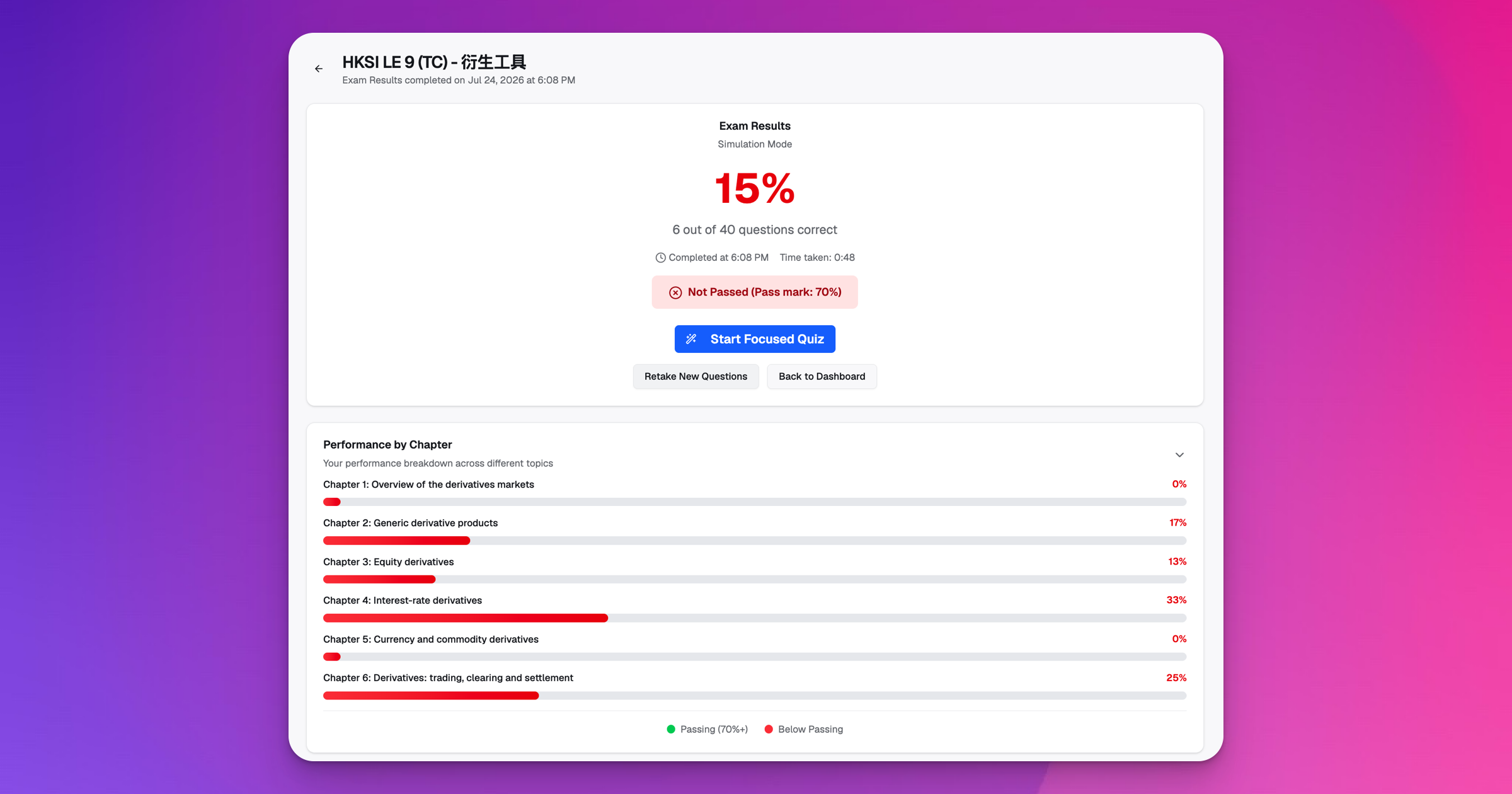
ExamPrep.hk's Performance by Chapter mode shows you exactly where you stand across all 6 chapters — so you know when you're ready.
More Resources for Your Preparation
- Complete HKSI Paper 9 Study Guide — a focused study plan built around the chapter weightings
- Passing Score & Exam Format — everything you need to know about the exam structure
- Try mock questions — test yourself with sample questions and detailed explanations
- Register for your exam — step-by-step guide to booking your slot
- Compare study resources — find the right tools for your preparation
The Bottom Line
Is HKSI Paper 9 difficult? It can be — and the ~55% pass rate shows it is harder than Paper 8 — but it's entirely manageable with the right approach.
The candidates who fail are typically those who:
- Spread their study time equally across all 6 chapters
- Don't practise Chapter 2 enough (it's ~30% of the exam!)
- Underestimate the calculation questions on spreads, futures P&L, and hedge returns
- Ignore Chapters 3 and 6, which together add another 40%
- Run out of time because they haven't practised under timed conditions
The candidates who pass are those who:
- Focus ~70% of their effort on Chapters 2, 3, and 6
- Drill formulas until they're automatic
- Use chapter-by-chapter practice to identify and fix weak areas
- Take timed mock exams to build exam stamina
Don't be one of the candidates who prepare the wrong way.
HKSI Paper 9 Difficulty — FAQ
Ready to Put This Strategy Into Action? 💯
Join thousands of successful candidates who have passed their HKSI Paper 9 exam using our proven study methods.