
How to Pass HKSI Paper 8 Exam Hong Kong: Complete 2026 Study Guide
Master HKSI Paper 8 (Securities) with our proven study strategy. Learn the exam format, killer chapter breakdown, and a focused 2-3 week study plan to pass on your first attempt.
The HKSI LE Paper 8 — Securities is one of the most content-heavy licensing exams in Hong Kong's financial services industry. Whether you're looking to deal in securities, advise on listed products, or work in asset management, Paper 8 is likely on your path.
(If you haven't registered yet, check our complete HKSI Paper 8 registration guide.)
What makes Paper 8 uniquely challenging isn't the pass mark or time limit — it's that a single chapter (Chapter 4: Types of Securities) covers an enormous breadth of topics from equities to bonds to derivatives to options, and accounts for 35% of the entire exam. Most candidates who fail do so because they underestimate this chapter's scope.
This guide gives you the 2026 exam strategy, a chapter-by-chapter breakdown with question weights, and a focused study plan to help you pass efficiently.
✨ TL;DR: The HKSI Paper 8 Passing Strategy
- The Scope: 6 Chapters covering securities markets, participants, products, administration, and analysis.
- The Trap: Chapter 4 (Types of Securities) alone is 35% of the exam — equities, bonds, derivatives, and options all in one chapter.
- The Score: You need 70% (28/40 questions) to pass.
- The Strategy: Focus 65% of your study time on Chapters 2, 3, and 4 — they make up 26 out of 40 questions.
Understanding the Exam: HKSI Paper 8 Format (2026)
HKSI LE stands for Hong Kong Securities Institute Licensing Examination, administered by HKSI. Paper 8 covers securities — the products, markets, and analysis techniques relevant to anyone dealing in or advising on securities in Hong Kong.
| Full Name | Licensing Examination Paper 8 — Securities |
| Questions | 40 Multiple Choice (MCQ) |
| Duration | 60 minutes |
| Passing Score | 70% (28 correct answers) |
| Wrong Answers Allowed | 12 questions |
| Format | Computer-based exam (CBE), English or Traditional Chinese |
| Calculator | Allowed (approved list) |
| Exam Fee | HK$1,470 (Hong Kong) / HK$1,890 (Global Centres) |
| Frequency | Monthly |
| Syllabus | Effective from 1 March 2026 |
(For a deeper dive into the scoring and format, read our HKSI Paper 8 Passing Score & Exam Format guide.)
The "Killer Chapter": Where Most Questions Come From
The difficulty of HKSI Paper 8 isn't evenly distributed. One chapter dominates the exam like no other.
| Chapter | Topic | Questions | Weight |
|---|---|---|---|
| 1 | Overview of securities investments | 4 | ~10% |
| 2 | The Stock Exchange of Hong Kong: primary and secondary markets | 6 | ~15% |
| 3 | Participants in the markets | 6 | ~15% |
| 4 | Types of securities ⚠️ | 14 | ~35% |
| 5 | Stock market administration | 4 | ~10% |
| 6 | Securities analysis | 6 | ~15% |
Chapter-by-Chapter Breakdown
Chapter 1: Overview of Securities Investments (4 questions, ~10%)
This is your warm-up chapter. It provides foundational context but carries relatively low weight.
Key topics to master:
- Features of the Hong Kong securities market and its role in the global economy
- Market sectors (equities, fixed income, derivatives)
- Overview of global financial markets and how they interact with HK
- Factors affecting securities markets (interest rates, inflation, geopolitical events)
- Market indices and how they are calculated (Hang Seng Index methodology)
Study tip: Don't spend more than 2–3 hours here. Understand the big picture and move on.
Chapter 2: The Stock Exchange of Hong Kong: Primary and Secondary Markets (6 questions, ~15%)
This chapter covers how securities come to market and how they trade once listed.
Key topics to master:
- The IPO process: from prospectus to listing
- Listing rules (Main Board vs GEM)
- Primary market vs secondary market operations
- Market surveillance and enforcement mechanisms
- Corporate actions (dividends, rights issues, share buybacks, stock splits)
Study tip: Focus on the IPO process steps and listing requirements — these are heavily tested. Understand the difference between Main Board and GEM listing criteria.
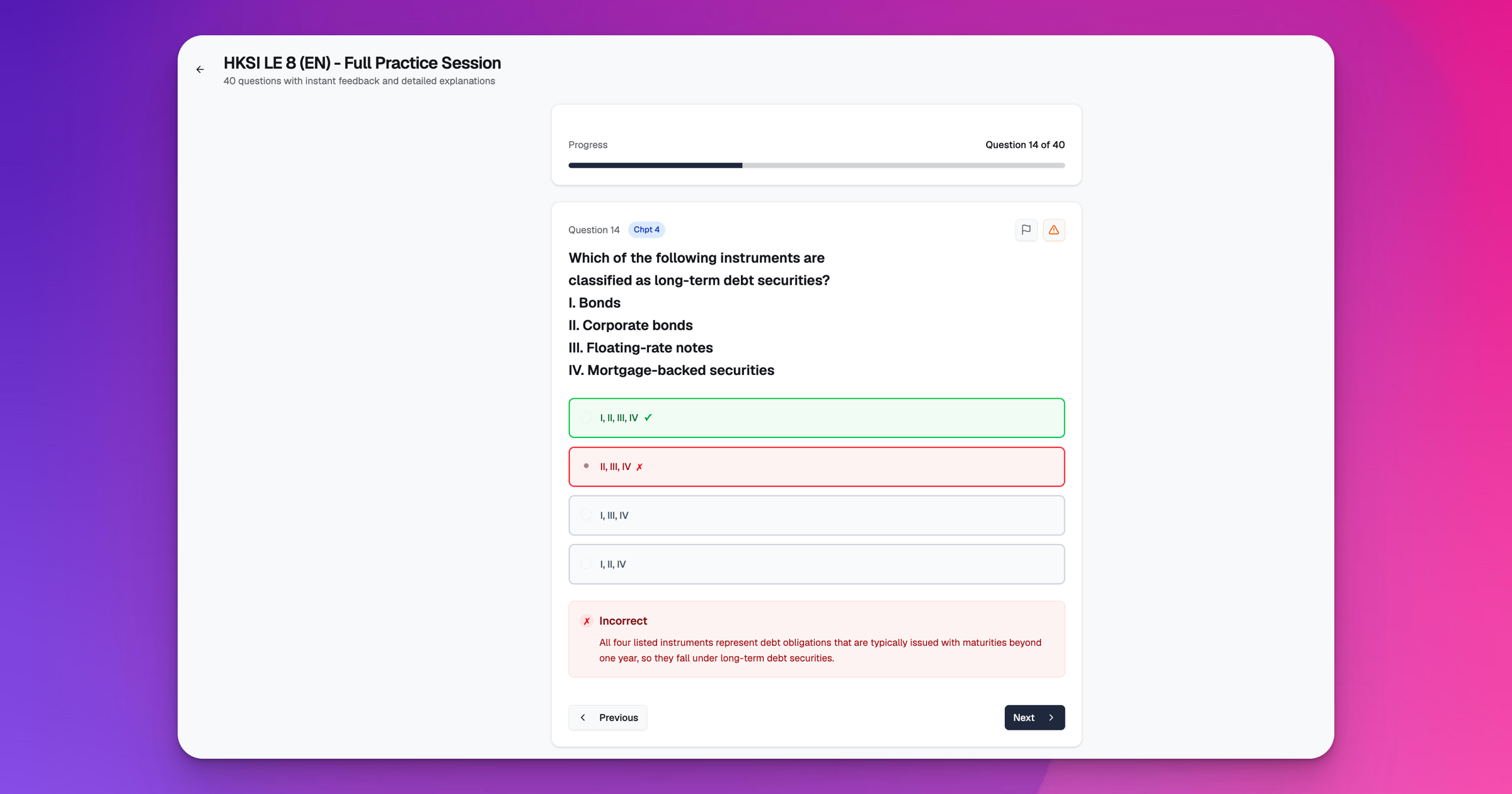
Get instant feedback with detailed explanations for each question on ExamPrep.hk — understand why each answer is correct
Chapter 3: Participants in the Markets (6 questions, ~15%)
This chapter examines the roles and responsibilities of various market participants.
Key topics to master:
- Types of traders: flow traders, proprietary traders, market makers
- The role of brokers, dealers, and intermediaries
- Institutional investors (fund managers, insurance companies, pension funds)
- Exchange participants and their obligations
- Clearing participants and custodians
Study tip: Know the distinction between different trader types and their functions. Questions often test whether you understand who does what in the trading ecosystem.
Chapter 4: Types of Securities — THE KILLER CHAPTER (14 questions, ~35%)
This is where Paper 8 becomes uniquely challenging. No other HKSI paper packs this much breadth into a single chapter. You're expected to understand equities, bonds, derivatives, AND options — each of which could be its own chapter.
Key topics to master:
Equity Products:
- Ordinary shares, preference shares, warrants
- Exchange Traded Funds (ETFs) and Real Estate Investment Trusts (REITs)
- Depositary receipts (ADRs, HDRs)
Debt Products:
- Bond characteristics, types (government, corporate, convertible)
- Bond pricing and yield calculations (current yield, YTM)
- Duration and convexity concepts
- Credit ratings and credit risk
Derivatives:
- Futures contracts (index futures, stock futures)
- Options (calls, puts, European vs American style)
- Option pricing models (Black-Scholes basics, put-call parity)
- Option strategies (covered calls, protective puts, spreads, straddles)
- Stock options and warrants
Margin Financing & Stock Borrowing/Lending:
- Margin trading mechanics and margin calls
- Securities borrowing and lending programmes
- Short selling regulations in Hong Kong
Study tip: Break Chapter 4 into 4 sub-sections (equities, bonds, derivatives, margin/lending) and study each as if it were its own chapter. Allocate at least 40% of your total study time here.
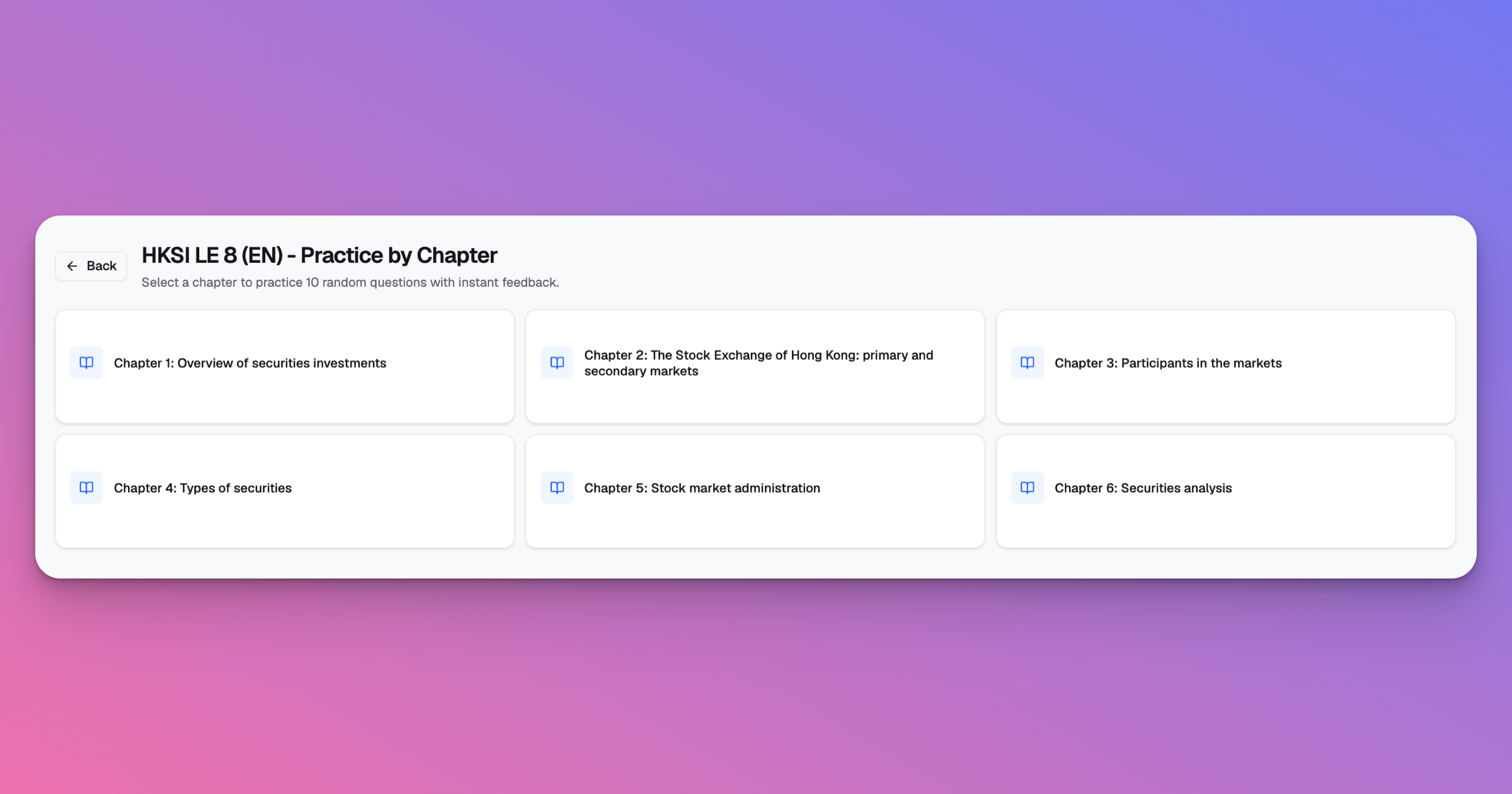
Practice questions organised by chapter — focus your efforts where they matter most
Chapter 5: Stock Market Administration (4 questions, ~10%)
This chapter covers the operational infrastructure of Hong Kong's securities market.
Key topics to master:
- Trading systems: OTP-C (Orion Trading Platform – Securities Market)
- Clearing and settlement: CCASS (Central Clearing and Settlement System)
- Trading costs (brokerage, stamp duty, transaction levy, trading fee)
- SFC regulatory requirements for market participants
- Technology's impact on trading (algorithmic trading, DMA)
Study tip: Memorise the key systems (OTP-C, CCASS) and the fee structure. Questions tend to be factual and straightforward.
Chapter 6: Securities Analysis (6 questions, ~15%)
This chapter tests your ability to evaluate securities using analytical frameworks.
Key topics to master:
- Fundamental analysis (top-down vs bottom-up approaches)
- Financial ratio analysis (P/E, P/B, ROE, debt ratios, liquidity ratios)
- Equity valuation methods (DCF, DDM, comparable company analysis)
- Technical analysis (chart patterns, moving averages, RSI, MACD)
- Efficient Market Hypothesis and its implications
Study tip: Know your formulas cold — P/E ratio, dividend yield, ROE. Technical analysis questions often show charts, so familiarise yourself with common patterns.
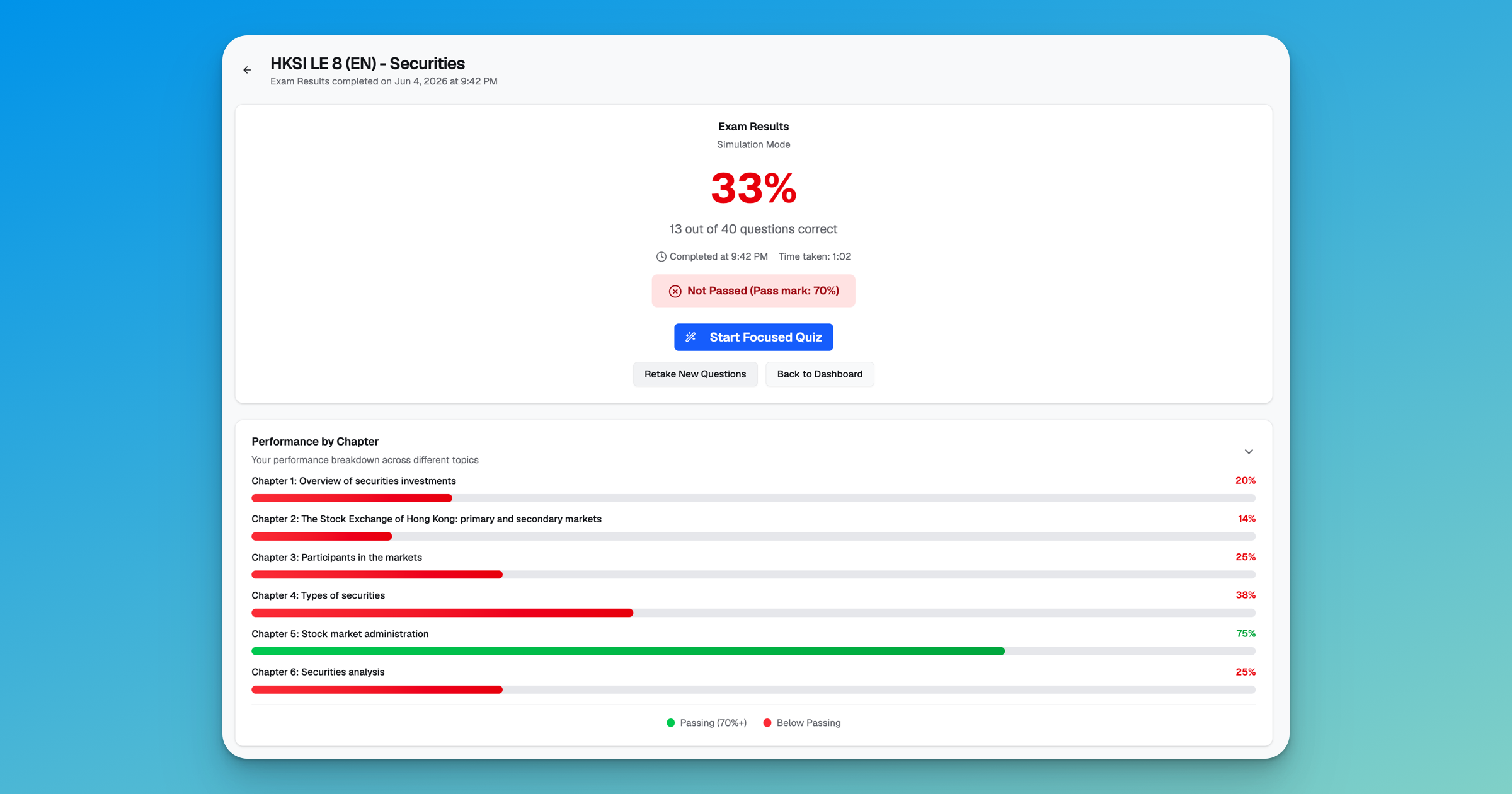
Track your performance by chapter to identify weak areas before exam day
Your 2–3 Week Study Plan
Here's a realistic study plan assuming you can dedicate 1.5–2 hours per day:
| Period | Focus | Activities |
|---|---|---|
| Days 1–2 | Chapters 1 & 5 | Read through these lighter chapters. Memorise key facts, systems, and fee structures. |
| Days 3–5 | Chapter 4 (Equities & Bonds) | Study equity products, then bond types, pricing, and yield calculations. Use your calculator. |
| Days 6–8 | Chapter 4 (Derivatives & Options) | Cover futures, options pricing, strategies, and margin/lending. Practice calculations. |
| Days 9–10 | Chapters 2 & 3 | IPO process, listing rules, market participants. Good factual recall material. |
| Days 11–12 | Chapter 6 | Financial ratios, valuation methods, technical analysis patterns. |
| Days 13–16 | Mock Exams | Full timed practice. Review wrong answers. Re-study weak chapters. |
| Days 17–18 | Final Review | Focus on Chapter 4 weak spots and formula revision. Light review of all chapters. |
(Want to start practising immediately? Try our HKSI Paper 8 sample mock questions.)
Mock Exam Strategy
Mock exams are non-negotiable for Paper 8. The breadth of Chapter 4 means you need exposure to as many question variations as possible.
How to use mock exams effectively:
- First mock (Day 13): Take under exam conditions — 40 questions, 60 minutes, no notes. This establishes your baseline.
- Review phase: For every wrong answer, go back to the source material. Don't just memorise the correct answer — understand the concept.
- Second mock (Day 15): Take another full mock. Your score should improve by 10–15%.
- Targeted practice (Day 16): Do chapter-specific question sets for your weakest areas.
(For a comparison of the best preparation resources, see our HKSI Paper 8 mock exam and study guide comparison.)
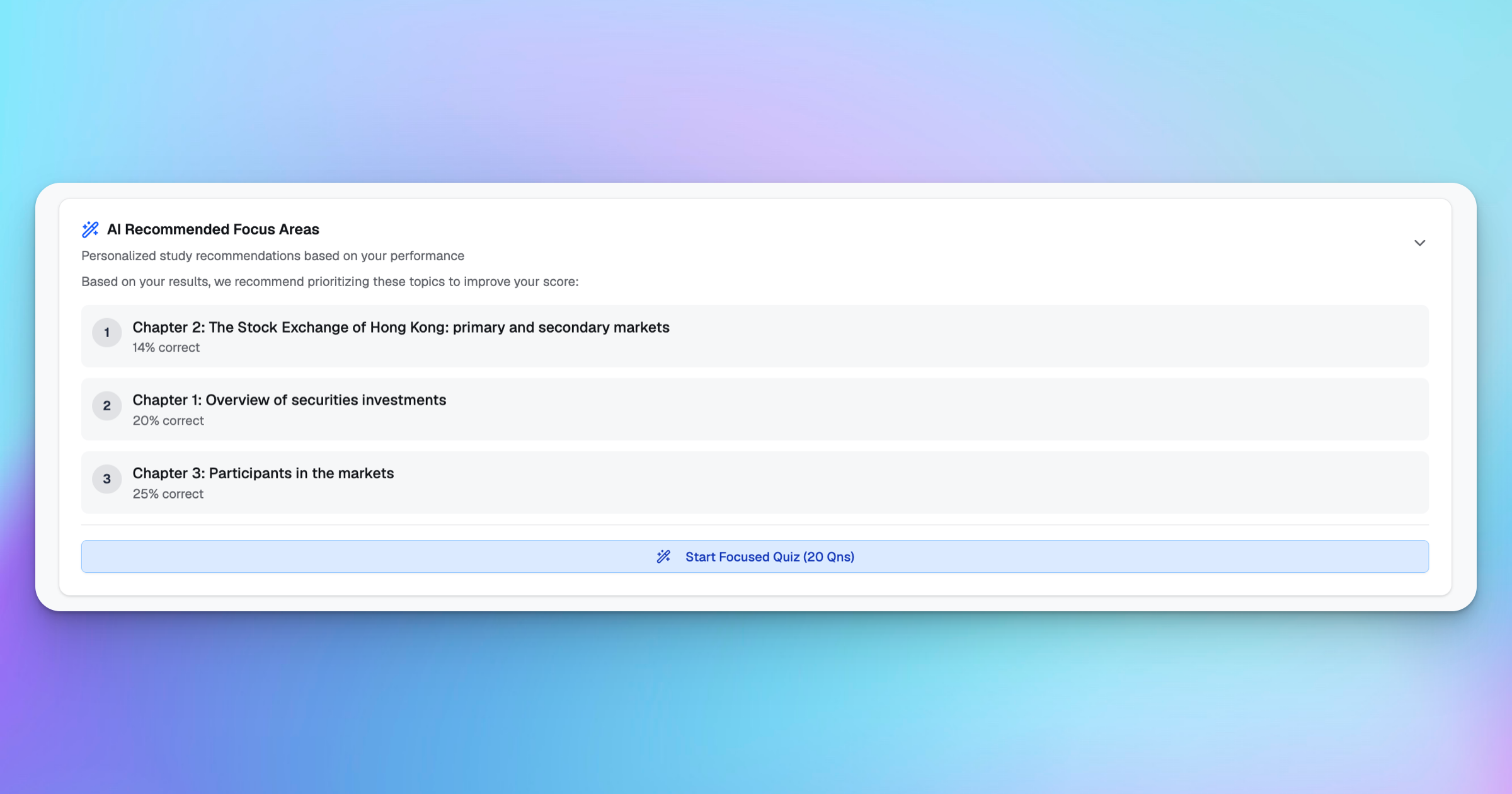
AI-powered recommendations help you focus on the topics that will improve your score fastest
Exam Day Tips
- Bring your calculator. You'll need it for bond pricing, ratio calculations, and option pricing questions. Make sure it's on the approved list.
- Time management: You have 1.5 minutes per question. Flag calculation-heavy questions and return to them after finishing the factual ones.
- Don't overthink Chapter 1 and 5 questions. These are typically straightforward recall — answer quickly and bank time for Chapter 4 calculations.
- For option strategy questions: Draw a simple payoff diagram on your scratch paper to visualise profit/loss.
- Arrive 30 minutes early. CBE centres require ID verification and system setup.
How Paper 8 Compares to Other HKSI Papers
If you've already passed HKSI Paper 1 or HKSI Paper 7, here's what's different about Paper 8:
- Calculator allowed: Papers 7–12 permit calculators, which changes the question style significantly. Expect actual calculations, not just conceptual questions.
- Chapter 4 breadth: No other HKSI paper has a single chapter covering equities, bonds, AND derivatives. This makes Chapter 4 the most content-dense chapter across all LE papers.
- Pass rate (~66%): Higher than Paper 7 but don't be complacent — candidates who fail typically underestimate Chapter 4.
Ready to Start Preparing?
The most efficient path to passing HKSI Paper 8 is structured practice with immediate feedback. Our question bank covers all 6 chapters with detailed explanations for every answer.
Related guides:
Frequently Asked Questions About HKSI Paper 8
Ready to Put This Strategy Into Action? 💯
Join thousands of successful candidates who have passed their HKSI Paper 8 exam using our proven study methods.