
How to Pass HKSI Paper 9 Exam Hong Kong: Complete 2026 Study Guide
Master HKSI Paper 9 (Derivatives) with our proven study strategy. Learn the exam format, killer chapter breakdown, and a focused 2-3 week study plan to pass on your first attempt.
The HKSI LE Paper 9 — Derivatives is one of the more calculation-heavy licensing exams in Hong Kong's financial services industry. Whether you're looking to deal in futures and options, advise on derivative products, or work on a derivatives desk, Paper 9 is likely on your path.
(If you haven't registered yet, check our complete HKSI Paper 9 registration guide.)
What makes Paper 9 uniquely challenging isn't only the 70% pass mark — it's that Chapter 2 (Generic derivative products) alone accounts for ~30% of the exam, and Chapters 2, 3, and 6 together make up 28 out of 40 questions (70%). Most candidates who fail underestimate the calculation load and under-prepare these three chapters.
This guide gives you the 2026 exam strategy, a chapter-by-chapter breakdown with question weights, and a focused study plan to help you pass efficiently.
✨ TL;DR: The HKSI Paper 9 Passing Strategy
- The Scope: 6 Chapters covering derivatives markets, generic products, equity/IR/FX/commodity derivatives, and trading/clearing/settlement.
- The Trap: Chapter 2 (Generic derivative products) alone is ~30% of the exam — futures, options, swaps, forwards, and pricing/strategies all in one chapter.
- The Score: You need 70% (28/40 questions) to pass.
- The Strategy: Focus ~70% of your study time on Chapters 2, 3, and 6 — they make up 28 out of 40 questions.
Understanding the Exam: HKSI Paper 9 Format (2026)
HKSI LE stands for Hong Kong Securities Institute Licensing Examination, administered by HKSI. Paper 9 covers derivatives — the products, markets, trading mechanics, and clearing/settlement processes relevant to anyone dealing in or advising on derivatives in Hong Kong.
| Full Name | Licensing Examination Paper 9 — Derivatives |
| Questions | 40 Multiple Choice (MCQ) |
| Duration | 60 minutes |
| Passing Score | 70% (28 correct answers) |
| Wrong Answers Allowed | 12 questions |
| Format | Computer-based exam (CBE), English or Traditional Chinese |
| Calculator | Allowed (approved list) |
| Exam Fee | HK$1,620 (Hong Kong) / HK$2,070 (Global Centres) |
| Frequency | Monthly |
| Syllabus | Updated on 6 July 2026 |
(For a deeper dive into the scoring and format, read our HKSI Paper 9 Passing Score & Exam Format guide.)
The "Killer Chapter": Where Most Questions Come From
The difficulty of HKSI Paper 9 isn't evenly distributed. One chapter dominates, and three chapters decide the outcome.
| Chapter | Topic | Questions | Weight |
|---|---|---|---|
| 1 | Overview of the derivatives markets | 6 | ~15% |
| 2 | Generic derivative products ⚠️ | 12 | ~30% |
| 3 | Equity derivatives | 8 | ~20% |
| 4 | Interest-rate derivatives | 3 | ~7.5% |
| 5 | Currency and commodity derivatives | 3 | ~7.5% |
| 6 | Derivatives: trading, clearing and settlement | 8 | ~20% |
Chapter-by-Chapter Breakdown
Chapter 1: Overview of the Derivatives Markets (6 questions, ~15%)
This chapter sets the foundation — market participants, purposes of derivatives, and how Hong Kong fits into the global derivatives landscape.
Key topics to master:
- Roles of hedgers, speculators, traders, and arbitrageurs
- Exchange-traded vs OTC derivatives
- Price discovery, leverage, and risk transfer functions
- Overview of HKFE and major global derivatives exchanges
- Basic concepts of margin, mark-to-market, and open interest
Study tip: Don't over-invest here, but don't skip participant-role questions — they are frequently tested and relatively quick marks.
Chapter 2: Generic Derivative Products — THE KILLER CHAPTER (12 questions, ~30%)
This is where Paper 9 becomes uniquely challenging. You're expected to understand forwards, futures, options, and swaps — including pricing logic, payoff profiles, and common strategies.
Key topics to master:
- Forwards vs futures: settlement, marking to market, standardisation
- Futures pricing basics (cost of carry concepts)
- Options: calls, puts, intrinsic/time value, European vs American style
- Option strategies: bull/bear spreads, straddles, strangles, covered calls
- Swaps overview (interest-rate and other generic structures)
- Payoff diagrams and break-even calculations
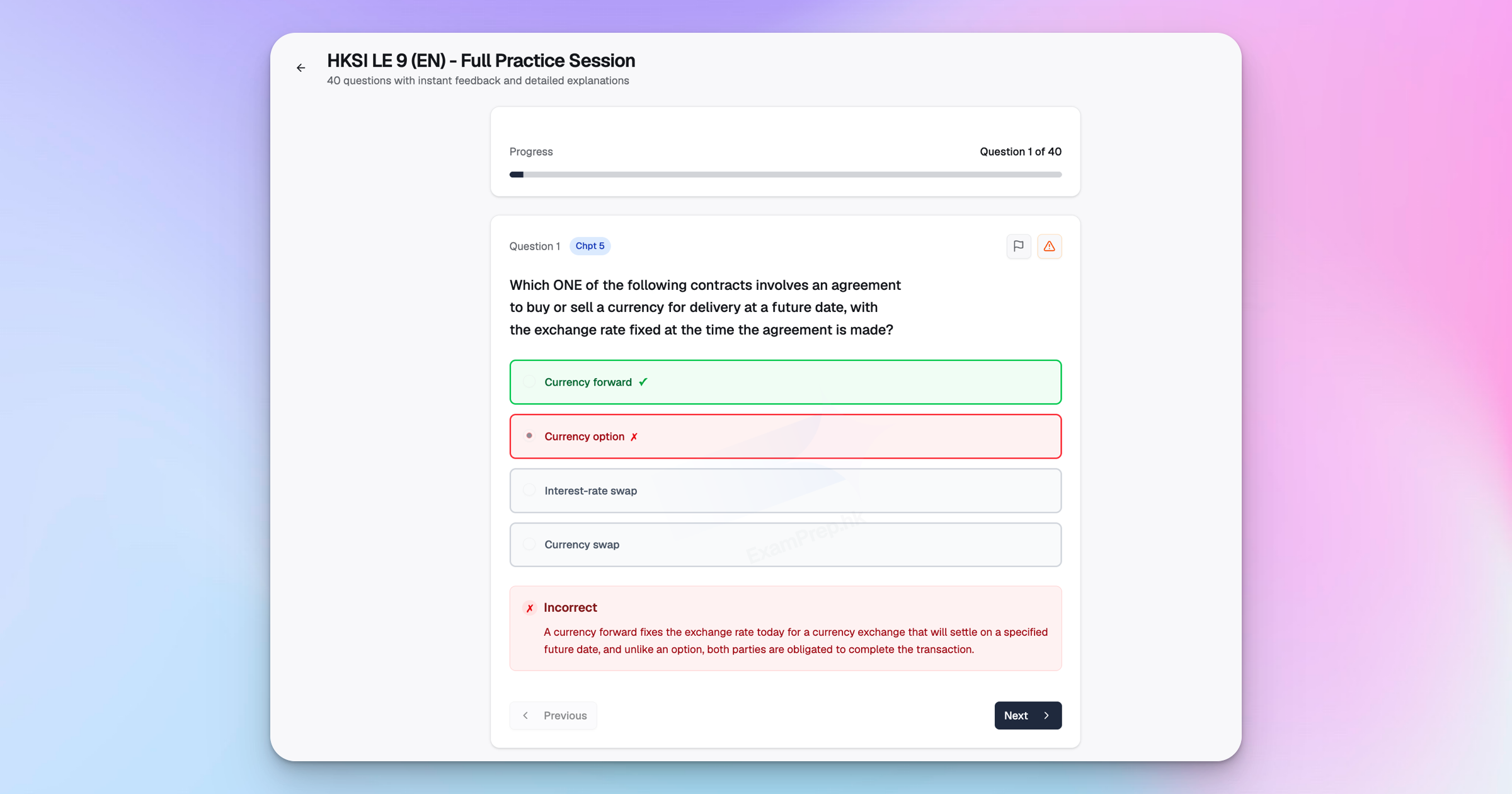
Get instant feedback with detailed explanations for each question on ExamPrep.hk — understand why each answer is correct
Study tip: Break Chapter 2 into product families (futures/forwards, options, swaps) and drill calculations daily. Allocate at least 35–40% of your total study time here.
Chapter 3: Equity Derivatives (8 questions, ~20%)
This chapter applies derivative concepts to equity underlyings — stock futures, index futures, equity options, and related products in Hong Kong.
Key topics to master:
- Hang Seng Index / stock futures and options mechanics
- Contract multipliers and futures P&L calculations
- Equity warrants and structured equity derivatives overview
- Hedging equity portfolios with index futures
- Key features of exchange-listed equity derivatives in Hong Kong
Study tip: Practise multiplier-based P&L questions until they are automatic — these appear regularly and cost easy marks if you rush.
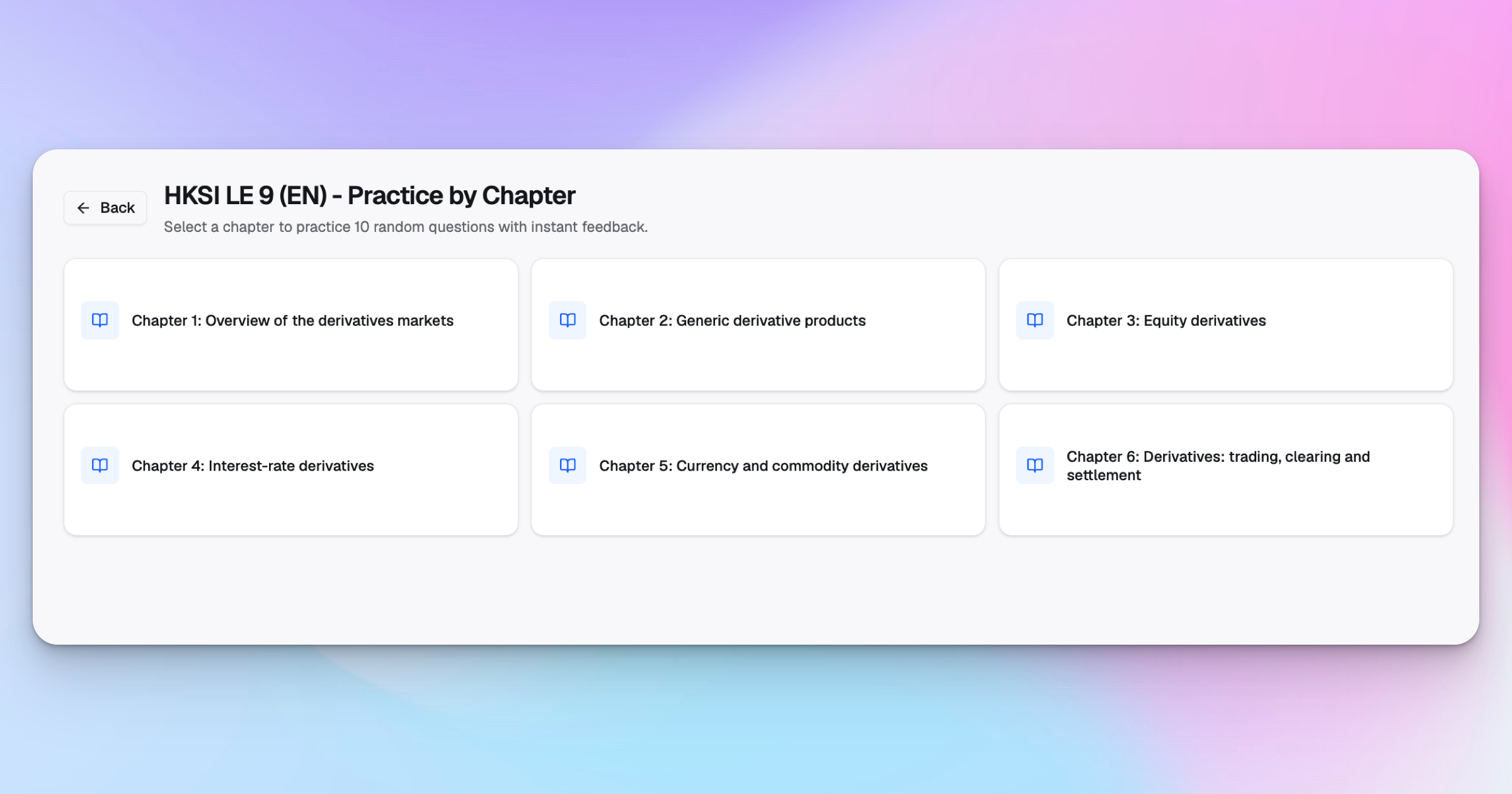
Practice questions organised by chapter — focus your efforts where they matter most
Chapter 4: Interest-Rate Derivatives (3 questions, ~7.5%)
A smaller chapter, but calculation-heavy when it appears.
Key topics to master:
- Interest-rate futures and forward rate agreements (FRAs)
- HIBOR-related products and basic hedge calculations
- Effective annualised return when combining interest income and futures P&L
- Duration / interest-rate risk hedging concepts at a syllabus level
Study tip: Know the annualisation maths cold (e.g. quarterly return × 4). Three questions is a small weight, but they are often "free marks" if you've practised the formula once.
Chapter 5: Currency and Commodity Derivatives (3 questions, ~7.5%)
Another lighter chapter covering FX and commodity product applications.
Key topics to master:
- Currency futures and forwards; hedging FX exposure
- Commodity futures basics (pricing factors, delivery concepts)
- Cross-hedging and basis risk at a conceptual level
- Common uses by corporates and investors
Study tip: Focus on conceptual distinctions (who hedges what, and why) rather than deep commodity market microstructure.
Chapter 6: Derivatives: Trading, Clearing and Settlement (8 questions, ~20%)
This chapter tests market infrastructure — how trades are executed, cleared, and settled in Hong Kong.
Key topics to master:
- HKFE trading via HKATS
- Clearing and settlement via DCASS; novation by the clearing house
- Margin requirements, margin calls, and client money segregation
- Broker obligations for monitoring client accounts
- House vs client accounts; collateral and risk management practices
Study tip: These questions are often fact-based and process-oriented. Memorise the systems (HKATS, DCASS) and client-protection rules — they combine for another 20% of the exam.
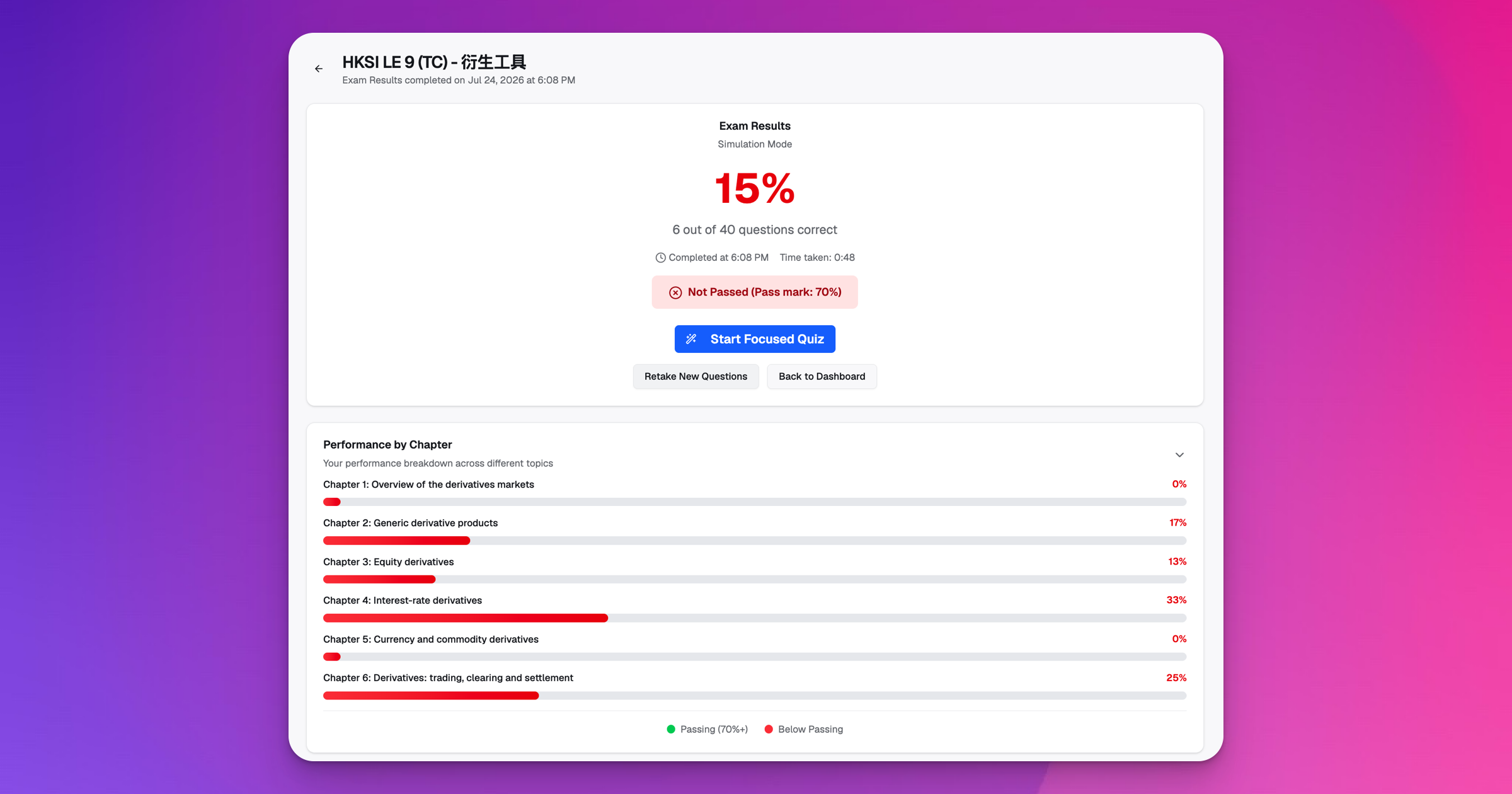
Track your performance by chapter to identify weak areas before exam day
Your 2–3 Week Study Plan
Here's a realistic study plan assuming you can dedicate 1.5–2 hours per day:
| Period | Focus | Activities |
|---|---|---|
| Days 1–2 | Chapters 1, 4 & 5 | Cover overview + lighter IR/FX/commodity chapters. Memorise participant roles and key formulas. |
| Days 3–6 | Chapter 2 (Futures & Options) | Deep dive on forwards/futures, options payoffs, spreads, and break-even maths. Use your calculator daily. |
| Days 7–8 | Chapter 2 (Swaps & strategies) | Finish generic products. Drill strategy identification and calculation questions. |
| Days 9–11 | Chapter 3 | Equity derivatives: contract multipliers, index/stock futures P&L, hedging applications. |
| Days 12–13 | Chapter 6 | HKATS, DCASS, margining, clearing/settlement, broker/client account rules. |
| Days 14–16 | Mock Exams | Full timed practice. Review wrong answers. Re-study weak chapters — especially Ch2. |
| Days 17–18 | Final Review | Focus on Chapter 2 calculations and Chapter 6 processes. Light review of all chapters. |
(Want to start practising immediately? Try our HKSI Paper 9 sample mock questions.)
Mock Exam Strategy
Mock exams are non-negotiable for Paper 9. The calculation load in Chapters 2–4 means you need exposure to as many question variations as possible.
How to use mock exams effectively:
- First mock (Day 14): Take under exam conditions — 40 questions, 60 minutes, calculator allowed, no notes. This establishes your baseline.
- Review phase: For every wrong answer, go back to the source material. Don't just memorise the correct answer — understand the concept and the formula.
- Second mock (Day 16): Take another full mock. Your score should improve by 10–15%.
- Targeted practice: Do chapter-specific question sets for Chapters 2, 3, and 6 until you consistently clear 75%+.
(For a comparison of the best preparation resources, see our HKSI Paper 9 mock exam and study guide comparison.)
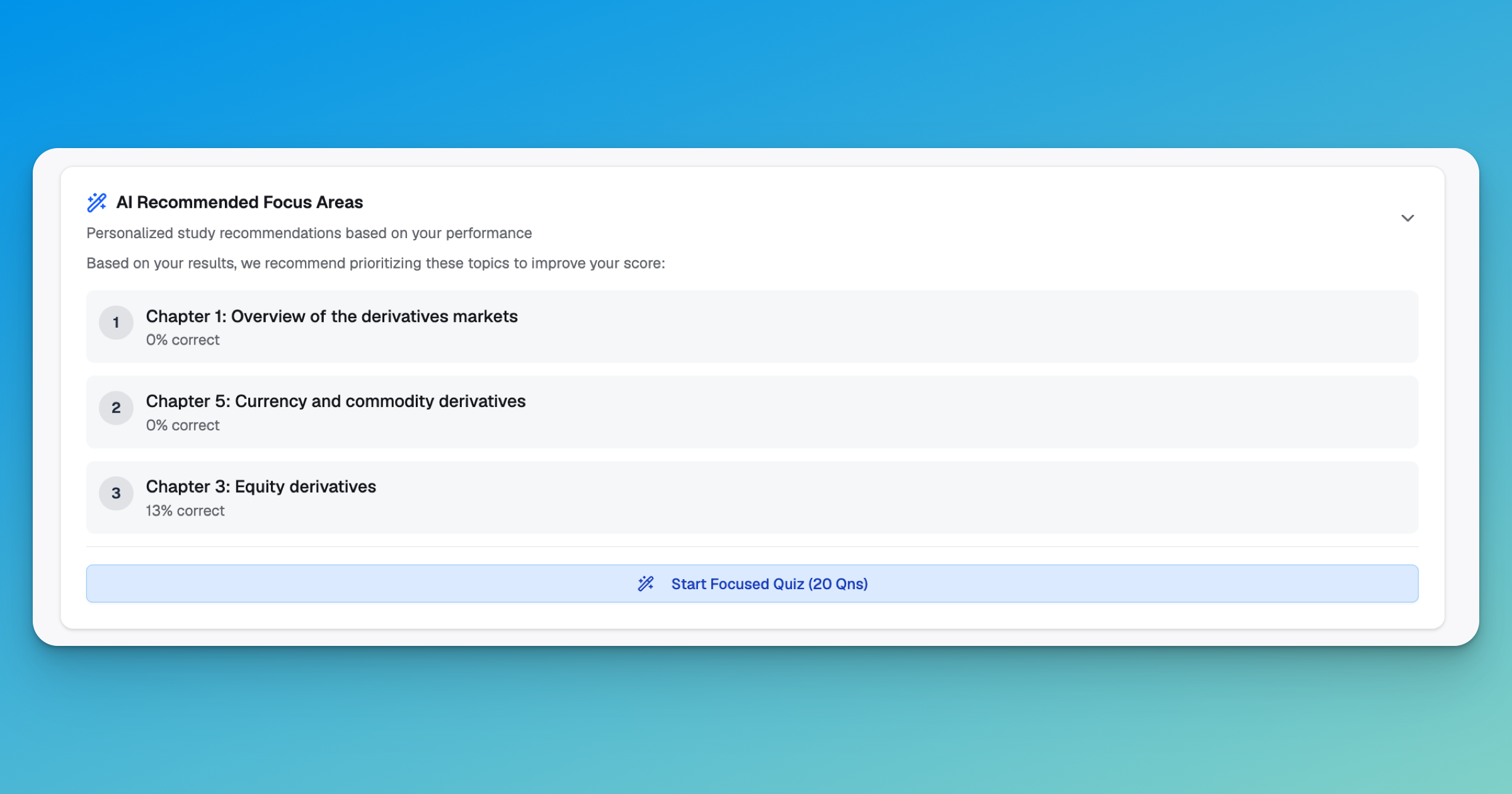
AI-powered recommendations help you focus on the topics that will improve your score fastest
Exam Day Tips
- Bring your calculator. Paper 9 is calculation-heavy — option spreads, futures P&L, and interest-rate hedge returns all appear. Make sure it's on the approved list.
- Time management: You have 1.5 minutes per question. Flag calculation-heavy questions and return to them after finishing the factual ones.
- Don't overthink Chapter 1 and Chapter 6 process questions. Answer quickly and bank time for Chapter 2 calculations.
- For option strategy questions: Sketch a simple payoff diagram on your scratch paper to visualise profit/loss and break-even.
- Arrive 30 minutes early. CBE centres require ID verification and system setup.
How Paper 9 Compares to Other HKSI Papers
If you've already passed HKSI Paper 1, HKSI Paper 7, or HKSI Paper 8, here's what's different about Paper 9:
- Calculator allowed: Papers 7–12 permit calculators, which changes the question style significantly. Expect actual calculations, not just conceptual questions.
- More calculation-heavy than Paper 8: Paper 9 focuses specifically on derivatives maths — spreads, futures P&L, and hedge returns appear frequently.
- Pass rate (~55%): Lower than Paper 8's ~66%, so don't assume a securities background alone is enough — you need deliberate calculation practice.
Ready to Start Preparing?
The most efficient path to passing HKSI Paper 9 is structured practice with immediate feedback. Our question bank covers all 6 chapters with detailed explanations for every answer.
Related guides:
Frequently Asked Questions About HKSI Paper 9
Ready to Put This Strategy Into Action? 💯
Join thousands of successful candidates who have passed their HKSI Paper 9 exam using our proven study methods.