
How to Pass HKSI Paper 7 Exam Hong Kong: Complete 2026 Study Guide
Master HKSI LE Paper 7 (Financial Markets) with our proven study strategy. Learn the exam format, high-weight chapters, calculation tips, and a focused study plan to pass on your first try.
The HKSI LE Paper 7 (Financial Markets) is one of the more quantitative papers in the Licensing Examination series. Unlike Paper 1, which focuses purely on regulation, Paper 7 tests your understanding of global and Hong Kong financial markets — including equity, debt, foreign exchange, and derivatives — with both theory and calculations.
(If you haven't booked your exam slot yet, read our HKSI Paper 7 Registration Guide here.)
With an average pass rate of around 67%, Paper 7 is statistically easier than Paper 1 (~52%). But don't be fooled — candidates who skip the calculation-heavy chapters or spread their study time too thin often struggle. Three chapters alone account for nearly 62% of the entire exam.
If you're trying to memorise the entire study manual without understanding the underlying financial concepts, you're studying inefficiently. (See our review of the best HKSI Paper 7 mock exams here.)
This guide covers the 2026 exam strategy, the "Killer Chapters" where most questions come from, and a focused study plan to help you pass on your first attempt.
✨ TL;DR: The HKSI Paper 7 Passing Strategy
- The Scope: 7 Chapters covering global finance, HK markets, equity, debt, FX, derivatives, and risk management.
- The Trap: Chapters 3, 4, and 5 make up approximately 61.7% of the exam (~37 questions).
- The Score: You need 70% (42/60 questions) to pass.
- The Strategy: Focus 60–70% of your study time on Chapters 3, 4, and 5 — and master the calculation formulas.
Understanding the Exam: HKSI Paper 7 Format (2026)
HKSI LE stands for Licensing Examination for Securities and Futures Intermediaries, administered by the Hong Kong Securities and Investment Institute (HKSI Institute).
| Full Name | Financial Markets |
| Questions | 60 Multiple Choice (MCQ) |
| Duration | 90 minutes (1.5 hours) |
| Passing Score | 70% (42 correct answers) |
| Format | Choose 1 answer from 4 options (A, B, C, D) |
| Exam Fee | HK$1,470 (HK Centre) / HK$1,890 (Global Centres) |
| Mode | Computer-based Examination (CBE) |
| Language | English or Traditional Chinese |
| Average Pass Rate | ~67% (based on HKSI public data) |
(Read our full breakdown of the HKSI Paper 7 Passing Score & Format here.)
Important: Exam slots fill up quickly. Book at least 5 full days in advance via the HKSI Institute Online Portal.
The "Killer Chapters": Where Most Questions Come From
The HKSI Paper 7 exam difficulty isn't evenly distributed. Three chapters alone account for nearly two-thirds of the exam.
| Chapter | Topic | ~Questions | Weight |
|---|---|---|---|
| Ch 3 | The equity market | 11 | 18.3% |
| Ch 4 | The debt market | 13 | 21.7% |
| Ch 5 | The foreign exchange and derivatives markets | 13 | 21.7% |
| Ch 1 | The global financial system | 7 | 11.7% |
| Ch 2 | Financial system in Hong Kong | 7 | 11.7% |
| Ch 6 | Financial risk management | 6 | 10% |
| Ch 7 | Applications in the financial sector | 3 | 5% |
1. Chapter 3: The Equity Market (18.3% — ~11 Questions)
This chapter tests your understanding of equity finance and the Hong Kong stock market:
- Equity Finance Concepts — how companies raise capital through shares
- Equity Pricing Methods — including TERP (Theoretical Ex-Rights Price) calculations
- Stock Market & Indices — how indices are constructed and what they represent
- HK Equity Market — HKEX, Main Board, GEM, Stock Connect
- Types of Equity Securities — ordinary shares, preference shares, warrants
- Trading & Settlement — T+2 settlement, CCASS
Pay special attention to TERP calculations — these are a favourite exam topic.
2. Chapter 4: The Debt Market (21.7% — ~13 Questions — The Big One)
This is the single highest-weighted chapter and the most calculation-intensive:
- Bond Concepts — par value, coupon rate, maturity, yield
- Interest Rate Calculations — nominal vs real vs effective rates
- Bond Pricing — present value of cash flows, clean vs dirty price
- Yield & Yield Curves — current yield, yield to maturity, yield curve shapes
- Repurchase Agreements (Repos) — mechanics and purposes
- HK Debt Market — Exchange Fund Bills and Notes, HKMA programmes
If you only have one week to study, spend most of it here. Master the bond pricing and yield calculation formulas — they appear every sitting.
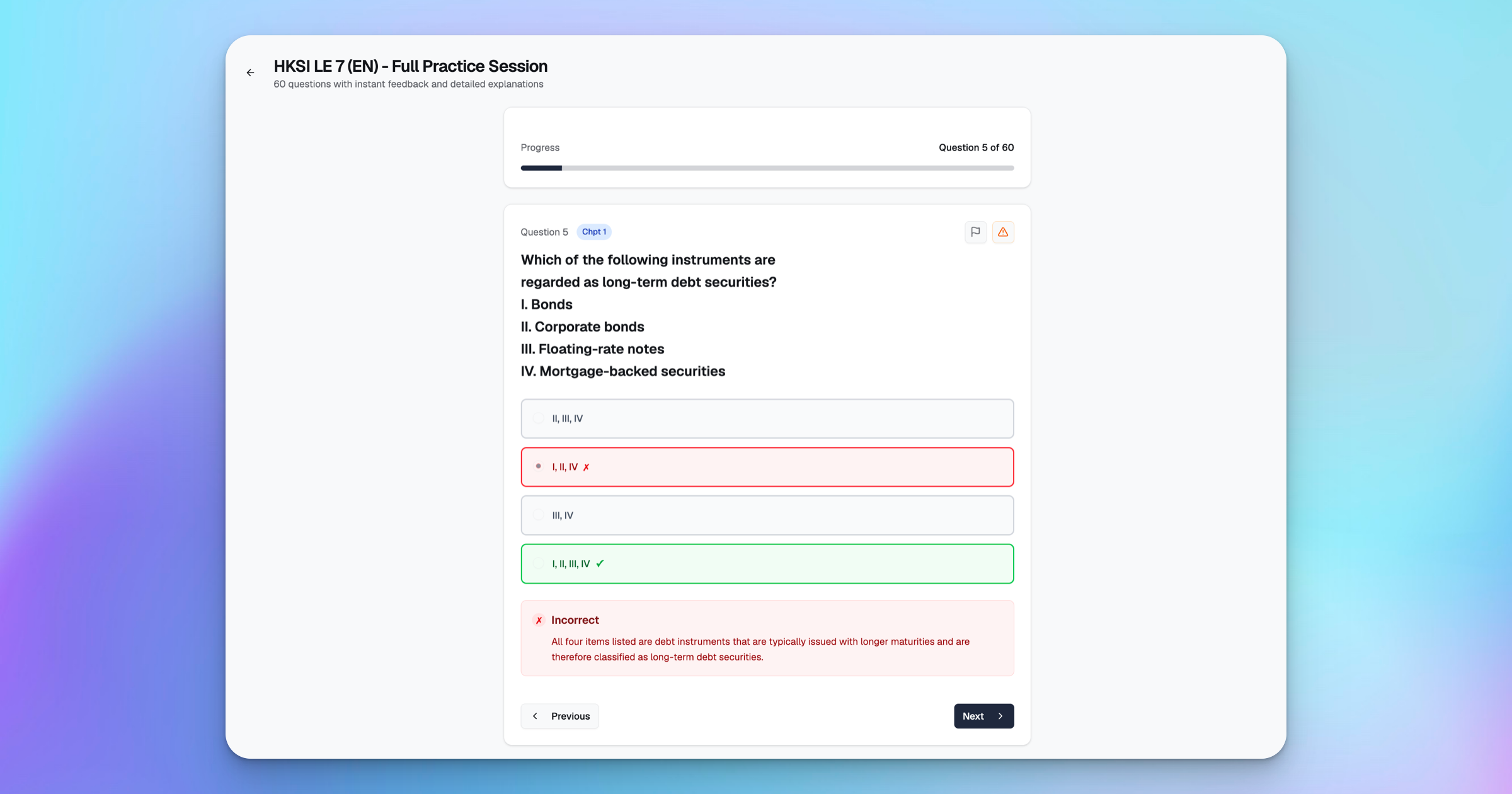
ExamPrep.hk's Instant Feedback and Explanation feature helps you understand the calculation steps.
3. Chapter 5: The Foreign Exchange and Derivatives Markets (21.7% — ~13 Questions)
Equally weighted with Chapter 4, this chapter covers two major areas:
- FX Market Structure — spot, forward, swap markets
- Cross Rates & Forward Rates — calculation of cross rates, forward premiums/discounts
- Derivatives Basics — definition, categories, and uses
- Derivatives Types — futures, options, swaps, forwards
- HK Derivatives Market — HKFE products, Hang Seng Index futures/options
- Trading & Settlement — margining, clearing, HKCC
Many candidates lose marks on cross-rate and forward-rate calculations. Practise these until they become second nature.
Your 3-Week Study Plan
Week 1: The Foundations (Chapters 1, 2, 6, 7)
Focus: Get the lower-weighted chapters done first.
Topics: Global financial system, HK financial system, risk management, financial sector applications.
Strategy: These chapters are largely theoretical and contribute ~38.4% of questions combined. Complete them efficiently so you can dedicate the majority of your time to the killer chapters.
| Chapter | ~Questions | Time |
|---|---|---|
| Ch 1: The Global Financial System | 7 | 1.5 days |
| Ch 2: Financial System in Hong Kong | 7 | 1.5 days |
| Ch 6: Financial Risk Management | 6 | 1.5 days |
| Ch 7: Applications in the Financial Sector | 3 | 0.5 days |
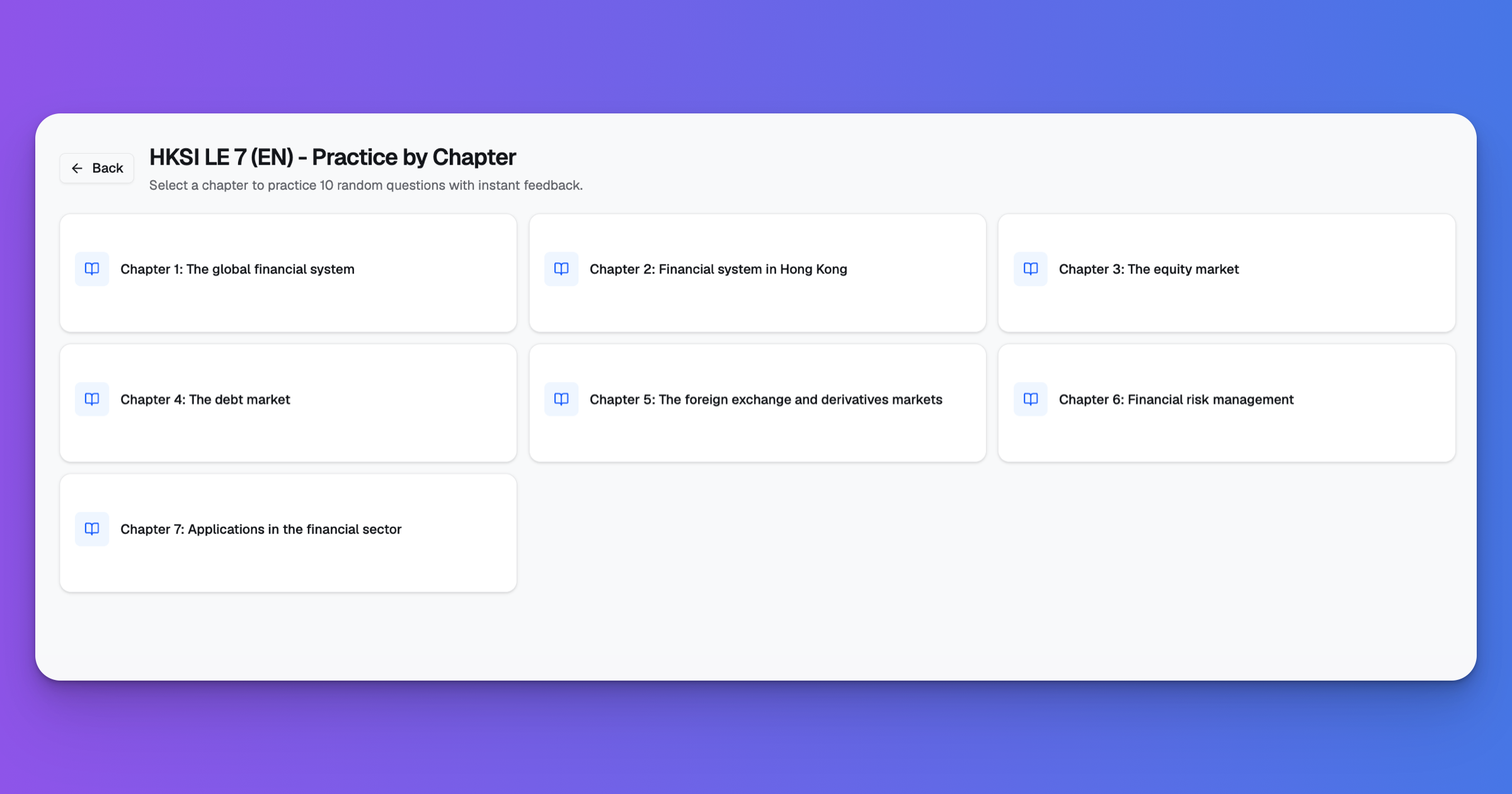
ExamPrep.hk's Practice by Chapter feature helps you focus on specific chapters and track your performance.
Week 2: The Killer Chapters (Chapters 3, 4, 5)
Focus: This is where you win or lose the exam.
Topics: Equity markets, debt markets, FX and derivatives.
Strategy: Don't just read — drill calculations and questions until you stop making mistakes. These chapters require both conceptual understanding and numerical proficiency.
| Chapter | ~Questions | Time |
|---|---|---|
| Ch 3: The Equity Market | 11 | 2 days |
| Ch 4: The Debt Market | 13 | 3 days |
| Ch 5: FX and Derivatives Markets | 13 | 2 days |
💡 Pro Tip: Master the Formulas
Unlike HKSI Paper 1 (which is pure regulation), Paper 7 includes calculation questions on bond pricing, yield to maturity, TERP, cross rates, and forward premiums. Create a formula sheet and practise working through each type of calculation under timed conditions.
Week 3: Review and Mock Exams
Focus: Consolidate knowledge, identify weak spots, and build exam stamina.
| Day | Activity |
|---|---|
| Day 1 | Review weak chapters based on practice results |
| Day 2 | Full mock exam #1 (timed, 60 questions in 90 minutes) |
| Day 3 | Review mistakes from mock #1, re-drill calculation questions |
| Day 4 | Full mock exam #2 (timed) |
| Day 5 | Review mistakes from mock #2, focus on Ch 4 and Ch 5 formulas |
| Day 6 | Full mock exam #3 (timed) |
| Day 7 | Final review of weak areas and formula sheet |
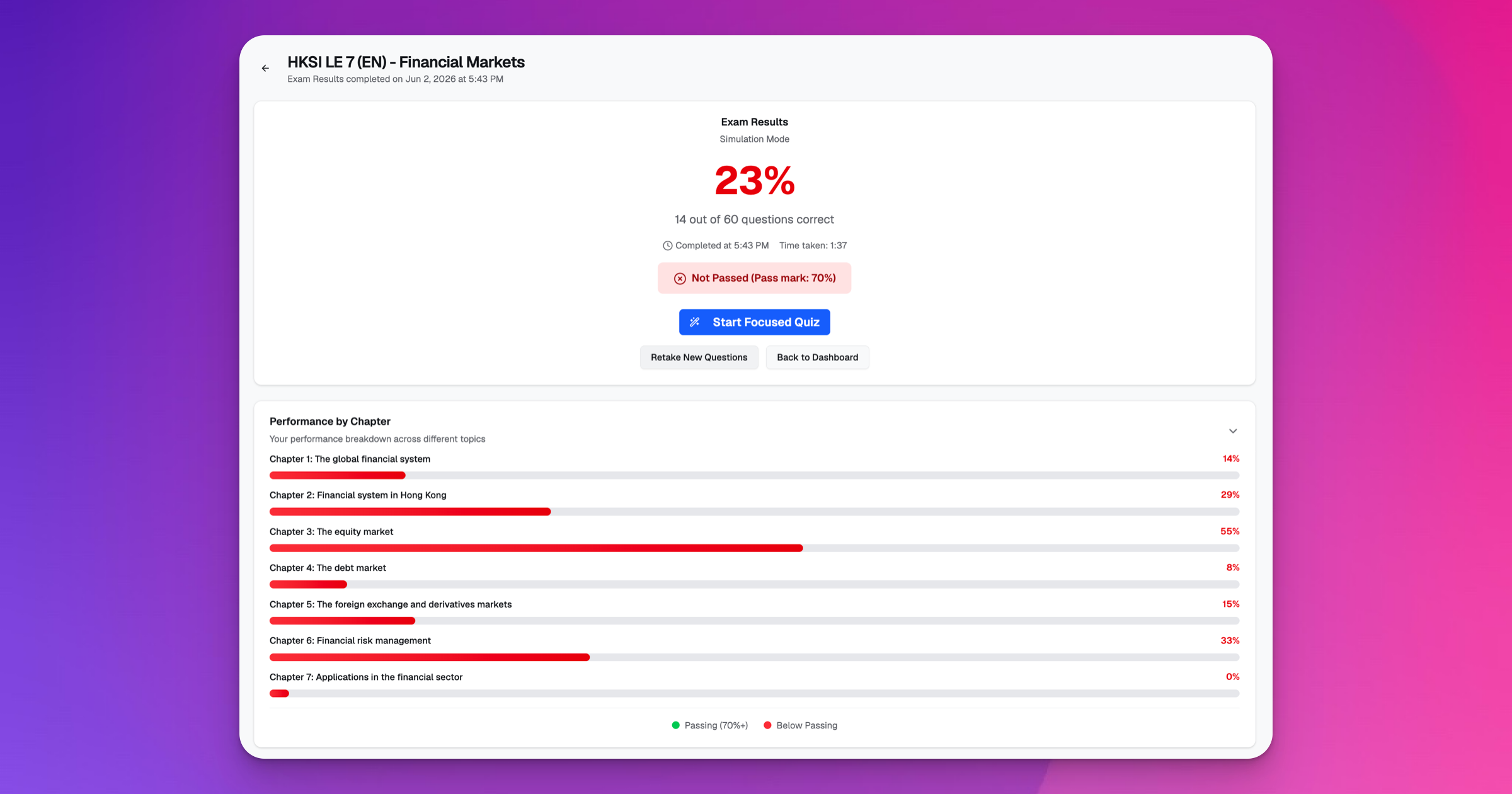
ExamPrep.hk's Performance by Chapter feature helps you track your performance and identify weak areas.
Key Exam Day Requirements
Don't let administrative issues derail your exam. Here's what you need:
📋 Exam Day Checklist
- ✅ Valid Photo ID — original government-issued document with English name matching HKSI records
- ✅ Arrive on Time — be at the centre at the scheduled start time
- ✅ Know Your Details — last 4 digits of your mobile number / confirmation number
- ⚠️ No Rescheduling on Exam Day — requests must be made 6 full days before the exam
You will be denied entry if:
- Your ID doesn't match HKSI records
- You fail to complete identity verification within 30 minutes of admission start time
- Your mobile number / confirmation number doesn't match
5 Essential Tips to Pass HKSI Paper 7
1. Focus on the Killer Chapters
Chapters 3, 4, and 5 account for approximately 61.7% of questions (~37 out of 60). If you're short on time, prioritise these above all else.
2. Build a Formula Sheet
Paper 7 is more quantitative than HKSI Paper 1. Write out the key formulas (bond pricing, YTM, TERP, cross rates, forward premiums) and drill them repeatedly.
3. Use Quality Mock Exams
Practise with realistic questions that match the exam format. Try our HKSI Paper 7 mock questions — they include worked calculation solutions.
4. Track Your Chapter Performance
Use ExamPrep.hk's performance analytics to identify weak chapters and focus your revision where it matters most.
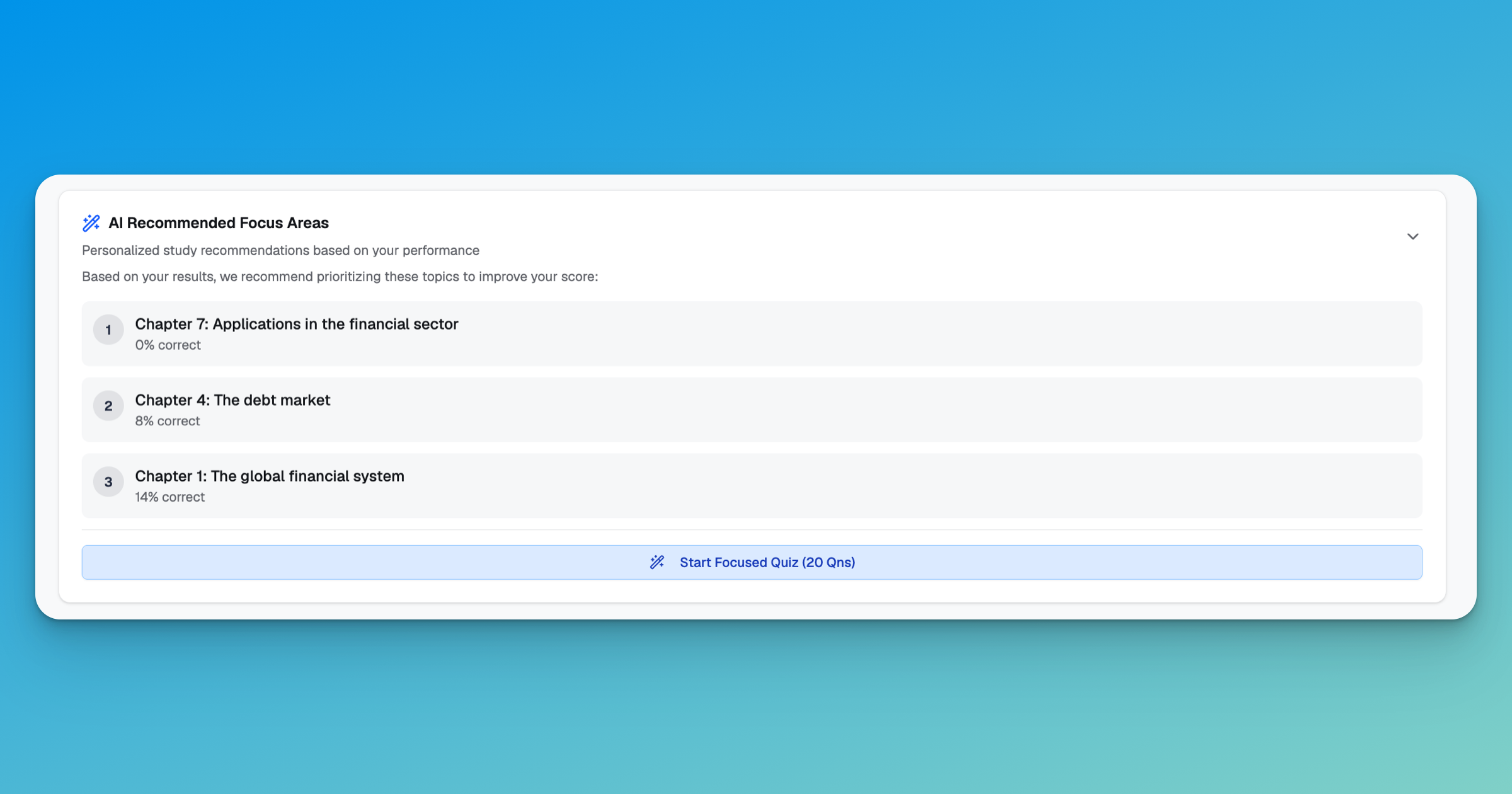
ExamPrep.hk's AI Focus Areas feature helps you focus your study time on your weakest areas.
5. Simulate Exam Conditions
Do at least 2–3 full mock exams under timed conditions (60 questions in 90 minutes). This builds stamina, helps you manage time on calculation questions, and reduces exam-day anxiety.
Final Thoughts
HKSI Paper 7 is a unique challenge — it combines global financial knowledge, HK-specific market details, and quantitative calculations. The ~67% pass rate is more forgiving than Paper 1's ~52%, but that doesn't mean you can take it lightly.
The key is working smarter, not harder. Don't waste time on low-weight chapters when Chapters 3, 4, and 5 determine your fate. Master the formulas, understand the market structures, and drill practice questions until you're consistently scoring above 75%.
Ready to start? Access 800+ HKSI Paper 7 practice questions with detailed explanations and chapter-by-chapter tracking.
Frequently Asked Questions
Ready to Put This Strategy Into Action? 💯
Join thousands of successful candidates who have passed their HKSI Paper 7 exam using our proven study methods.