
Is HKSI Paper 8 Difficult? Chapter Breakdown & Difficulty Analysis (2026)
HKSI Paper 8 has a ~66% pass rate, but Chapter 4 alone accounts for 35% of the exam and covers equities, bonds, derivatives, and options. Learn the real difficulty breakdown and how to prepare.
"Is HKSI Paper 8 difficult?"
This is the first question most candidates ask before sitting the Securities exam. The answer depends entirely on how you prepare.
With an average pass rate of around 66%, roughly one in three candidates fails. That's comparable to HKSI Paper 7's ~67% pass rate — but Paper 8 brings its own unique challenges, particularly a single chapter that dominates over a third of the exam.
(Haven't registered yet? Check our step-by-step registration guide.)
📊 HKSI Paper 8 at a Glance
- Pass Rate: ~66%
- Questions: 40 MCQ
- Time: 60 minutes (1.5 min per question)
- Passing Score: 70% (28/40)
- Chapters: 6
- Key Challenge: Chapter 4 alone = 35% of the exam
Why HKSI Paper 8 Is Challenging
1. One chapter dominates the entire exam
Chapter 4 (Types of Securities) carries 14 out of 40 questions — a staggering 35% of the exam. No other HKSI paper has a single chapter that weighs this heavily. It covers equities, bonds, derivatives, margin financing, options pricing, and option strategies — all packed into one massive chapter.
If you underperform on Chapter 4, it's mathematically very difficult to pass.
2. It combines theory AND calculations
Like HKSI Paper 7, Paper 8 isn't purely conceptual. You'll face calculation questions on simple interest, options strategies, and margin requirements — all under time pressure. Calculators are allowed (see the approved calculator list), but you still need to know which formula to apply.
3. Broad scope within the securities domain
Paper 8 covers everything from basic investment concepts (Chapter 1) to SEHK market structure (Chapter 2), market participants (Chapter 3), all types of securities and derivatives (Chapter 4), administration and regulation (Chapter 5), and securities analysis techniques (Chapter 6). The breadth is substantial for a 40-question exam.
⚠️ The Math Behind the Killer Chapter
Chapter 4 = 14 questions. If you score only 50% on Chapter 4 (7 correct), you'd need 21 out of 26 on the remaining chapters just to reach the passing score of 28. That's an 81% score on everything else — a very thin margin.
Chapter-by-Chapter Difficulty Analysis
| Chapter | Topic | ~Questions | Weight | Difficulty |
|---|---|---|---|---|
| 1 | Overview of securities investments | 4 | ~10% | ⭐⭐ |
| 2 | The Stock Exchange of Hong Kong: primary and secondary markets | 6 | ~15% | ⭐⭐⭐ |
| 3 | Participants in the markets | 6 | ~15% | ⭐⭐⭐ |
| 4 | Types of securities | 14 | ~35% | ⭐⭐⭐⭐⭐ |
| 5 | Stock market administration | 4 | ~10% | ⭐⭐ |
| 6 | Securities analysis | 6 | ~15% | ⭐⭐⭐⭐ |
Chapter 4: Types of Securities — ⭐⭐⭐⭐⭐ (Hardest)
Chapter 4 is the undisputed heavyweight of the Paper 8 exam. It covers an enormous breadth of content in a single chapter:
- Equities — types of shares, dividends, and corporate actions
- Bonds — government bonds, corporate bonds, pricing, and yield
- Derivatives — futures, options, warrants, and structured products
- Margin financing — margin requirements and margin calls
- Options pricing — intrinsic value, time value, and the Greeks
- Option strategies — calls, puts, spreads, and combined positions
Why it's hard: The sheer breadth combined with calculation questions on options and margin requirements makes this the most difficult chapter. At 35% of the exam, you simply cannot afford to be weak here.
Want to see what Chapter 4 questions look like? Try our sample mock questions.
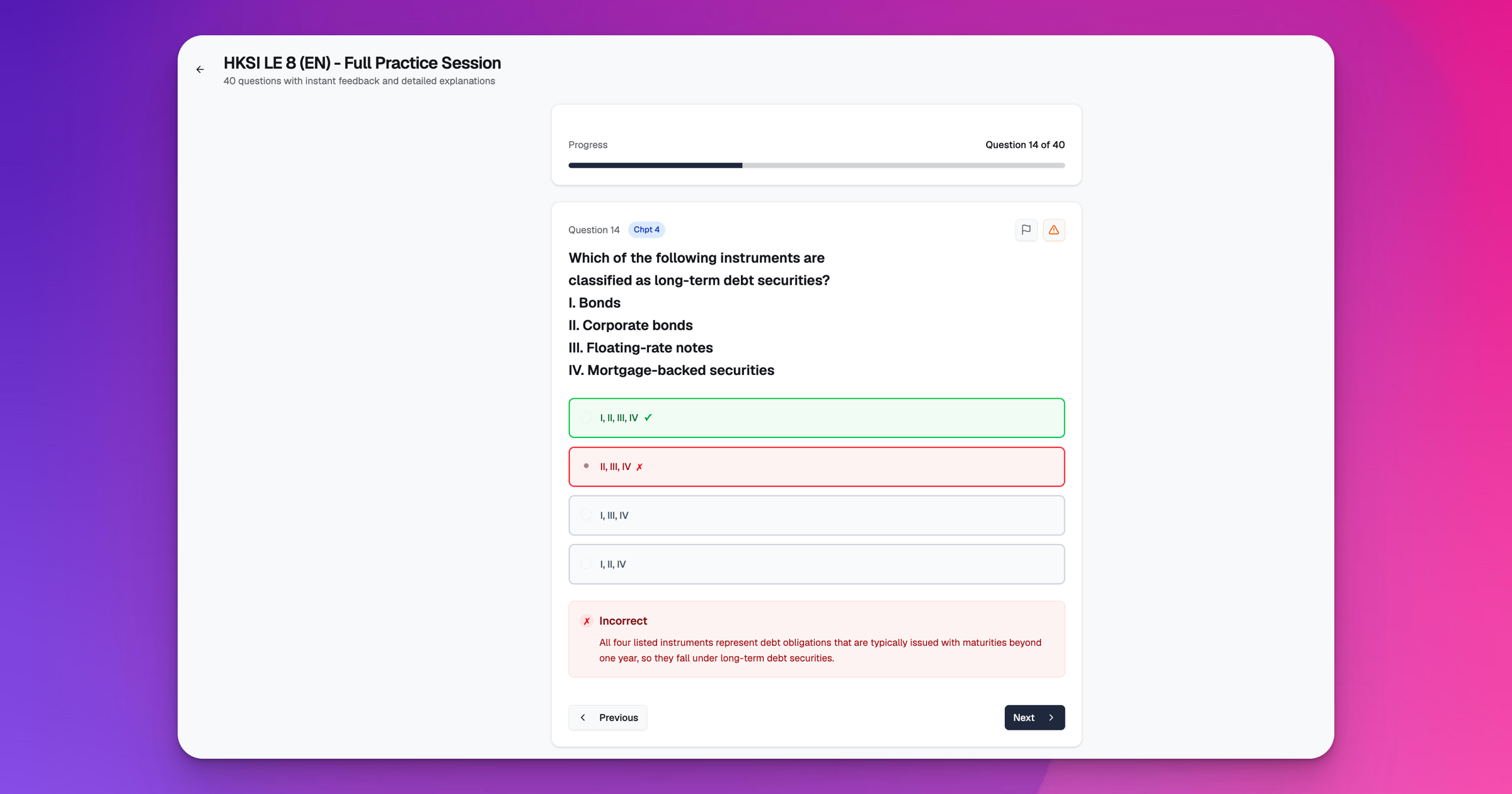
ExamPrep.hk provides instant feedback with detailed explanations for every question — essential for mastering Chapter 4's complex topics.
Chapter 6: Securities Analysis — ⭐⭐⭐⭐
The second most challenging chapter combines fundamental analysis with technical analysis:
- Fundamental analysis — financial ratios, earnings analysis, valuation methods
- Technical analysis — chart patterns, indicators, moving averages
- Quantitative measures — risk-return metrics and portfolio analysis
Why it's hard: Candidates need to understand both qualitative assessment and quantitative calculations. The analysis techniques require both conceptual understanding and the ability to interpret data under pressure.
Chapters 2 and 3: SEHK Markets & Market Participants — ⭐⭐⭐
These chapters are moderately difficult and carry 15% each:
- Chapter 2 covers SEHK listing rules, IPO process, trading mechanisms (e.g. T+2 settlement), and market structure
- Chapter 3 covers exchange participants, intermediaries, fund managers, flow traders vs. proprietary traders, and regulatory roles
Why they're moderate: The content is primarily conceptual — no heavy calculations — but requires solid familiarity with Hong Kong's market infrastructure and participant roles.
Chapters 1 and 5: Overview & Administration — ⭐⭐
The easiest chapters, each carrying ~10% of the exam:
- Chapter 1 introduces basic investment concepts, risk-return fundamentals, and the role of financial markets
- Chapter 5 covers exchange rules, disciplinary procedures, compensation arrangements, and administrative matters
Why they're easier: These are introductory and administrative topics with straightforward, fact-based questions. However, don't skip them entirely — those 8 questions are free marks if you've reviewed the material.
How Does Paper 8 Compare to Paper 1 and Paper 7?
Many candidates take multiple HKSI papers. Here's how they compare:
| Feature | Paper 1 (Regulation) | Paper 7 (Financial Markets) | Paper 8 (Securities) |
|---|---|---|---|
| Questions | 60 MCQ | 60 MCQ | 40 MCQ |
| Duration | 90 minutes | 90 minutes | 60 minutes |
| Time per Question | 1.5 min | 1.5 min | 1.5 min |
| Passing Score | 70% (42/60) | 70% (42/60) | 70% (28/40) |
| Pass Rate | ~52% | ~67% | ~66% |
| Content Type | Pure regulation & law | Theory + calculations | Theory + calculations |
| Chapters | 9 | 7 | 6 |
| Calculations | None | TERP, bond pricing, cross rates | Simple interest, options, margin |
| Killer Chapter(s) | Ch3 + Ch6 (~50%) | Ch3 + Ch4 + Ch5 (~62%) | Ch4 alone (~35%) |
| Exam Fee (HK) | HK$1,630 | HK$1,470 | HK$1,470 |
Key takeaway: Paper 8 has fewer questions than Paper 1 and Paper 7, but the same time pressure (1.5 minutes per question). The unique challenge of Paper 8 is the extreme concentration of marks in a single chapter — Chapter 4 at 35%. In Papers 1 and 7, the difficulty is spread across multiple killer chapters; in Paper 8, there's one clear boss to beat.
Candidates who've passed Paper 7 will find some overlap in Paper 8's market structure and derivatives content, while those who've cleared Paper 1 will have a foundation in Hong Kong's regulatory framework.
Strategies to Overcome the Difficulty
1. Make Chapter 4 your top priority
Allocate 40–50% of your study time to Chapter 4. This single chapter is worth 14 questions, so mastering it gives you the highest return on your study investment. Break it into sub-topics and tackle them one at a time: equities first, then bonds, then derivatives and options.
✅ Recommended Time Allocation
- 40–50% of study time: Chapter 4 (types of securities — equities, bonds, derivatives, options)
- 15–20% of study time: Chapter 6 (securities analysis — fundamental + technical)
- 20–25% of study time: Chapters 2 and 3 (SEHK markets, market participants)
- 10–15% of study time: Chapters 1 and 5 (overview, administration)
2. Drill the formulas until they're automatic
For each calculation type, you should be able to recall and apply the formula within 30 seconds:
- Simple interest — Total = Principal × (1 + rate × time)
- Options intrinsic value — Call = max(0, stock price − strike); Put = max(0, strike − stock price)
- Margin calculations — initial margin, maintenance margin, and margin call triggers
- Basic bond pricing — present value of coupons and face value
3. Use chapter-by-chapter practice mode
Don't just take full mock exams from day one. Isolate each chapter — especially Chapter 4 — and drill it until you consistently score above 75% before moving on.
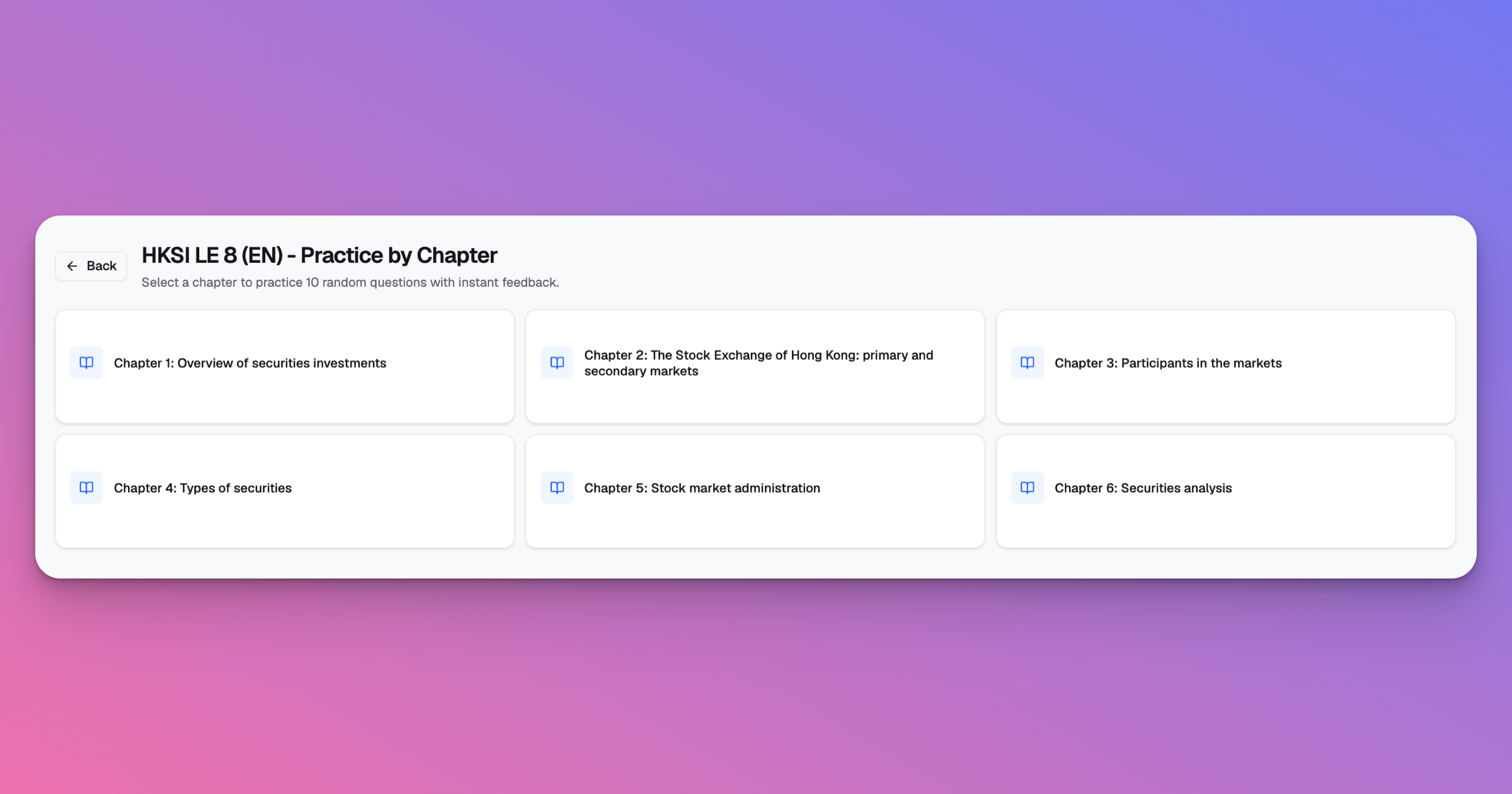
ExamPrep.hk's Practice by Chapter mode lets you drill individual chapters until you've mastered them.
For a complete study plan, read our HKSI Paper 8 Study Guide.
4. Take timed mock exams
Once you're scoring well by chapter, switch to full 40-question mock exams under timed conditions (60 minutes). This builds exam stamina and helps you manage your time when calculation questions slow you down.
Try our sample mock questions to get a feel for the exam format.
5. Understand, don't just memorise
Paper 8 tests understanding of how securities markets work, not just factual recall. For theory questions, make sure you understand why something is true — not just that it's true. For example, understand why buying a call on shares you already own is speculation (not hedging) rather than memorising the answer.
How to Know If You're Ready
Before sitting the exam, make sure you can:
- Score 75%+ on Chapter 4 in practice mode
- Score 70%+ on full mock exams consistently (not just once)
- Complete all calculations within 2 minutes each without mistakes
- Finish mock exams within 60 minutes with time to review flagged questions
If you're not hitting these benchmarks yet, keep practising. It's better to delay by a month than to waste HK$1,470 on a failed attempt.
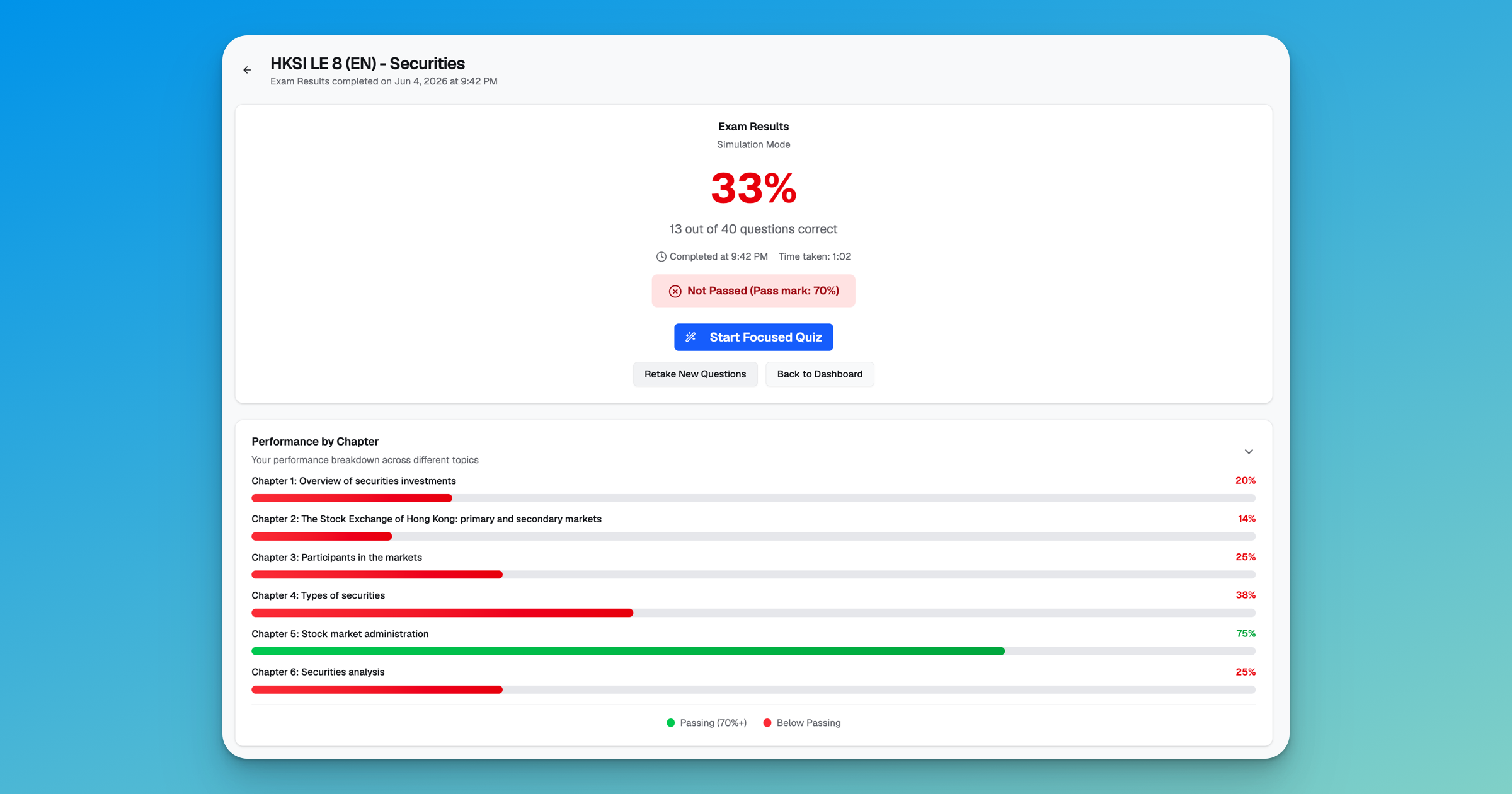
ExamPrep.hk's Performance by Chapter mode shows you exactly where you stand across all 6 chapters — so you know when you're ready.
More Resources for Your Preparation
- Complete HKSI Paper 8 Study Guide — a focused study plan built around the chapter weightings
- Passing Score & Exam Format — everything you need to know about the exam structure
- Try mock questions — test yourself with sample questions and detailed explanations
- Register for your exam — step-by-step guide to booking your slot
- Compare study resources — find the right tools for your preparation
The Bottom Line
Is HKSI Paper 8 difficult? It can be — but it's entirely manageable with the right approach.
The candidates who fail are typically those who:
- Spread their study time equally across all 6 chapters
- Don't practise Chapter 4 enough (it's 35% of the exam!)
- Underestimate the calculation questions on options and margin
- Run out of time because they haven't practised under timed conditions
The candidates who pass are those who:
- Focus 40–50% of their effort on Chapter 4
- Drill formulas until they're automatic
- Use chapter-by-chapter practice to identify and fix weak areas
- Take timed mock exams to build exam stamina
The ~34% who fail don't fail because the content is impossibly hard. They fail because they prepare the wrong way. Don't be one of them.
HKSI Paper 8 Difficulty — FAQ
Ready to Put This Strategy Into Action? 💯
Join thousands of successful candidates who have passed their HKSI Paper 8 exam using our proven study methods.