
Is HKSI Paper 7 Difficult? Chapter Breakdown & Difficulty Analysis (2026)
HKSI Paper 7 has a ~67% pass rate, but Chapters 3, 4, and 5 account for 61.7% of the exam and include calculations. Learn the real difficulty breakdown and how to prepare.
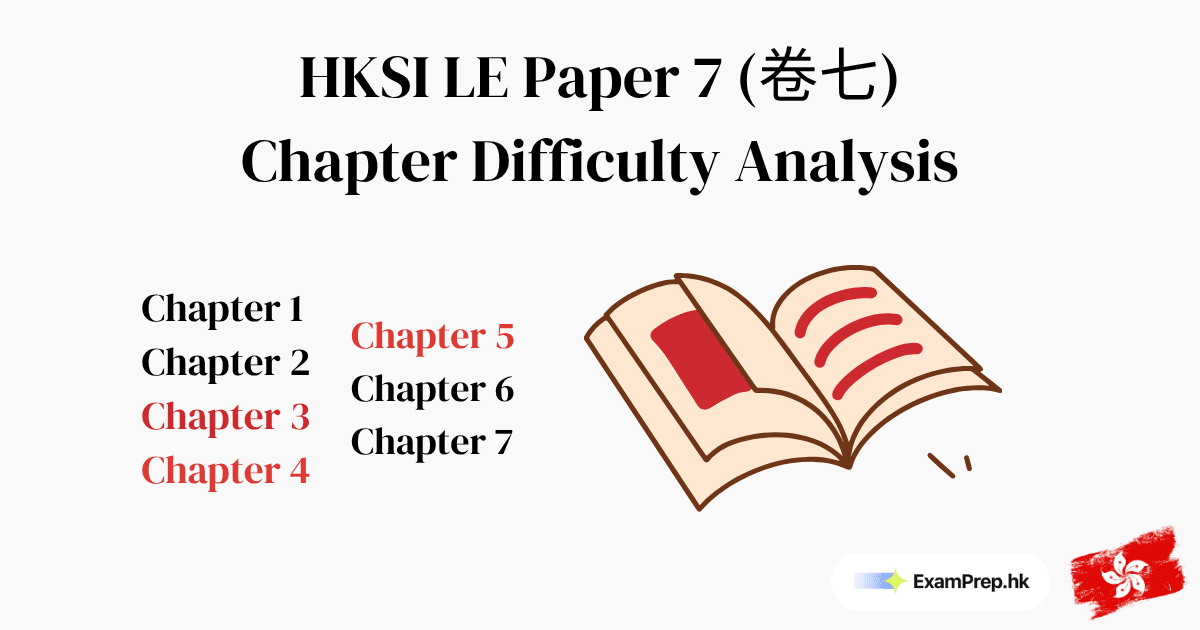
"Is HKSI Paper 7 difficult?"
This is the first question most candidates ask before sitting the Financial Markets exam. The answer depends entirely on how you prepare.
With an average pass rate of around 67%, roughly one in three candidates fails. That's better than HKSI Paper 1's ~52% pass rate — but Paper 7 brings its own unique challenges that catch unprepared candidates off guard.
(Haven't registered yet? Check our step-by-step registration guide.)
📊 HKSI Paper 7 at a Glance
- Pass Rate: ~67%
- Questions: 60 MCQ
- Time: 90 minutes (1.5 min per question)
- Passing Score: 70% (42/60)
- Chapters: 7
- Key Challenge: Combines theory AND calculations
Why HKSI Paper 7 Is Challenging
1. It combines theory AND calculations
This is the biggest difference from HKSI Paper 1, which is purely regulation-based. Paper 7 requires you to both understand financial market concepts and perform calculations under time pressure.
Calculation topics include:
- TERP (theoretical ex-rights price) in Chapter 3
- Real interest rates, bond pricing, and yield calculations in Chapter 4
- Cross rates, forward rates, and premium/discount calculations in Chapter 5
If you haven't practised these formulas until they're second nature, you'll burn through precious exam time on just a handful of questions.
2. Broad scope: global AND Hong Kong
Paper 7 covers financial markets from two angles. You need to understand how global financial systems work (Chapter 1) and know the specifics of Hong Kong's financial infrastructure (Chapter 2). The equity, debt, and derivatives chapters then test both international concepts and HK-specific rules.
3. Three "killer chapters" carry 61.7% of the exam
Chapters 3 (Equity Market), 4 (Debt Market), and 5 (FX & Derivatives) together account for approximately 37 out of 60 questions. If you don't master these three chapters, it's mathematically very difficult to pass.
⚠️ The Math Behind the Killer Chapters
Chapters 3, 4, and 5 = ~37 questions. If you score only 50% on these chapters, you'd need 23 out of 23 on the remaining chapters just to reach the passing score. That's essentially impossible.
Chapter-by-Chapter Difficulty Analysis
| Chapter | Topic | ~Questions | Weight | Difficulty |
|---|---|---|---|---|
| 1 | The global financial system | 7 | 11.7% | ⭐⭐ |
| 2 | Financial system in Hong Kong | 7 | 11.7% | ⭐⭐⭐ |
| 3 | The equity market | 11 | 18.3% | ⭐⭐⭐⭐ |
| 4 | The debt market | 13 | 21.7% | ⭐⭐⭐⭐⭐ |
| 5 | The FX and derivatives markets | 13 | 21.7% | ⭐⭐⭐⭐⭐ |
| 6 | Financial risk management | 6 | 10% | ⭐⭐⭐ |
| 7 | Applications in the financial sector | 3 | 5% | ⭐⭐ |
Chapter 4: The Debt Market — ⭐⭐⭐⭐⭐ (Hardest)
The debt market chapter is the most challenging because it combines dense theory with multiple calculation types:
- Nominal vs. real vs. effective interest rates
- Bond pricing and present value calculations
- Yield-to-maturity and yield curve analysis
- Repurchase agreements
- HK-specific debt instruments and the Exchange Fund
Why it's hard: Interest rate and bond pricing questions require both formula recall and careful arithmetic under time pressure.
Chapter 5: The FX and Derivatives Markets — ⭐⭐⭐⭐⭐ (Hardest)
Equally challenging, this chapter covers two vast topics combined:
- Foreign exchange market structure and participants
- Cross rate and forward rate calculations
- Forward premium and discount
- The four main types of derivatives (futures, forwards, swaps, options)
- HK derivatives market structure and HKFE products
Why it's hard: The sheer breadth of content plus calculation questions on cross rates and forward rates.
Chapter 3: The Equity Market — ⭐⭐⭐⭐
The equity market chapter includes both conceptual knowledge and TERP calculations:
- Equity pricing methods and valuation
- Stock market structure and indices
- Rights issues and the TERP formula
- HK equity market specifics (SEHK, trading and settlement)
Why it's hard: TERP calculations are a common exam question, and the chapter covers a wide range of HK-specific market mechanics.
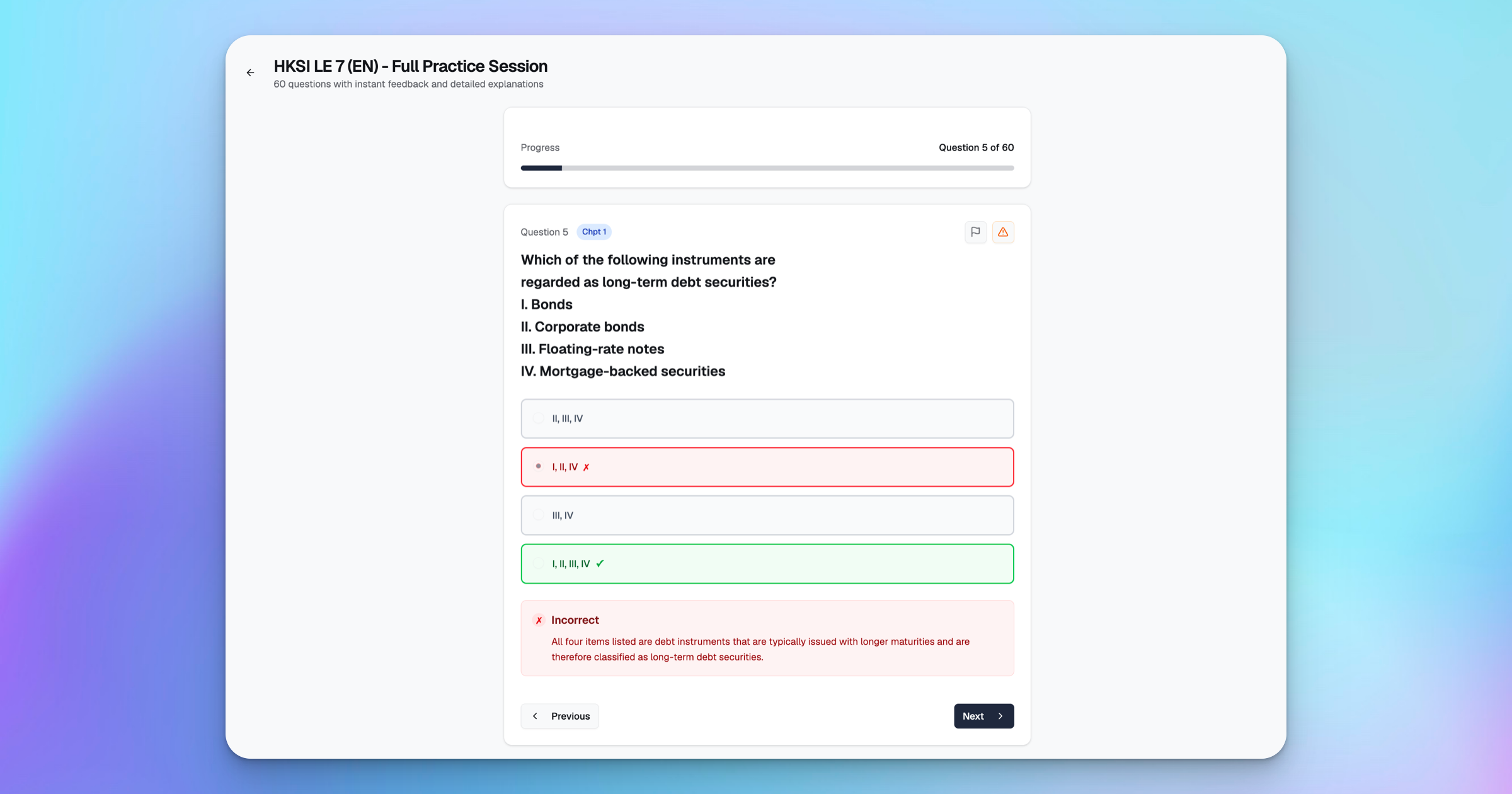
ExamPrep.hk provides instant feedback and detailed explanations for every question — including step-by-step calculation walkthroughs.
How Does Paper 7 Compare to Paper 1?
Many candidates take both papers. Here's how they stack up:
| Feature | Paper 1 (Regulation) | Paper 7 (Financial Markets) |
|---|---|---|
| Questions | 60 MCQ | 60 MCQ |
| Duration | 90 minutes | 90 minutes |
| Passing Score | 70% (42/60) | 70% (42/60) |
| Pass Rate | ~52% | ~67% |
| Content Type | Pure regulation & law | Theory + calculations |
| Chapters | 9 | 7 |
| Calculations | None | TERP, bond pricing, cross rates, forward rates |
| Exam Fee (HK) | HKD 1,630 | HKD 1,470 |
Key takeaway: Paper 7 has a higher pass rate, but that doesn't mean it's easier. Paper 1 tests your ability to memorise dense regulatory rules, while Paper 7 tests your ability to understand financial concepts and apply formulas under pressure. Candidates with a finance or economics background often find Paper 7 more intuitive, while those from a legal or compliance background may find Paper 1 more manageable.
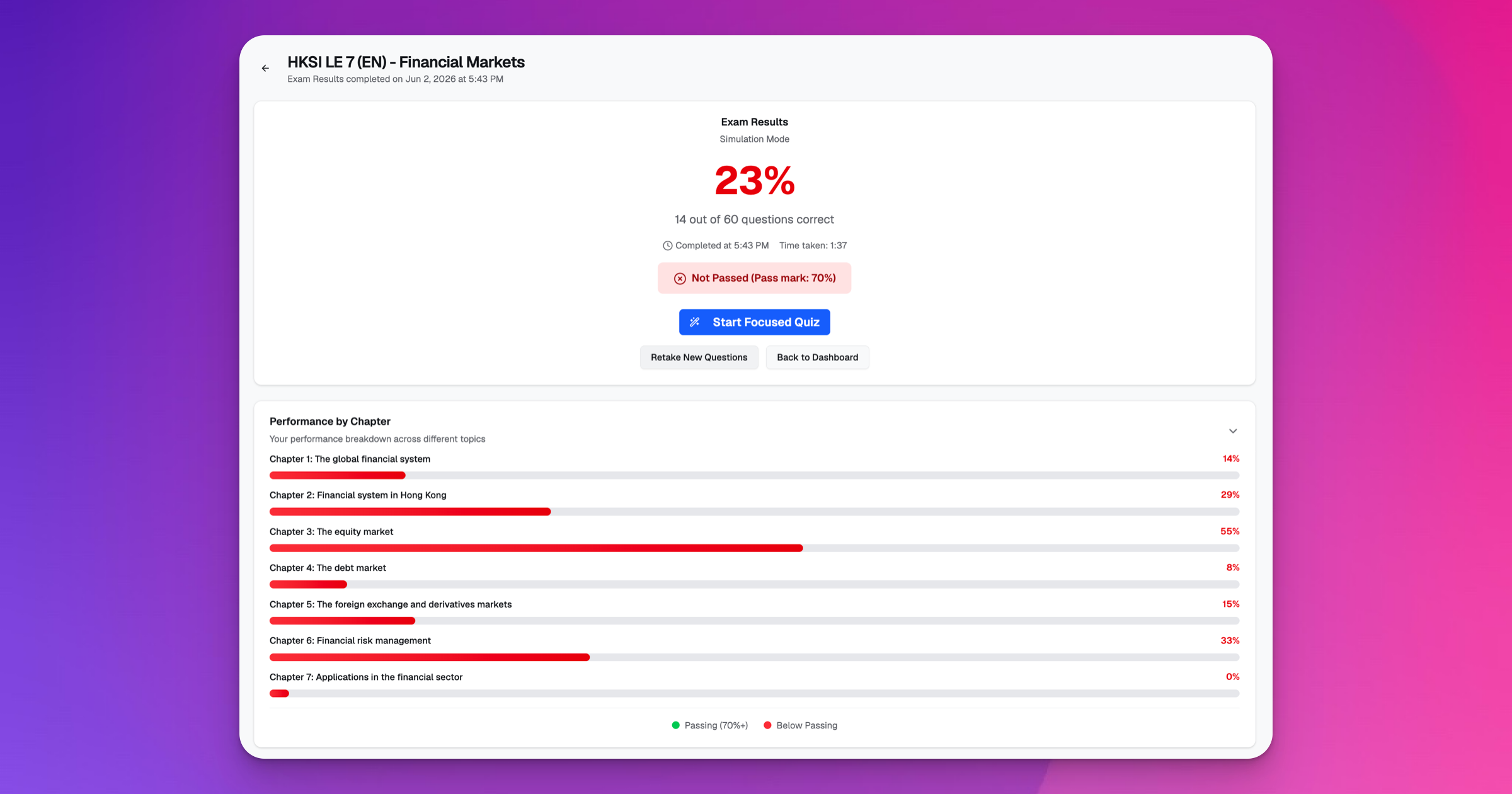
ExamPrep.hk's Performance by Chapter feature tracks your performance by chapter and highlights your strengths and weaknesses.
Strategies to Overcome the Difficulty
1. Prioritise the killer chapters
Allocate 60–70% of your study time to Chapters 3, 4, and 5. These chapters carry 61.7% of the exam and include the calculation questions that separate passing candidates from failing ones.
✅ Recommended Time Allocation
- 60–70% of study time: Chapters 3, 4, and 5 (equity, debt, FX & derivatives)
- 20–25% of study time: Chapters 1, 2, and 6 (global system, HK system, risk management)
- 5–10% of study time: Chapter 7 (applications)
2. Drill the formulas until they're automatic
For each calculation type, you should be able to recall and apply the formula within 30 seconds:
- TERP = (cum-rights price × existing shares + subscription price × new shares) / total shares after issue
- Real interest rate ≈ nominal rate − inflation rate
- Cross rates and forward rates — practise both direct and indirect quotation methods
- Bond pricing — present value of coupon payments plus present value of face value
3. Use chapter-by-chapter practice mode
Don't just take full mock exams. Isolate each chapter and drill it until you consistently score above 75% before moving on.
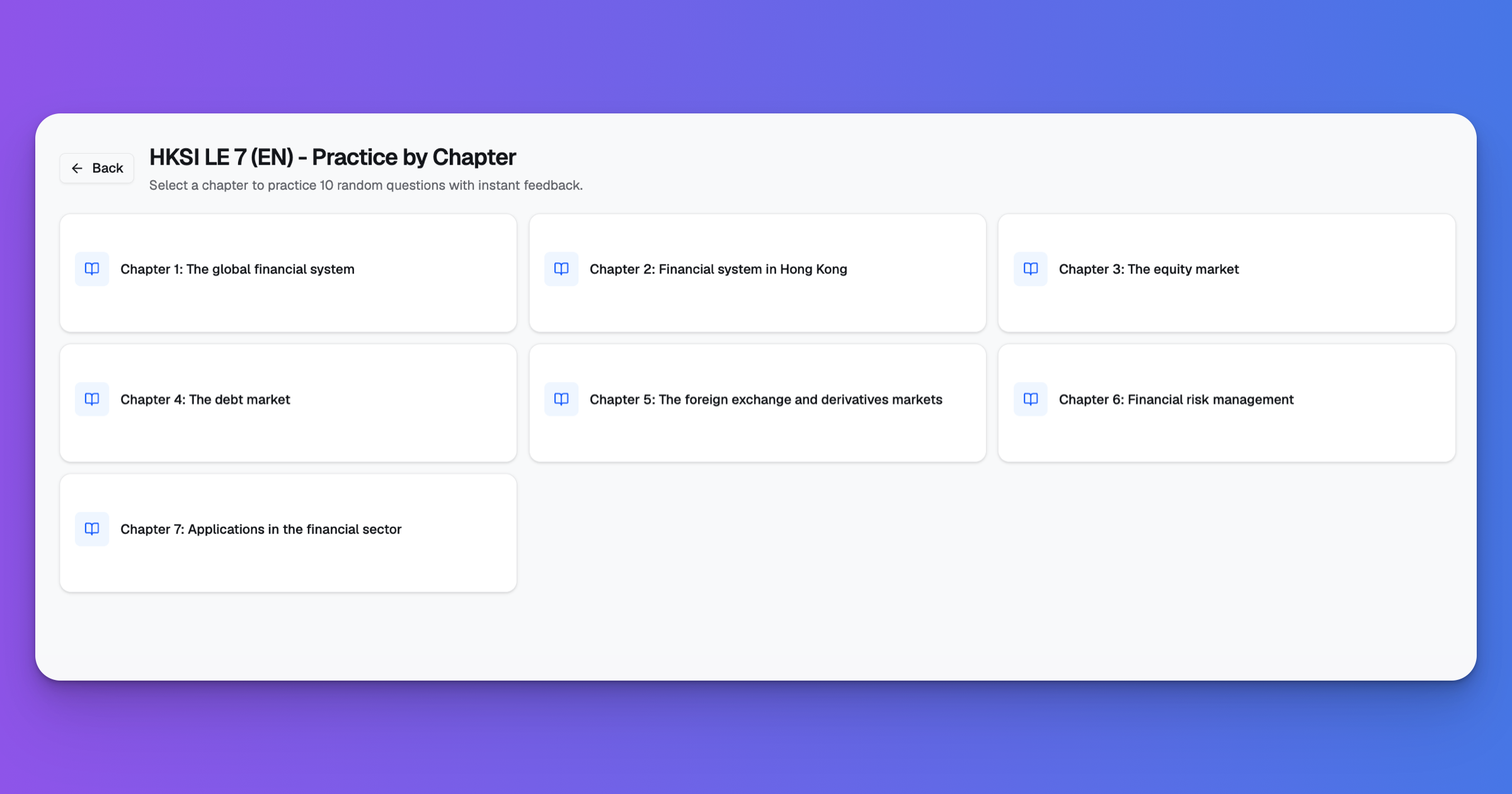
ExamPrep.hk's Practice by Chapter feature lets you focus on one chapter at a time and track your improvement.
4. Take timed mock exams
Once you're scoring well by chapter, switch to full 60-question mock exams under timed conditions (90 minutes). This builds exam stamina and helps you manage your time when calculation questions slow you down.
5. Understand, don't just memorise
Paper 7 tests understanding of how financial markets work, not just factual recall. For theory questions, make sure you understand why something is true — not just that it's true.
How to Know If You're Ready
Before sitting the exam, make sure you can:
- Score 75%+ on Chapters 3, 4, and 5 in practice mode
- Score 70%+ on full mock exams consistently (not just once)
- Complete all calculations within 2 minutes each without mistakes
- Finish mock exams within 90 minutes with time to review flagged questions
If you're not hitting these benchmarks yet, keep practising. It's better to delay by a month than to waste HKD 1,470 on a failed attempt.
More Resources for Your Preparation
- Complete HKSI Paper 7 Study Guide — a focused study plan built around the chapter weightings
- Passing Score & Exam Format — everything you need to know about the exam structure
- Try mock questions — test yourself with sample questions and detailed explanations
- Register for your exam — step-by-step guide to booking your slot
- Compare study resources — find the right tools for your preparation
The Bottom Line
Is HKSI Paper 7 difficult? It can be — but it's entirely manageable with the right approach.
The candidates who fail are typically those who:
- Spread their study time equally across all 7 chapters
- Don't practise calculation questions enough
- Underestimate the breadth of Chapters 4 and 5
The candidates who pass are those who:
- Focus 60–70% of their effort on Chapters 3, 4, and 5
- Drill formulas until they're automatic
- Use chapter-by-chapter practice to identify and fix weak areas
- Take timed mock exams to build exam stamina
The ~33% who fail don't fail because the content is impossibly hard. They fail because they prepare the wrong way. Don't be one of them.
Frequently Asked Questions
Ready to Put This Strategy Into Action? 💯
Join thousands of successful candidates who have passed their HKSI Paper 7 exam using our proven study methods.