
How to Pass HKSI Paper 2 Exam Hong Kong: Complete 2026 Study Guide
Master the HKSI Paper 2 (Regulation of Securities) exam in 2026. 7 chapters, core trio Chapters 3–5 at 52.5%, ~62% pass rate. Targeted 2–3 week study plan.
HKSI LE Paper 2 — Licensing Examination Paper 2: Regulation of Securities — is the regulatory companion for Type 1 (Dealing in Securities) licensing. If you're pursuing a career in securities dealing, this paper covers the regulatory framework, subsidiary legislation, and conduct rules you need to know.
(If you haven't registered yet, see the full HKSI Paper 2 registration guide.)
Paper 2's challenge isn't one killer chapter — it's breadth. With 7 chapters spanning the regulatory framework, subsidiary legislation, securities management, SEHK dealing, other securities activities, OTC derivatives, and market misconduct, there's a lot of ground to cover. The pass rate sits around ~62%, meaning roughly 4 in 10 candidates fail.
This guide gives you the 2026 strategy, chapter-by-chapter weight breakdown, and a targeted 2–3 week study plan.
✨ TL;DR: HKSI Paper 2 Passing Strategy
- Exam scope: 7 chapters — regulatory framework, subsidiary legislation, securities supervision, SEHK dealing, other activities, OTC derivatives, market misconduct.
- Core trio: Chapters 3, 4 & 5 carry ~52.5% of all questions (~21/40) — master these first.
- Passing score: You need 70% (28/40); pass rate is ~62%.
- Strategy: ~50% study time on Chapters 3–5; Chapters 2 & 6 next (~30% combined); Chapters 1 & 7 last (~17.5%).
Understanding the Exam: HKSI Paper 2 Format (2026)
The HKSI LE is administered by the Hong Kong Securities and Investment Institute (HKSI Institute). Paper 2 covers the regulation of securities — the rules, compliance requirements, and conduct standards for securities businesses in Hong Kong.
| Official Name | Licensing Examination Paper 2: Regulation of Securities |
| Questions | 40 multiple-choice questions (MCQ) |
| Duration | 60 minutes (1 hour) |
| Passing Score | 70% (28 out of 40 correct) |
| Questions You Can Get Wrong | 12 questions |
| Format | Computer-based exam (CBE), English or Traditional Chinese |
| Calculator | Not permitted (Papers 1–6) |
| Exam Fee | HK$2,000 (Hong Kong Centre) / HK$2,450 (Global Centres) |
| Frequency | Monthly sessions |
| Syllabus | Updated for 2026 |
(Want a deeper dive into the score and format? See the HKSI Paper 2 passing score and exam format guide.)
The "Core Trio": Where Most Questions Come From
HKSI Paper 2's difficulty is spread across 7 chapters, but three dominate:
| Chapter | Topic | ~Questions | ~Weight |
|---|---|---|---|
| 1 | Regulatory framework | ~3 | ~7.5% |
| 2 | Requirements of relevant subsidiary legislation | ~6 | ~15% |
| 3 | Management and supervision of securities business ⚠️ | ~7 | ~17.5% |
| 4 | Dealing in securities traded on the SEHK ⚠️ | ~7 | ~17.5% |
| 5 | Other securities activities ⚠️ | ~7 | ~17.5% |
| 6 | Exchange traded options and OTC derivatives | ~6 | ~15% |
| 7 | Market misconduct and improper trading practices | ~4 | ~10% |
Chapter-by-Chapter Breakdown
Chapter 1: Regulatory Framework (~3 questions, ~7.5%)
This is the lightest chapter, covering the overall regulatory landscape — the Companies Ordinance, Securities and Futures Ordinance (SFO), and the regulatory bodies.
Key topics to master:
- Companies Ordinance basics (AGM requirements, prospectus requirements)
- SFO framework and regulated activities
- SFC's role, powers, and enforcement approach
- Key differences between public and private companies
Study tip: Don't over-invest here — 3 questions don't justify 15% of your time. Know the key ordinances and regulator roles at a high level.
Chapter 2: Requirements of Relevant Subsidiary Legislation (~6 questions, ~15%)
This chapter covers the detailed rules under the SFO — how client securities must be handled, registration requirements, and safekeeping obligations.
Key topics to master:
- Client securities safekeeping and segregation requirements
- Registration of client securities (in whose name they can be registered)
- Client money handling rules
- Trust account requirements
- Securities collateral rules — when the intermediary's own name may be used
Study tip: Pay close attention to the precise conditions under which client securities can be registered in different names — this is a classic exam question type.
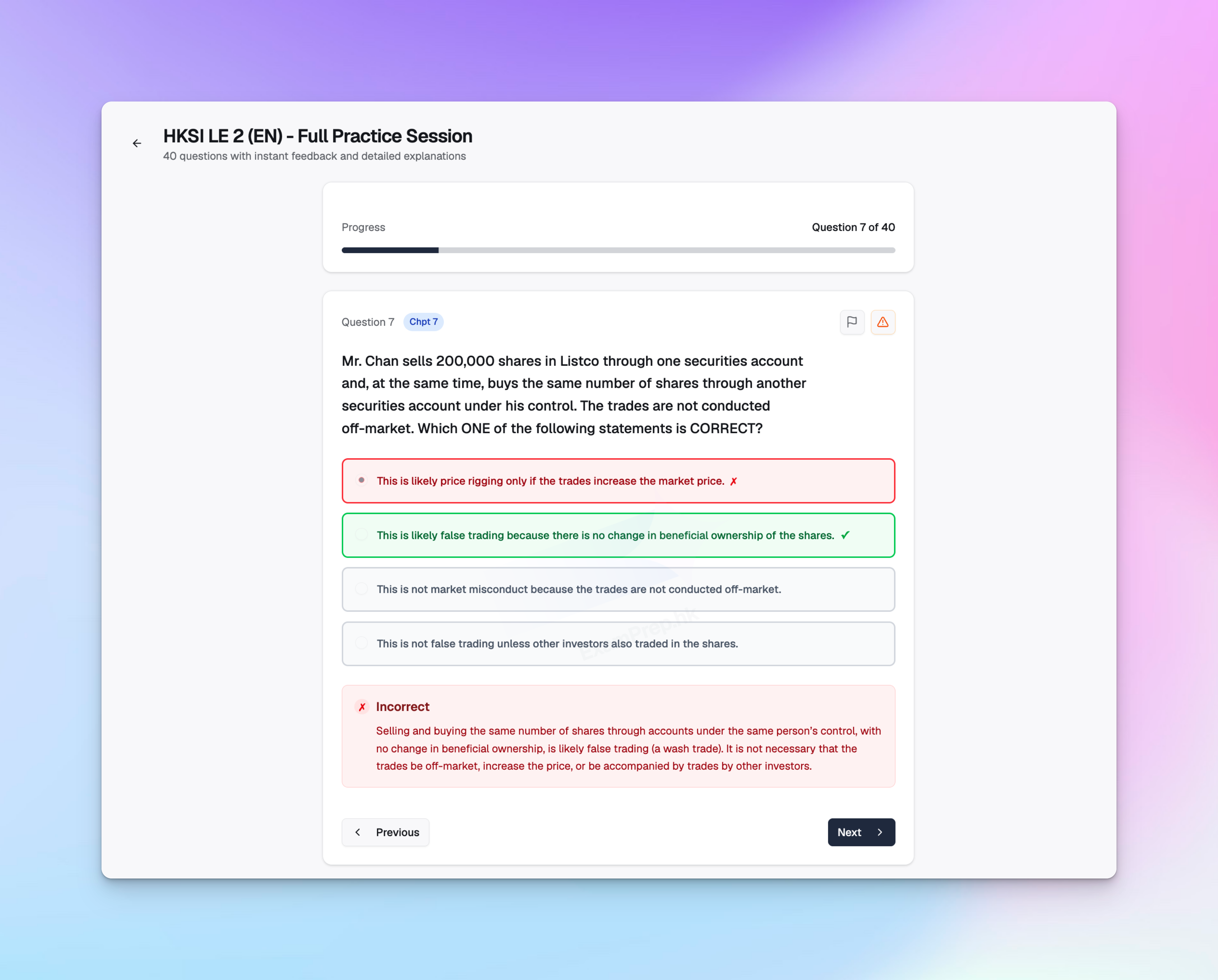
ExamPrep.hk gives you instant feedback with detailed explanations for every question — understand why the answer is correct
Chapter 3: Management and Supervision of Securities Business (~7 questions, ~17.5%)
The first of the "core trio". This covers how securities firms must be managed — internal controls, compliance, responsible officers, and supervision requirements.
Key topics to master:
- Responsible officer duties and minimum staffing requirements
- Internal control and compliance frameworks
- Supervision of representatives and client order handling
- Management responsibilities for securities businesses
- Record-keeping obligations
Study tip: This chapter tests whether you understand how a properly run securities firm operates. Think from the perspective of a compliance officer.
Chapter 4: Dealing in Securities Traded on the SEHK (~7 questions, ~17.5%)
This covers the Listing Rules, trading mechanics, and dealing requirements on the Stock Exchange of Hong Kong.
Key topics to master:
- SEHK Listing Rules — initial listing, continuing obligations, suspension and cancellation
- When SEHK can cancel a listing (18-month continuous suspension)
- Voluntary withdrawal requirements and shareholder approval
- Short selling rules and restrictions
- Trading halt and suspension triggers
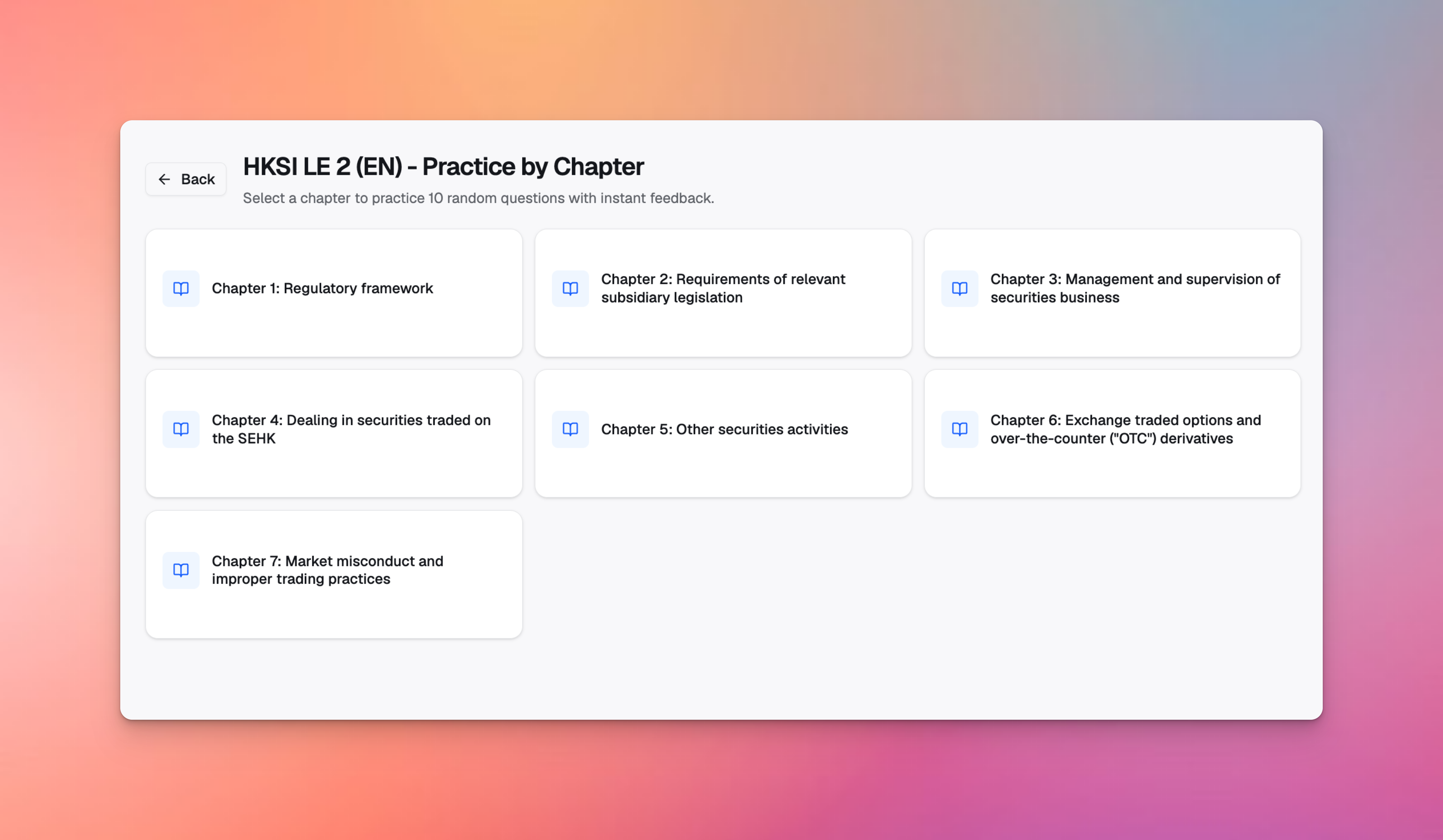
Organise your practice by chapter — focus your energy where it matters most
Study tip: The listing/delisting rules are tested heavily. Know the specific timelines (18 months for cancellation after suspension, shareholder approval for voluntary withdrawal).
Chapter 5: Other Securities Activities (~7 questions, ~17.5%)
This covers securities activities beyond exchange trading — prospectus requirements, underwriting, placing, and offers.
Key topics to master:
- Prospectus requirements under the Companies Ordinance
- Land and building valuation thresholds (10% of assets or HK$3 million)
- Auditor's report requirements (3 years)
- Underwriting and placing regulations
- Public offer rules and exemptions
Study tip: The prospectus rules are detail-heavy. Remember the specific thresholds — HK$3 million land valuation trigger, 3-year audit requirement, and the rule about including all valuations obtained in the 6 months before the prospectus date.
Chapter 6: Exchange Traded Options and OTC Derivatives (~6 questions, ~15%)
This covers the derivatives side — options traded on exchanges and OTC derivative regulations.
Key topics to master:
- Exchange traded options — HKEX options market structure
- OTC derivative risk management requirements
- Credit and market risk standards for counterparties
- Same risk-management standards for group affiliates, connected persons, and independent third parties
- Reporting and record-keeping for derivatives transactions
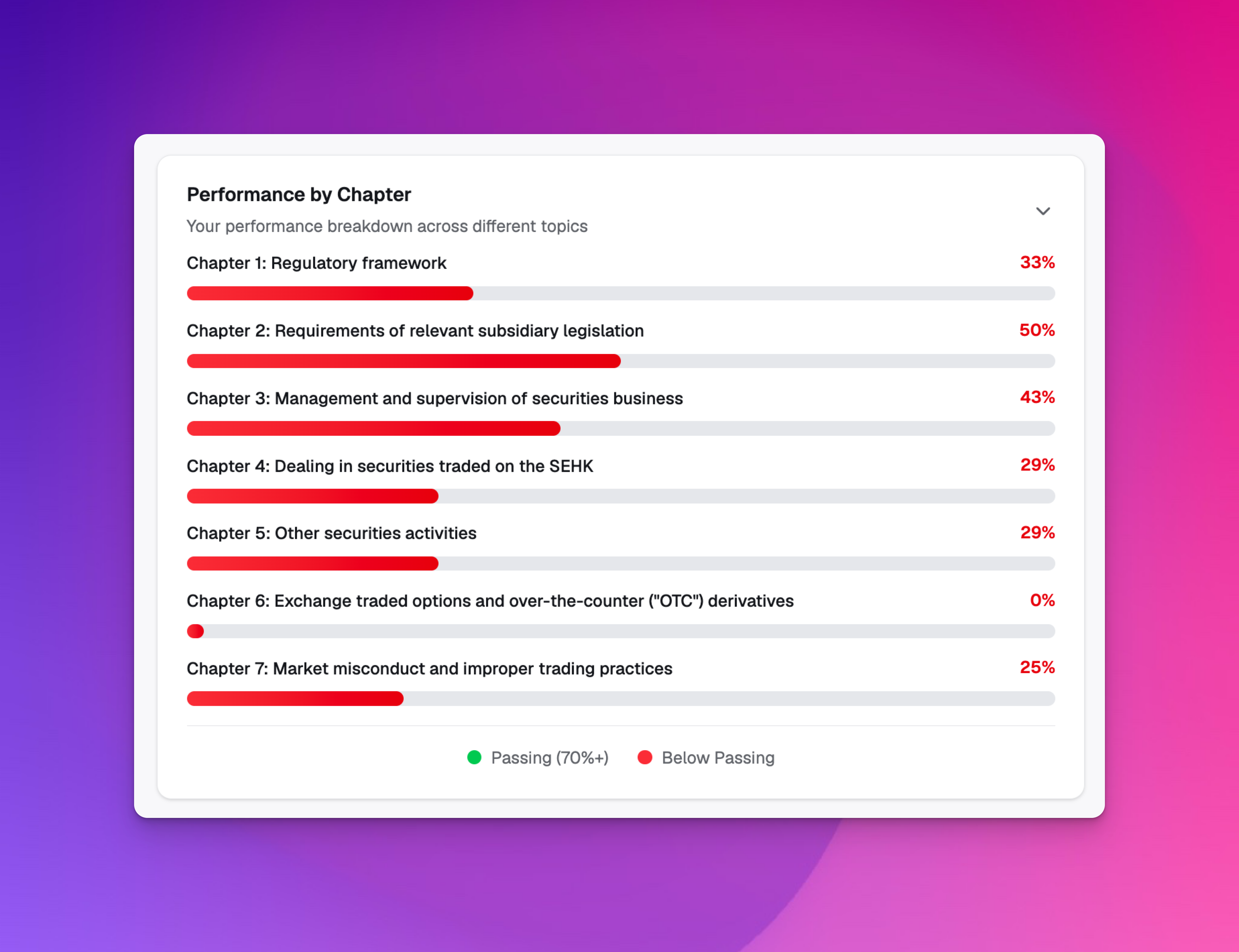
Track your performance by chapter to identify weak spots before exam day
Study tip: The key principle for OTC derivatives is that the same risk-management standards apply to everyone — group affiliates, connected persons, and third parties. Don't assume affiliates get softer treatment.
Chapter 7: Market Misconduct and Improper Trading Practices (~4 questions, ~10%)
The lightest chapter alongside Chapter 1. Covers market manipulation, insider dealing, and enforcement.
Key topics to master:
- SFO market misconduct categories (insider dealing, market manipulation, false trading)
- Market Misconduct Tribunal (MMT) composition and powers
- Criminal vs civil proceedings for market misconduct
- SFC disciplinary powers and sanctions
- Front-running and other improper trading practices
Study tip: Similar to Paper 6's Chapter 4 (Misconduct) — if you've studied Paper 6, there's overlap here. Focus on the specific penalties and tribunal structure.
2–3 Week Study Plan
Assuming 1.5–2 hours of study per day, here's a practical plan weighted toward the core trio:
| Period | Focus | Details |
|---|---|---|
| Days 1–2 | Chapters 1 & 2 | Regulatory framework basics + subsidiary legislation. Client securities rules, registration names, trust accounts. |
| Days 3–5 | Chapter 3 | Securities business management — compliance, internal controls, RO duties. First of the core trio. |
| Days 6–8 | Chapter 4 | SEHK dealing — listing rules, suspension/cancellation, short selling. Know the specific timelines. |
| Days 9–11 | Chapter 5 | Other securities activities — prospectus rules, valuation thresholds, underwriting. Detail-heavy chapter. |
| Days 12–13 | Chapter 6 | Options and OTC derivatives — risk management standards, counterparty rules. |
| Day 14 | Chapter 7 | Market misconduct — quick review. 4 questions, learn the misconduct types and MMT structure. |
| Days 15–17 | Mock exams | Full timed practice. Review all wrong answers. Re-drill Chapters 3–5 weak spots. |
| Days 18–19 | Final revision | Focus on Chapters 3–5 rules and thresholds. Light review of Ch 2 & 6. Quick scan Ch 1 & 7. |
(Want to try some questions right now? Check out HKSI Paper 2 sample mock questions.)
Mock Exam Strategy
Mock exams are essential for Paper 2. With 7 chapters of regulatory content, the best way to retain the rules is repeated practice under exam conditions.
How to use mock exams effectively:
- First mock (Day 15): Full exam conditions — 40 questions, 60 minutes, no calculator, no notes. Establish your baseline.
- Review phase: For every wrong answer, go back to the source material. Don't just memorise the answer — understand the rule behind it.
- Second mock (Day 17): Full timed exam again. Your score typically improves 10–15%.
- Targeted drills: Practice by chapter for Chapters 3, 4, and 5 until you're consistently hitting 75%+.
(Want to compare study resources? See HKSI Paper 2 mock exams and study guides compared.)
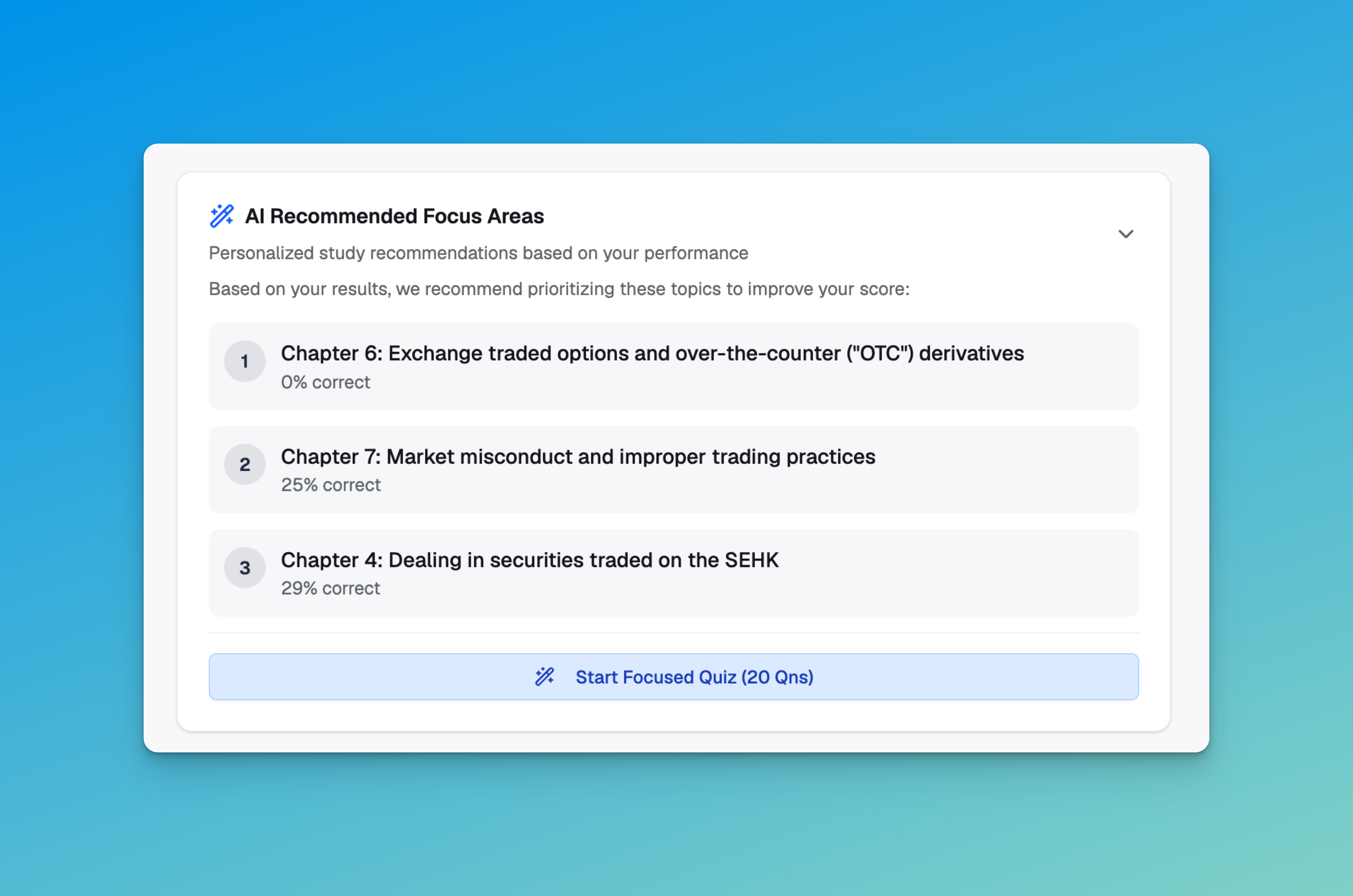
AI-powered recommendations help you focus on the topics that will boost your score fastest
Exam Day Tips
- No calculator needed. Paper 2 is almost entirely regulatory content — there are virtually no calculation questions.
- Time management: ~1.5 minutes per question. Regulatory recall questions should be fast — flag uncertain ones and come back.
- Watch for precise wording. Regulatory questions often hinge on one word — "must" vs "may", "6 months" vs "9 months", or specific monetary thresholds.
- The core trio is ~52.5%. Expect roughly 21 of your 40 questions to come from Chapters 3–5. Pace yourself.
- Arrive 30 minutes early. CBE centres require ID verification and system setup.
How Paper 2 Fits With Other HKSI Papers
Paper 2 is the regulatory component for Type 1 (Dealing in Securities) licensing. If you're pursuing a Type 1 licence, you typically need:
- Paper 1 — Fundamentals of Securities and Futures Regulation (core paper)
- Paper 2 — Regulation of Securities (regulatory specialist paper — this one)
- Paper 7 — Financial Markets (technical paper)
- Paper 8 — Securities (technical paper)
If you've already passed Paper 1, Paper 2 builds on that regulatory foundation with securities-specific rules. If you're also sitting Paper 7 or Paper 8, Paper 2 provides the regulatory context for those technical subjects.
Preparing for other HKSI papers? See guides for Paper 9 and Paper 12.
Ready to Start Studying?
The most effective path to passing is structured practice with instant feedback. Regulatory content sticks through active practice — not just reading the manual.
Related guides:
HKSI Paper 2 Study Guide FAQ
Ready to Put This Strategy Into Action? 💯
Join thousands of successful candidates who have passed their HKSI Paper 2 exam using our proven study methods.