
HKSI Paper 2 Mock Questions with Answers: Practice Regulation of Securities Questions (2026)
Free HKSI Paper 2 mock questions with detailed answers and explanations. Sample questions from Chapters 1, 2, 4, 5, and 6 (2026 syllabus).
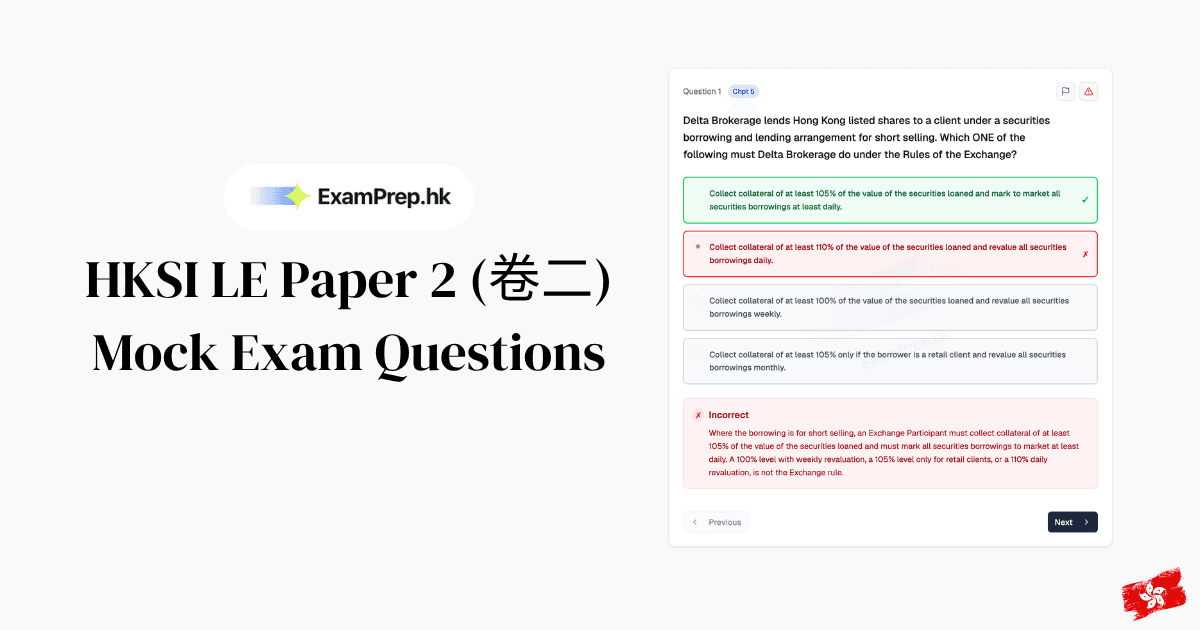
The best way to prepare for HKSI Paper 2 (Regulation of Securities) is to practise questions that mirror the real exam format. Below are 5 sample questions covering key chapters with detailed explanations.
(For a complete study strategy, see the HKSI Paper 2 study guide.)
HKSI Paper 2 Quick Facts
- Questions: 40 MCQ | Time: 60 minutes | Pass: 70% (28/40)
- Chapters: 7 chapters covering securities regulation
- Core trio: Chapters 3–5 carry ~52.5%
- Pass rate: ~62%
Sample Questions
These questions are designed to match the style and difficulty of the real HKSI Paper 2 exam. In the actual exam, you'll face 40 questions across all 7 chapters in 60 minutes.
Question 1 — Chapter 1: Regulatory Framework
Under the Companies Ordinance, which ONE of the following statements regarding annual general meetings is CORRECT?
- A) Every company must hold an annual general meeting in every financial year with no exceptions or alternatives.
- B) Private companies must hold an annual general meeting within 6 months after the end of their accounting reference period.
- C) Public companies must hold an annual general meeting within 6 months after the end of their accounting reference period.
- D) Annual general meetings must be chaired by an independent non-executive director.
Show Answer & Explanation
✅ Answer: C
Unless exempted, a public company must hold an annual general meeting within 6 months after the end of its accounting reference period; a private company has 9 months. Companies may dispense with an AGM by unanimous consent, and there is no requirement that an independent non-executive director chair the meeting.
Key rule: Public company = 6 months; Private company = 9 months. Companies can dispense with AGMs by unanimous consent.
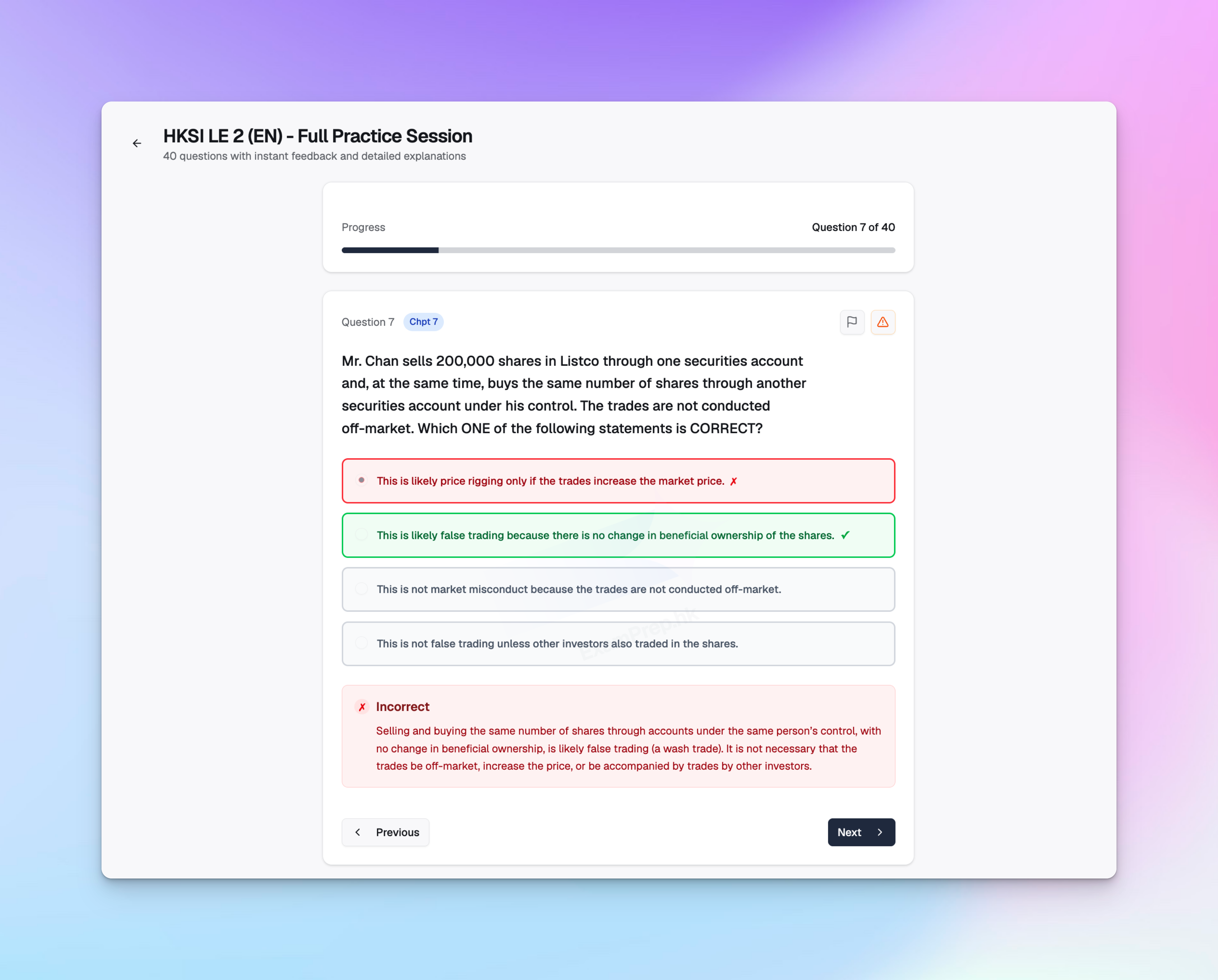
On ExamPrep.hk, every question shows you the explanation immediately — so you learn while you practise
Question 2 — Chapter 2: Requirements of Relevant Subsidiary Legislation
If client securities or securities collateral received by an intermediary are to be registered, in whose name may they be registered?
- A) In the name of the client, or of an associated entity of the intermediary and, in the case of securities collateral only, also in the name of the intermediary itself.
- B) Only in the name of The Stock Exchange of Hong Kong Limited, which must appear as registered holder of every client holding.
- C) Only in the name of the Hong Kong Monetary Authority, which acts as the sole central registrar for client securities in Hong Kong.
- D) In the name of any employee or director of the intermediary, whether or not that person is the client, so that the firm can give instructions more quickly.
Show Answer & Explanation
✅ Answer: A
If registered, the holding must be in the name of the client or of an associated entity of the intermediary and, for securities collateral only, it may also be in the name of the intermediary itself. It may not be registered in the name of the Exchange, the HKMA, or an employee who is not the client.
Key rule: Client securities → client's name or associated entity. Securities collateral → additionally may be in the intermediary's own name. Never in the name of employees, directors, the Exchange, or the HKMA.
Chapters 3–5 carry the most weight at ~52.5% combined (~21/40 questions). The next question covers Chapter 4 — SEHK dealing rules, one of the most heavily tested areas. See the full difficulty analysis.
Question 3 — Chapter 4: Dealing in Securities Traded on the SEHK
When may the SEHK cancel an issuer's listing after a trading suspension, and what is generally required if an issuer wishes to withdraw its listing voluntarily?
- A) The SEHK may cancel a listing after a continuous suspension of 6 months, and a voluntary withdrawal never requires shareholders' approval.
- B) The SEHK may cancel an issuer's listing where it has been suspended from trading for a continuous period of 18 months. A voluntary withdrawal must generally meet shareholders' approval requirements, which are more onerous for issuers without a recognised alternative listing.
- C) The SEHK may cancel a listing only with the issuer's consent, and a voluntary withdrawal may be effected by a board resolution alone.
- D) The SEHK may cancel a listing after a continuous suspension of 24 months, and shareholders' approval is required only where the issuer also has a recognised overseas listing.
Show Answer & Explanation
✅ Answer: B
Cancellation may follow a continuous suspension of 18 months, not 6 or 24 months. A voluntary withdrawal generally requires the shareholders' approvals set out in the Listing Rules, and those requirements are more onerous if the issuer has no alternative listing on another regulated, regularly operating, open stock exchange recognised by the SEHK for this purpose.
Key rule: 18-month continuous suspension → SEHK may cancel. Voluntary withdrawal requires shareholder approval, with stricter requirements if no recognised alternative listing exists.
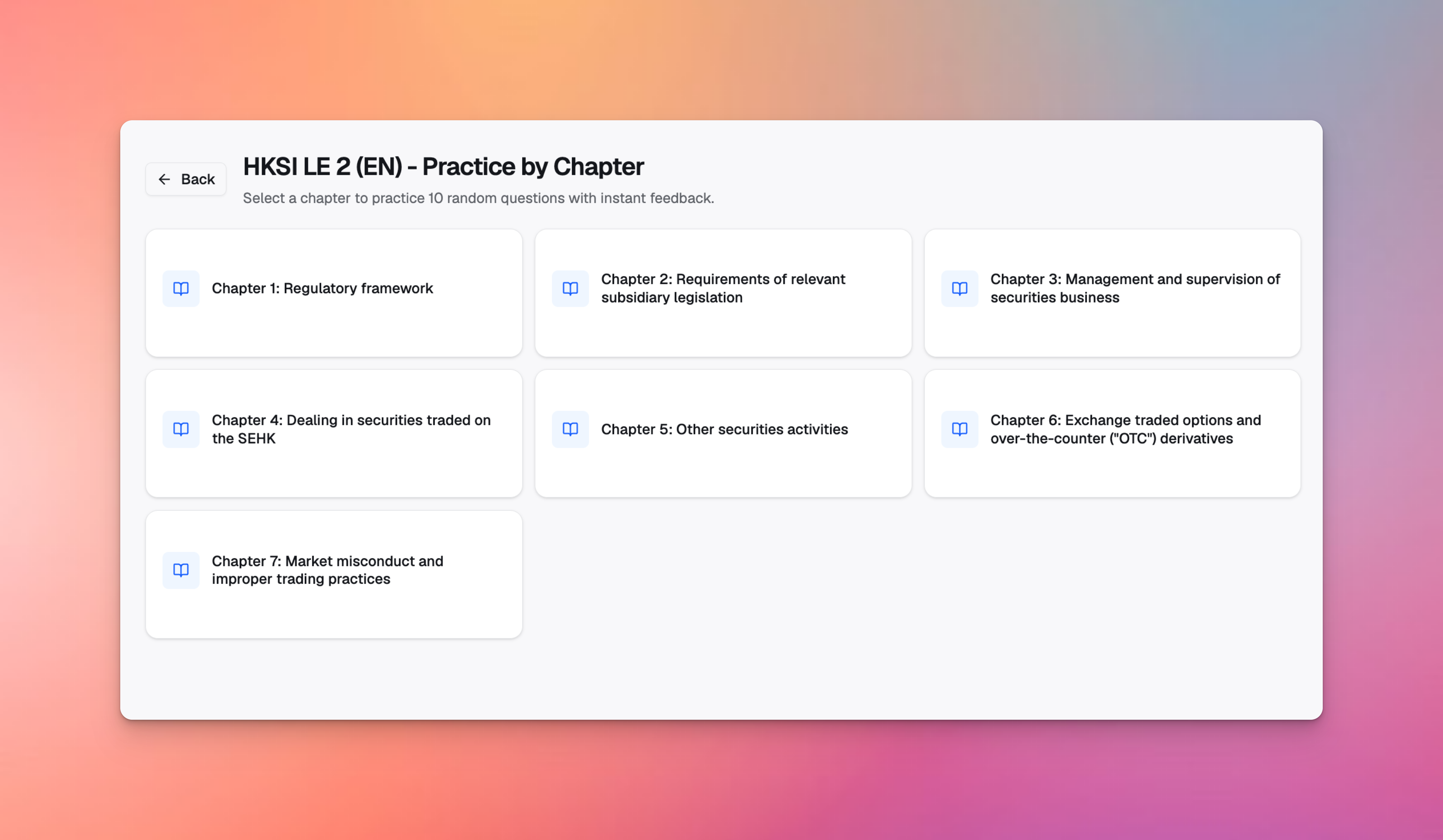
Practice chapter by chapter — focus on the areas that carry the most weight
Question 4 — Chapter 5: Other Securities Activities
Dragon Holdings, a Hong Kong incorporated company, is preparing a prospectus for a public offer. Its land and building interests are 8% of assets, valued at HK$4 million. Which ONE of the following statements is CORRECT?
- A) No valuation report is required because the land interests are less than 10% of assets, and an auditor's report is required only for the most recent financial year.
- B) A valuation report is required only if the land interests exceed 50% of assets.
- C) A valuation report is required because the land interests are not less than HK$3 million, even though they are less than 10% of assets. The prospectus must include enough information for a reasonable person to form a valid view of financial condition and profitability, an auditor's report for each of the preceding three years, and if more than one valuation was obtained in the 6 months before the prospectus date, all must be included.
- D) A valuation report is never required where the company is incorporated in Hong Kong.
Show Answer & Explanation
✅ Answer: C
The Third Schedule requires enough information for a reasonable person to form a valid view of the company's financial condition and profitability, an auditor's report for each of the preceding three years, and a land-or-buildings valuation report where those interests are more than 10% of assets or not less than HK$3 million. Since HK$4 million ≥ HK$3 million, the valuation report is required even though 8% < 10%. If more than one valuation was obtained in the 6 months before the prospectus date, all must be included.
Key rule: Valuation report required if land/buildings > 10% of assets OR ≥ HK$3 million. Auditor's report for 3 years. All valuations in the preceding 6 months must be included.
Pssst.. ExamPrep.hk has instant feedback and explanations to help you easily digest and understand the logic and concept behind each question.
Question 5 — Chapter 6: Exchange Traded Options and OTC Derivatives
When a licensed corporation assesses financial exposures arising from OTC derivative transactions, which ONE of the following statements is CORRECT?
- A) The same risk-management standards should be applied to group affiliates, other connected persons such as shareholders, directors and employees, and independent third parties, subject to any legal or regulatory requirement or exemption that may apply.
- B) Group affiliates may be excluded from all risk-management standards, because a group relationship is treated as removing any financial exposure.
- C) Independent third parties need not be subject to any credit or market-risk standard, provided group affiliates are tightly controlled.
- D) A single, lower standard must be applied to group affiliates than to independent third parties in every case.
Show Answer & Explanation
✅ Answer: A
Because of the nature of OTC derivative transactions, a firm's risk profile may be affected by exposures to group affiliates, other connected persons and independent third parties. The same risk-management standards should be applied to all of them, subject to any applicable legal or regulatory requirement or exemption.
Key rule: Same risk-management standards for everyone — group affiliates, connected persons, and independent third parties. No group gets softer treatment by default.
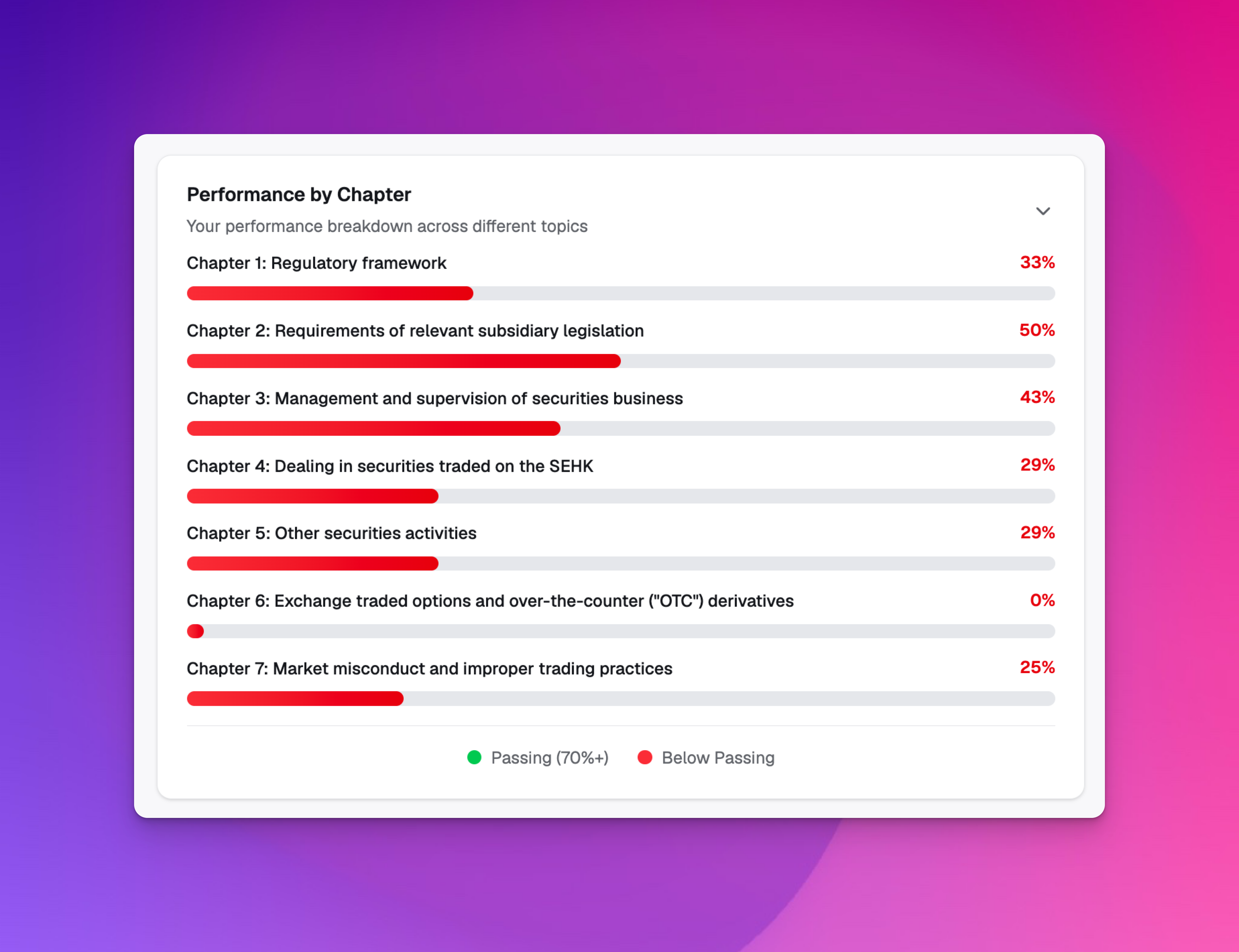
Track how you perform across all 7 chapters — know your weak spots before exam day
What These Questions Tell You About Paper 2
- Precision matters — regulatory questions hinge on specific numbers (6 months vs 9 months, HK$3 million threshold, 18-month suspension period)
- Rules have exceptions — the exam tests whether you know both the rule AND the exception (e.g., companies can dispense with AGMs by unanimous consent)
- Plausible distractors — wrong answers often sound reasonable (e.g., "the HKMA acts as sole registrar") but contain subtle errors
- Chapter 5 is detail-heavy — prospectus rules have multiple interacting requirements (valuation thresholds, audit periods, and the "all valuations" rule)
ExamPrep.hk offers HKSI Paper 2 practice questions with detailed explanations, chapter-by-chapter practice, performance tracking, and full mock exams.
Paper 2 is the regulatory companion for Type 1 (Dealing in Securities) licensing — typically paired with Paper 1, Paper 7, and Paper 8. If you're also sitting Paper 6 for asset management, there's overlap in the misconduct chapter.
Related guides:
HKSI Paper 2 Mock Questions FAQ
Ready to Put This Strategy Into Action? 💯
Join thousands of successful candidates who have passed their HKSI Paper 2 exam using our proven study methods.