
How to Pass HKSI Paper 6 Exam Hong Kong: Complete 2026 Study Guide
Master HKSI Paper 6 (Regulation of Asset Management) with our proven study strategy. Chapter 3 alone is 40% of the exam. Learn the chapter breakdown, study plan, and how to beat this tedious regulatory paper.
The HKSI LE Paper 6 — Regulation of Asset Management is the regulatory companion to Paper 12 (Asset Management). If you want to carry out SFC Type 9 regulated activities (asset management) in Hong Kong, Paper 6 covers the rules, compliance frameworks, and conduct standards you need to know.
(If you haven't registered yet, check our complete HKSI Paper 6 registration guide.)
What makes Paper 6 uniquely challenging isn't one big calculation — it's the sheer volume of regulatory detail. The average pass rate fluctuates between 50%–60%, making it one of the tougher HKSI LE specialist papers. The reason? Chapter 3 (Asset management regulations) alone accounts for 16 of 40 questions (40%), and candidates who underestimate the density of SFC codes, CIS requirements, and fund-management rules in that chapter are the ones who fail.
This guide gives you the 2026 exam strategy, a chapter-by-chapter breakdown with question weights, and a focused 2–3 week study plan to help you pass efficiently.
✨ TL;DR: The HKSI Paper 6 Passing Strategy
- The Scope: 4 Chapters covering regulatory framework, back-office compliance, asset management regulations, and misconduct.
- The Trap: Chapter 3 (Asset management regulations) alone is 40% of the exam — CIS rules, fund-management conduct, capital requirements, and SFC authorisation all concentrate here.
- The Score: You need 70% (28/40 questions) to pass. Pass rate fluctuates 50%–60% — this is a harder-than-average HKSI LE paper.
- The Strategy: Focus ~50% of your study time on Chapter 3. Chapters 1–3 together cover 36 out of 40 questions (90%).
Understanding the Exam: HKSI Paper 6 Format (2026)
HKSI LE stands for Hong Kong Securities Institute Licensing Examination, administered by HKSI. Paper 6 covers the regulation of asset management — the general regulatory framework, back-office compliance, specific asset management regulations, and misconduct provisions relevant to anyone dealing in or advising on asset management in Hong Kong.
| Full Name | Licensing Examination Paper 6 — Regulation of Asset Management |
| Questions | 40 Multiple Choice (MCQ) |
| Duration | 60 minutes |
| Passing Score | 70% (28 correct answers) |
| Wrong Answers Allowed | 12 questions |
| Format | Computer-based exam (CBE), English or Traditional Chinese |
| Calculator | Not permitted (Papers 1–6) |
| Exam Fee | HK$2,000 (Hong Kong) / HK$2,450 (Global Centres) |
| Frequency | Monthly |
| Syllabus | Updated for the 2026 syllabus |
(For a deeper dive into the scoring and format, read our HKSI Paper 6 Passing Score & Exam Format guide.)
The "Killer Chapter": Where Most Questions Come From
The difficulty of HKSI Paper 6 isn't evenly distributed. One chapter dominates, and three chapters together decide almost everything.
| Chapter | Topic | Questions | Weight |
|---|---|---|---|
| 1 | General regulatory framework | 10 | 25% |
| 2 | Back-office compliance | 10 | 25% |
| 3 | Asset management regulations ⚠️ | 16 | 40% |
| 4 | Misconduct | 4 | 10% |
Chapter-by-Chapter Breakdown
Chapter 1: General Regulatory Framework (10 questions, 25%)
This chapter covers the overall regulatory landscape — the SFO, licensing regime, and how Hong Kong's securities regulation works at the structural level.
Key topics to master:
- Securities and Futures Ordinance (SFO) structure and scope
- Definition of collective investment schemes (CIS) and key exclusions
- SFC licensing regime and Type 9 (asset management) regulated activity
- Fit and proper criteria for licensed persons
- Responsible officer requirements and ongoing obligations
Study tip: Focus on CIS definitions and exclusions — they appear frequently and the distinctions are precise. Knowing what is and isn't a CIS under the SFO is a classic exam question.
Chapter 2: Back-Office Compliance (10 questions, 25%)
This chapter covers the operational and compliance rules — client asset segregation, record-keeping, and the practical compliance obligations of an asset management firm.
Key topics to master:
- Client money and securities segregation rules
- Trust account requirements and withdrawal conditions
- Record-keeping obligations and retention periods
- Compliance monitoring and internal control requirements
- Anti-money laundering (AML) and know-your-client (KYC) obligations for asset managers
Study tip: Pay close attention to the rules on when and how client securities can be withdrawn from segregated accounts — this is a frequently tested area with precise conditions.
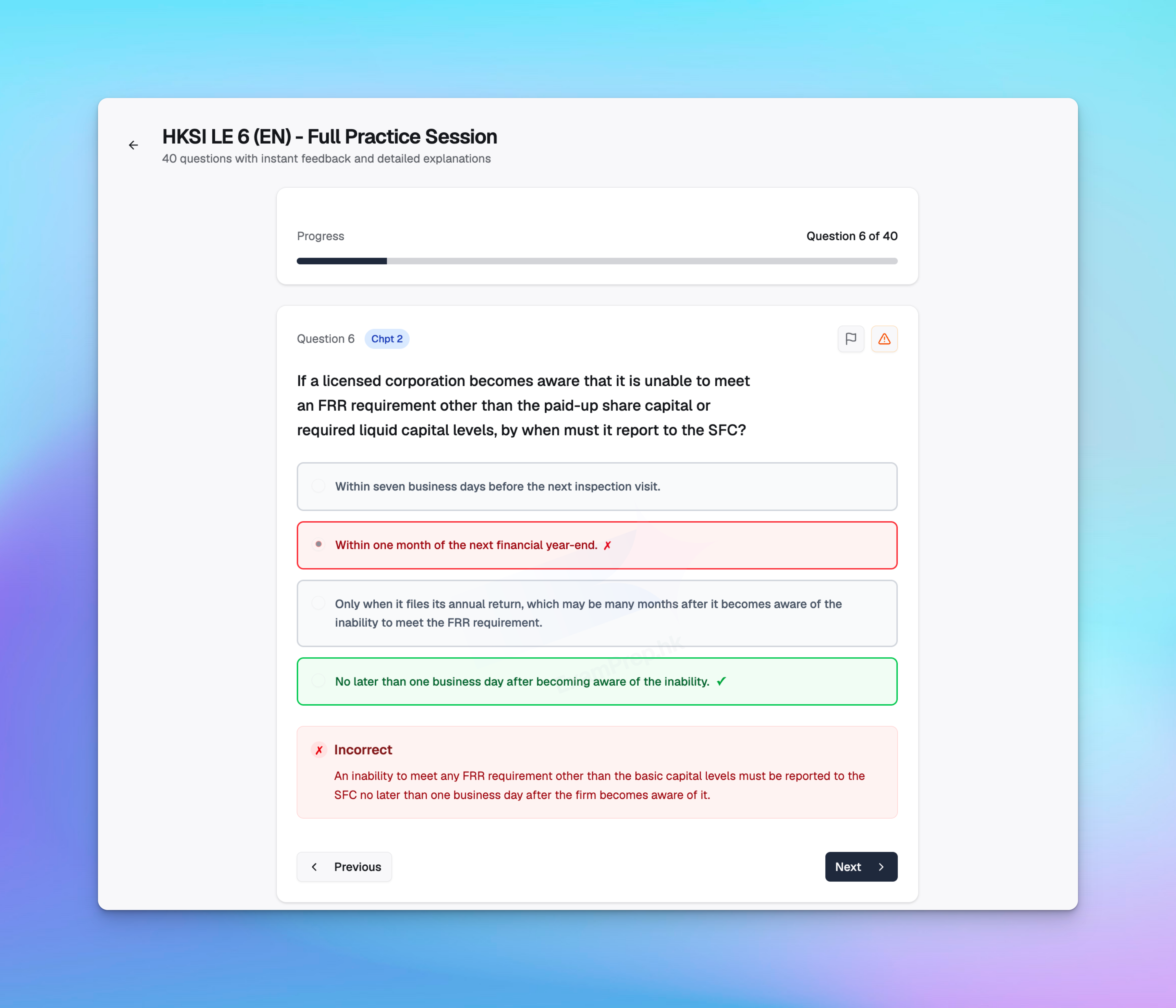
Get instant feedback with detailed explanations for each question on ExamPrep.hk — understand why each answer is correct
Chapter 3: Asset Management Regulations — THE KILLER CHAPTER (16 questions, 40%)
This is where Paper 6 is decided. Chapter 3 covers the specific regulations governing asset management firms, authorised CIS, fund-management conduct, and capital requirements.
Key topics to master:
- SFC Code on Unit Trusts and Mutual Funds — authorisation requirements
- Management company obligations: minimum paid-up share capital (HK$10 million), no material lending, positive net assets
- Fund manager conduct: best execution, soft dollar, churning restrictions
- Investment restrictions and mandate compliance
- Underwriting on behalf of a fund — commission and fee rules
- Conflicts of interest management and disclosure obligations
- Trustee and custodian independence and oversight
- Ongoing reporting and disclosure to the SFC
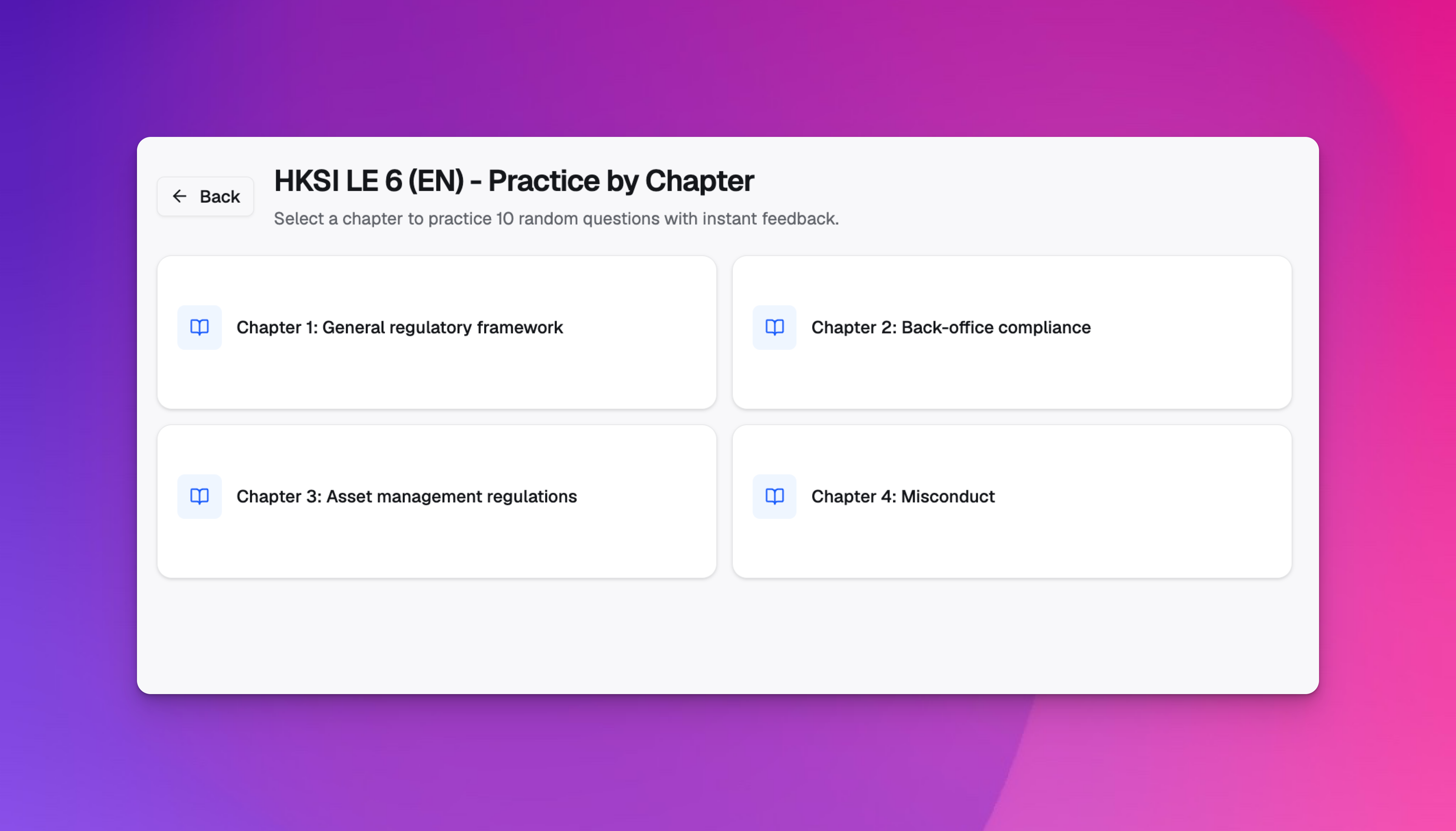
Practice questions organised by chapter — focus your efforts where they matter most
Study tip: Allocate at least 40–50% of your total study time here. Create a cheat sheet of key thresholds and rules (e.g. capital requirements, commission rules, independence rules) and drill them repeatedly.
Chapter 4: Misconduct (4 questions, 10%)
The lightest chapter by far, but still worth preparing — 4 free marks if you know the basics.
Key topics to master:
- Market misconduct under the SFO (insider dealing, market manipulation, false trading)
- Market Misconduct Tribunal (MMT) composition and powers
- Criminal vs civil proceedings for market misconduct
- SFC disciplinary powers and sanctions
- Penalties and consequences for licensed persons
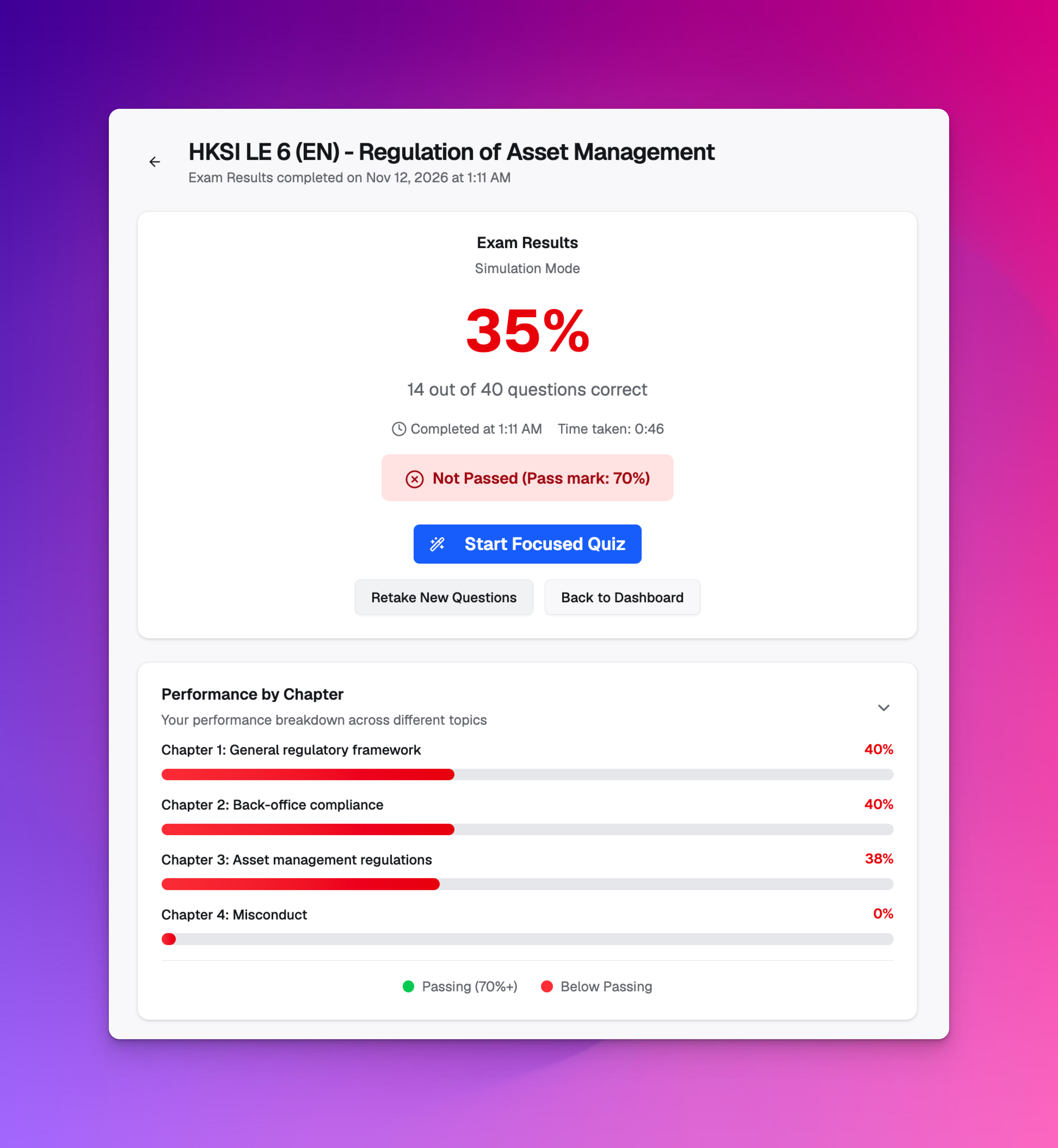
Track your performance by chapter to identify weak areas before exam day
Study tip: Don't skip Chapter 4, but don't over-invest. Learn the MMT composition (judge + 2 non-public-officer members, appointed by the Chief Executive) and the key misconduct categories. These are quick marks.
Your 2–3 Week Study Plan
Here's a realistic study plan assuming you can dedicate 1.5–2 hours per day, weighted heavily toward Chapter 3:
| Period | Focus | Activities |
|---|---|---|
| Days 1–3 | Chapter 1 | SFO structure, CIS definitions, licensing regime, Type 9 requirements. Build a foundation of the regulatory landscape. |
| Days 4–6 | Chapter 2 | Client asset segregation, trust accounts, withdrawal rules, record-keeping, AML/KYC. Practical compliance — memorise the conditions. |
| Days 7–13 | Chapter 3 (Killer) | Deep dive on CIS authorisation, management company rules, fund-manager conduct, capital requirements. This is 40% of the exam — give it 7 full days. |
| Day 14 | Chapter 4 | Market misconduct, MMT, SFC powers. Quick chapter — 1 day is enough for 4 questions. |
| Days 15–17 | Mock Exams | Full timed practice. Review wrong answers. Re-study weak areas — especially Chapter 3. |
| Days 18–19 | Final Review | Focus on Chapter 3 regulations and thresholds. Light review of Chapters 1–2. Quick Chapter 4 refresh. |
(Want to start practising immediately? Try our HKSI Paper 6 sample mock questions.)
Mock Exam Strategy
Mock exams are essential for Paper 6. The regulatory content is dense and tedious — the best way to retain it is through repeated exposure to exam-style questions.
How to use mock exams effectively:
- First mock (Day 15): Take under exam conditions — 40 questions, 60 minutes, no calculator, no notes. This establishes your baseline.
- Review phase: For every wrong answer, go back to the source material. Don't just memorise the correct answer — understand the underlying rule or regulation.
- Second mock (Day 17): Take another full mock. Your score should improve by 10–15%.
- Targeted practice: Do chapter-specific question sets for Chapter 3, then Chapters 1 and 2, until you consistently clear 75%+.
(For a comparison of the best preparation resources, see our HKSI Paper 6 mock exam and study guide comparison.)
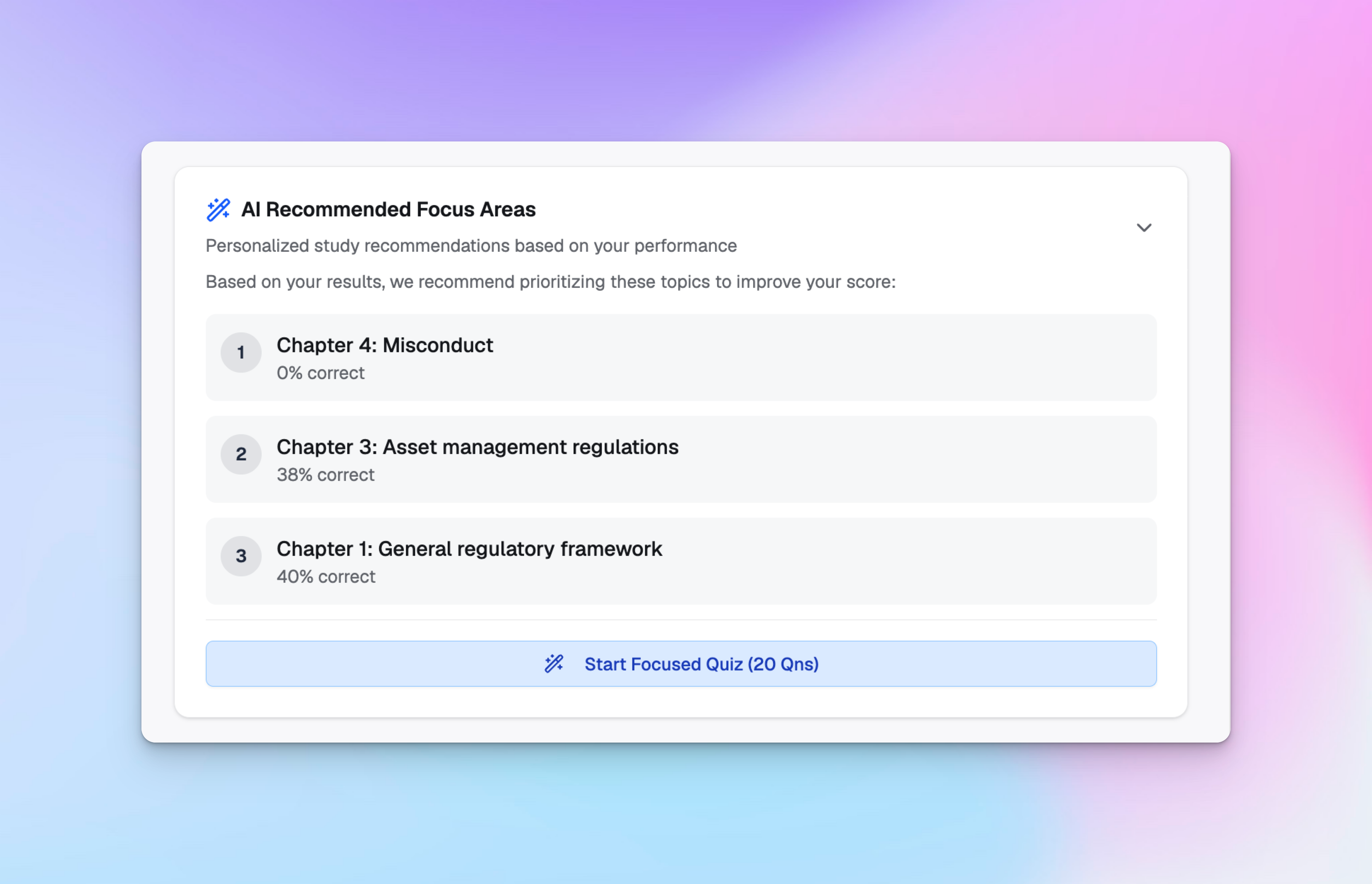
AI-powered recommendations help you focus on the topics that will improve your score fastest
Exam Day Tips
- No calculator needed. Paper 6 is a purely regulatory exam with virtually no calculations. Don't worry about maths.
- Time management: You have 1.5 minutes per question. Regulatory recall questions should be quick — flag anything you're unsure about and return to it.
- Watch for precise wording. Regulatory questions often hinge on a single word — "must" vs "may", "prior written consent" vs "notification", or exact thresholds like HK$10 million.
- Chapter 3 questions will dominate. Expect roughly 16 of your 40 questions to be Chapter 3. Pace yourself — don't rush these.
- Arrive 30 minutes early. CBE centres require ID verification and system setup.
How Paper 6 Relates to Other HKSI Papers
Paper 6 is the regulatory half of the Type 9 (Asset Management) licensing requirement. If you're pursuing a Type 9 licence, you'll typically need:
- Paper 1 — Fundamentals of Securities and Futures Regulation (the core paper everyone needs)
- Paper 6 — Regulation of Asset Management (the regulatory specialist paper — this one)
- Paper 12 — Asset Management (the technical/business specialist paper)
If you've already passed Paper 1, Paper 6 builds on that regulatory foundation with asset-management-specific rules. If you've passed Paper 12, Paper 6 is the regulatory complement — Paper 12 covers the investment process, Paper 6 covers the rules governing that process.
Also preparing for other HKSI papers? See our guides for Paper 7, Paper 8, and Paper 9.
Ready to Start Preparing?
The most efficient path to passing HKSI Paper 6 is structured practice with immediate feedback. Regulatory content is best learnt through repeated question exposure — not just reading the manual.
Related guides:
Frequently Asked Questions About HKSI Paper 6
Ready to Put This Strategy Into Action? 💯
Join thousands of successful candidates who have passed their HKSI Paper 6 exam using our proven study methods.