
Is HKSI Paper 12 Difficult? What the Official Pass Rates and Syllabus Show (2026)
HKSI Paper 12's official pass rate averaged 74.19% from October 2025 to September 2026 — higher than Papers 1, 7, 8 and 9 — yet monthly results ranged from 52.94% to 100%. Here is where candidates actually lose marks.
"Is HKSI Paper 12 difficult?" The honest answer is that it's one of the more passable HKSI Licensing Examination papers — but not one you can walk into unprepared.
On HKSI Institute's own figures, about three in four candidates pass. But the published monthly rate has dropped as low as 52.94%, and the marks people lose tend to come from the same few places: return calculations that look like theory questions, CAPM and valuation models, and the "which step comes first" judgement questions in the investment management process.
Short answer
- Pass rate: HKSI's monthly figures from October 2025 to September 2026 average 74.19% — the highest of Papers 1, 7, 8, 9 and 12.
- But it varies: individual months ranged from 52.94% to 100%, and April to September 2026 averaged about 70%.
- Where it gets hard: Topic 3 (portfolio theory and calculations) and Topic 4 (the investment management process).
- Margin for error: 12 wrong answers out of 40. The 13th wrong answer is a fail.
The Evidence: Official Pass Rates Compared
HKSI Institute publishes monthly pass rates for every LE paper on its Pass Rate for LE in Hong Kong page. Ranking the papers most often taken alongside Paper 12:
| Paper | Average pass rate | Lowest month | Highest month |
|---|---|---|---|
| Paper 12 — Asset Management | 74.19% | 52.94% | 100.00% |
| Paper 7 — Financial Markets | 67.01% | 59.47% | 87.50% |
| Paper 8 — Securities | 65.38% | 55.56% | 88.89% |
| Paper 9 — Derivatives* | 56.94% | 28.57% | 73.33% |
| Paper 1 — Fundamentals of Securities and Futures Regulation | 49.98% | 44.24% | 61.84% |
Averages cover October 2025 to September 2026. *Paper 9's latest 12 published months are November 2024 plus October 2025 to September 2026, with no figure for November 2025.
Two things stand out. First, Paper 12 is clearly the most passable paper in this group. Second, Paper 12 also has the widest spread of the five, partly because of three unusually strong months (100% in November 2025, 95% in December 2025 and 87.10% in January 2026). From February 2026 onwards, every month except March (52.94%) has fallen between about 61% and 76%. HKSI publishes percentages only, not candidate numbers, so treat any single month with caution.
Why Paper 12's Pass Rate Is Higher
Two structural features of the paper help explain the gap. Neither means the content is trivial.
- It's a short paper. 40 questions in 60 minutes, compared with 60 questions in 90 minutes for Papers 1 and 7. The time per question is the same, but there is less ground to cover.
- It's a concepts paper, not a rules paper. Asset management regulation is examined separately — in Paper 6, which Type 9 responsible officers must take. Paper 12 tests how the industry works, portfolio theory and the investment process. There are fewer section numbers and time limits to memorise, but more ideas you have to actually understand.
Where Candidates Lose Marks
HKSI doesn't publish an official question split by topic. The v3.7 syllabus (effective from 1 November 2024) does list Expected Learning Outcomes for each topic, and those outcomes line up closely with the questions candidates report finding hardest.
1. Return calculations dressed up as theory (Topic 3)
The syllabus expects you to "calculate returns using various methods and explain how tax and inflation affect returns", and to "differentiate between and calculate nominal and effective returns". These look like definitions until a number appears in the question.
Worked example — after tax and after inflation: A bond yields 8% before tax, the tax rate is 20% and inflation is 2%. After-tax return = 8% × (1 − 0.20) = 6.4%. Real after-tax return = (1.064 ÷ 1.02) − 1 ≈ 4.31%. The quick approximation, 6.4% − 2% = 4.4%, may sit right next to it as a distractor.
2. CAPM, beta and the security market line (Topic 3)
You must "apply CAPM and describe its assumptions, limitations, and practical applications". The formula is simple; the traps are in the interpretation.
Also know which risk CAPM rewards: only systematic (market) risk, measured by beta. Unsystematic risk can be diversified away, so it earns no premium — a favourite true/false-style statement.
3. Models that sound alike (Topic 3)
The syllabus asks you to "apply and assess the APT and the P/B-ROE valuation model" and to explain the efficient market hypothesis (EMH) and the random walk hypothesis. Common confusions:
- CAPM vs APT: CAPM uses a single factor (the market). APT allows multiple macroeconomic factors.
- P/B-ROE: the model links a stock's price-to-book ratio to its return on equity relative to the required return. A company earning an ROE above its cost of equity should trade above book value.
- EMH forms: weak form (past prices are already reflected, so technical analysis can't consistently win), semi-strong (all public information is reflected) and strong (even private information is reflected).
- Indifference curves vs the efficient frontier: the curves describe the investor's preferences; the frontier describes the market's best available portfolios. The optimal portfolio is where the two meet.
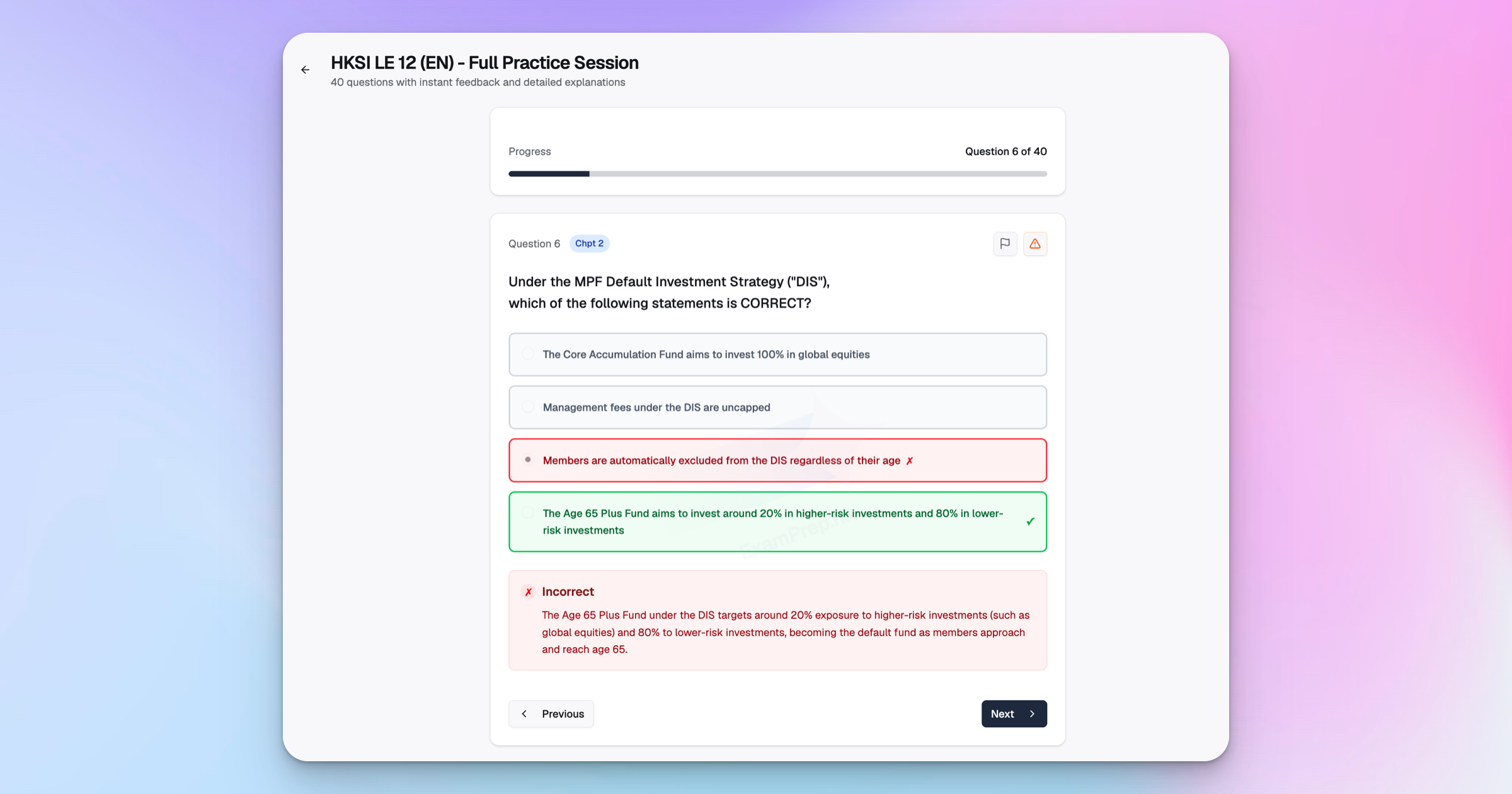
Every explanation shows why the distractors are wrong, not just which answer is right
4. Process and judgement questions (Topic 4)
Topic 4 is where "I recognise this word" stops being enough. The syllabus expects you to:
- identify the four key steps of the investment management process, and explain how the review step can lead to revisions at each earlier step;
- distinguish strategic asset allocation (the long-term policy mix) from tactical asset allocation (deliberate short-term deviations from it);
- compare active vs passive management, including passive allocation using indexing;
- evaluate a fund manager using qualitative, quantitative and attribution analysis — attribution splits performance into asset-allocation and security-selection effects;
- describe what fund research houses and rating agencies contribute to manager selection.
These questions are usually worded "which should be done first", "which is most appropriate" or "which statement is correct". Read every option before answering, because two may be partly right.
5. Breadth in Topics 1 and 2
These are the more recall-based topics, but the v3.7 syllabus is broad. It covers the different types of professional investors, closed-ended vs open-ended funds, guaranteed, money market, property and multi-asset funds, ESG investing, and an asset-class list that now explicitly includes virtual assets. Skipping "easy" topics is how candidates who understood the theory still end up on 26 or 27.
Difficulty by Topic
| Topic | Difficulty | Why |
|---|---|---|
| 1. Asset management industry | Low–medium | Definitions and participant roles; easy marks if you have revised them |
| 2. Client objectives and products | Medium | Broad product coverage plus short client-suitability scenarios |
| 3. Portfolio theory | High | Calculations, plus several models that are easy to mix up |
| 4. Investment management process | High | Judgement-style questions; most questions in our bank come from this topic |
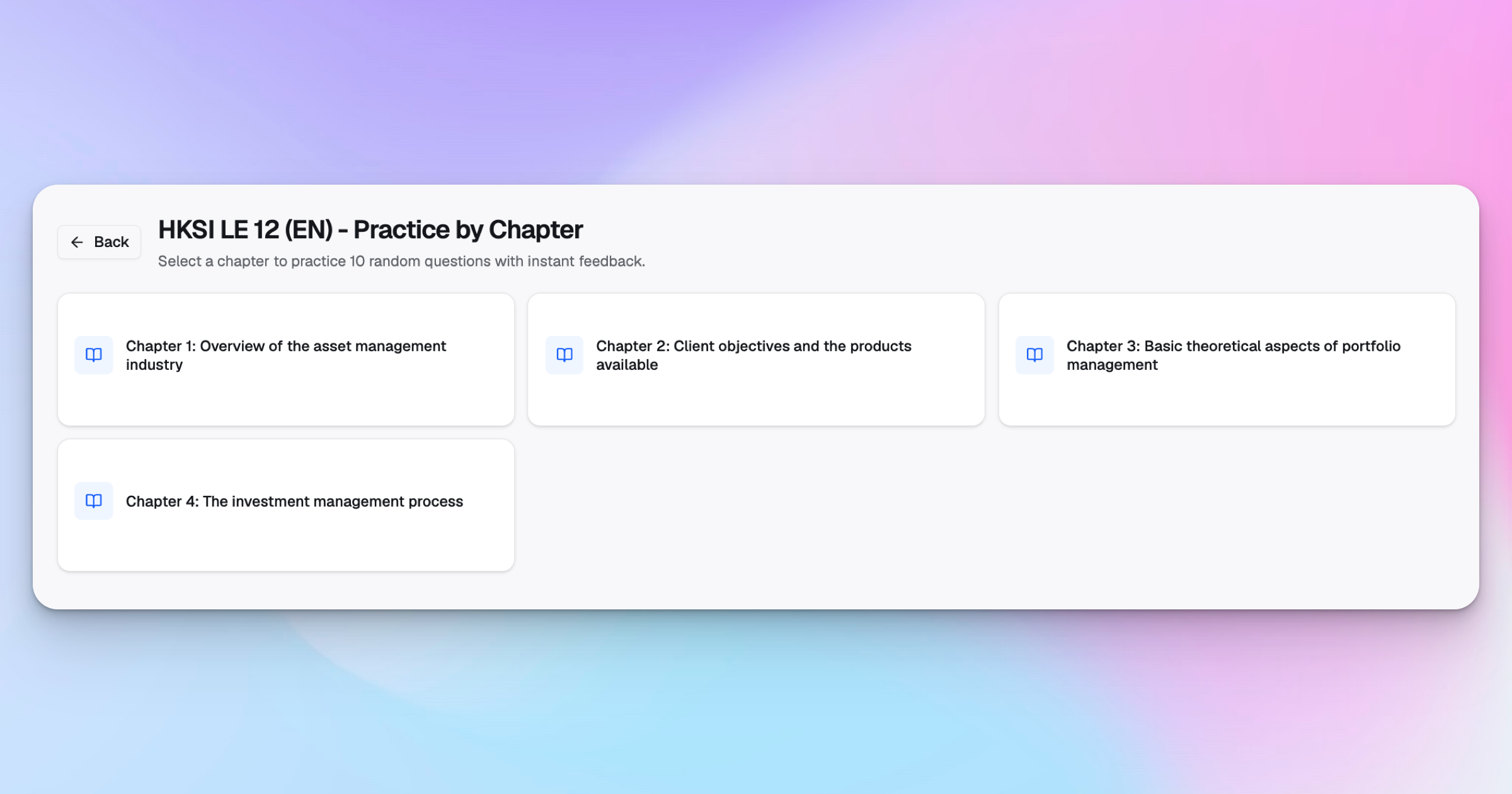
Drill Topics 3 and 4 separately until your accuracy is consistently above 80%
How to Make Paper 12 Feel Easy
- Read the official syllabus first. The v3.7 syllabus PDF is seven pages long. Use the Expected Learning Outcomes as a checklist.
- Study from the current eStudy Guide. It's provided free once you enrol and stays accessible until your exam date.
- Practise Topic 3 calculations with the calculator you'll actually use — including the onscreen calculator provided in the exam system.
- Write out the four-step investment management process from memory, then explain what feedback from the review step can change at each stage.
- Do HKSI's free sample practice test and at least two full timed mocks. Aim for 32/40 or better before booking your sitting.
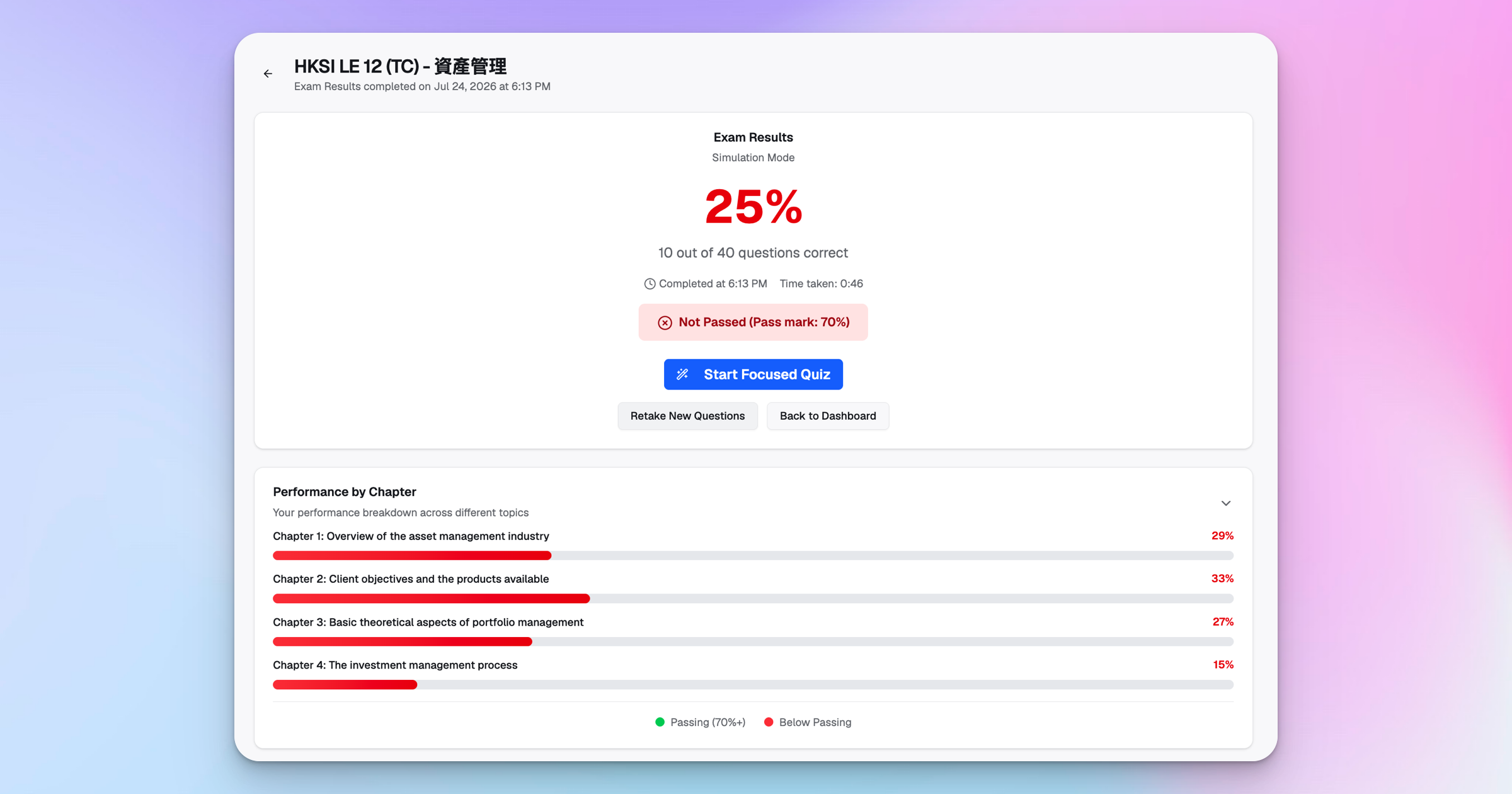
Your topic-level accuracy shows whether you're exam-ready or just familiar with the material
Is Paper 12 Harder Than Paper 9 or Paper 8?
On HKSI's published pass rates, no. Paper 12 (74.19%) averaged well above Paper 8 (65.38%) and Paper 9 (56.94%). Paper 9 is the more calculation-heavy paper, with futures, options and interest-rate derivatives maths throughout. Paper 12's calculations are concentrated in Topic 3.
If you're aiming for a Type 9 licence you'll also need Paper 7 (Financial Markets), which is 60 questions in 90 minutes and averaged 67.01%. On those numbers, Paper 7 is the bigger hurdle of the two for most candidates. See our guides to Paper 8 and Paper 9 if you're comparing options.
The Verdict
Paper 12 rewards understanding over memorisation. Candidates who can do the Topic 3 calculations and explain the Topic 4 process in their own words usually pass. Candidates who rely on a high pass rate and skim the theory make up the quarter who don't.
Related guides:
HKSI Paper 12 Difficulty — FAQ
Ready to Put This Strategy Into Action? 💯
Join thousands of successful candidates who have passed their HKSI Paper 12 exam using our proven study methods.