
HKSI Paper 12 Mock Questions with Worked Answers: Asset Management Practice (2026)
Five HKSI Paper 12 mock questions covering unit trusts, bond yields, diversification, indifference curves and tactical asset allocation — each with working and why the wrong options are wrong.
HKSI Paper 12 (Asset Management) has the highest pass rate of the practical papers — HKSI's published monthly figures from October 2025 to September 2026 average 74.19%. But individual months have ranged from 52.94% to 100%, and the candidates who fail usually come unstuck on portfolio theory and the investment management process.
The five practice questions below cover all four chapters. For each one we show the answer, the working where there's a calculation, and why each wrong option is wrong.
Not sure how the exam works? Read our HKSI Paper 12 Passing Score & Format guide first.
📝 HKSI Paper 12 at a Glance
- Questions: 40 multiple-choice questions in 60 minutes
- Pass mark: 70% — you need 28 correct answers
- Chapters: 4, with Chapters 3 and 4 carrying 24 of the 40 questions
- Syllabus: Version 3.7, effective from 1 November 2024
- Calculator: an approved calculator is allowed (Papers 7–12)
Chapter 1: Overview of the Asset Management Industry
Question 1:
Which of the following BEST describes the key legal distinction between a unit trust and a mutual fund in Hong Kong?
- A: A unit trust has shareholders, while a mutual fund has unit holders
- B: A unit trust is set up as a limited company, while a mutual fund is established as a trust
- C: A unit trust is established as a trust with a trustee, while a mutual fund is set up as a limited company
- D: Both are established in exactly the same legal form under the Companies Ordinance
Show Answer & Explanation
Answer: C
A unit trust is formed under a trust deed, with a trustee holding the assets for unit holders. A mutual fund is a limited company whose investors are shareholders, with the assets held by a custodian.
Why the other options are wrong
- A and B — both swap the two structures round. Unit trusts have unit holders; mutual funds have shareholders.
- D — the whole point of the question is that their legal forms differ.
Key Concept: Unit Trust vs Mutual Fund
| Unit trust | Mutual fund | |
|---|---|---|
| Legal form | Trust, created by a trust deed | Limited company |
| Investors hold | Units | Shares |
| Assets held by | Trustee | Custodian |
Memory trick: the name tells you the structure — a unit trust has a trustee and units.
Chapter 2: Client Objectives and the Products Available
Question 2:
A bond has a face value of HKD1,000, an annual coupon rate of 7% and a current market price of HKD1,050. What is the bond's current yield?
- A: 6.25%
- B: 7.00%
- C: 7.35%
- D: 6.67%
Show Answer & Explanation
Answer: D
Current yield = annual coupon ÷ current market price = (7% × HKD1,000) ÷ HKD1,050 = HKD70 ÷ HKD1,050 = 6.67%.
Where the wrong answers come from
- B (7.00%) — that's the coupon rate, which ignores the price you pay for the bond.
- C (7.35%) — multiplies by the price ratio (7% × 1.05) instead of dividing.
- A (6.25%) — doesn't correspond to the current-yield formula.
🧮 Worked Calculation: Current Yield
- Annual coupon in dollars: 7% × HKD1,000 = HKD70
- Divide by the market price, not the face value: 70 ÷ 1,050 = 0.0667
- Current yield: 6.67%
Sense check: the bond trades at a premium (above face value), so the current yield must be below the 7% coupon rate. For a premium bond, coupon rate > current yield > yield to maturity. For a discount bond, the order reverses.
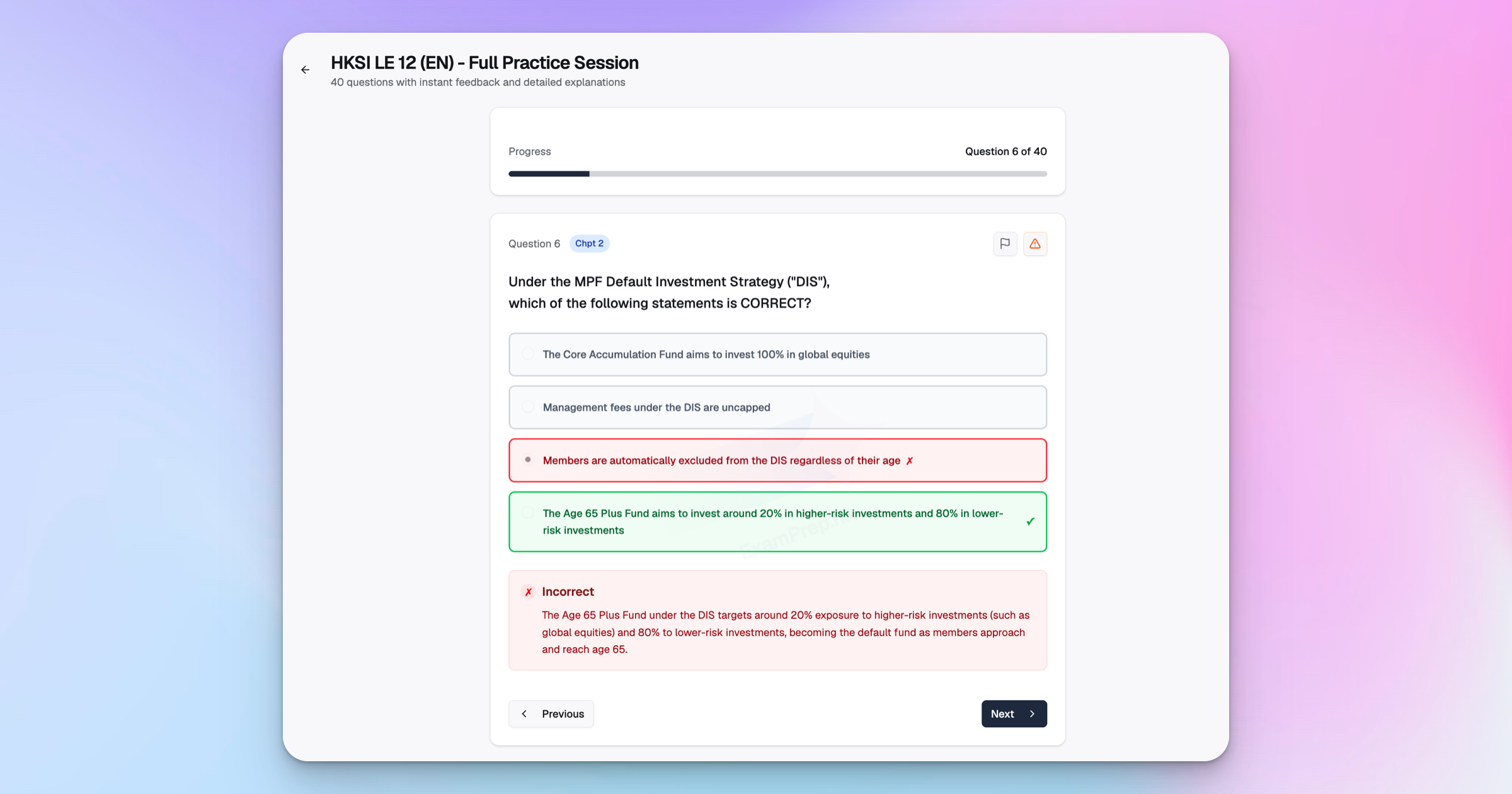
ExamPrep.hk provides instant feedback with detailed explanations for every question.
Chapter 3: Basic Theoretical Aspects of Portfolio Management
Question 3:
Mr. Lam already holds a global equity fund and a global bond fund. Which ONE of the following additional funds would BEST provide him with further diversification benefits?
- A: A passively managed exchange-traded fund tracking the Vietnamese stock market.
- B: An Eastern European bond fund following a liability-driven strategy.
- C: A gold fund investing in a basket of gold-mining company stocks.
- D: A hedge fund adopting market-neutral strategies.
Show Answer & Explanation
Answer: D
A market-neutral hedge fund aims to generate returns independent of the direction of broad equity and bond markets. That gives it the lowest correlation — and so the greatest diversification benefit — relative to Mr. Lam's existing global equity and bond funds.
Why the other options are wrong
- A — a Vietnamese equity ETF is still equity exposure, and tends to move with global equities.
- B — an Eastern European bond fund is still bonds, overlapping with his global bond fund.
- C — gold-mining shares are equities. They're linked to the gold price, but also move with the stock market.
Key Concept: Diversification Is About Correlation
- Adding an asset reduces portfolio risk most when its returns have low or negative correlation with what you already hold.
- A different country or region is not automatically diversification — the asset class matters more.
- Exam tip: when an option sounds exotic, ask what it really is underneath. "Gold fund" here turns out to mean equities.
Question 4:
Which best describes the preference of an aggressive investor when comparing indifference curves at the same level of risk?
- A: They prefer the lowest indifference curve, because of the highest return
- B: They prefer the highest indifference curve, because of the lowest risk
- C: They prefer lower indifference curves, because of lower risk
- D: They prefer the highest indifference curve, because it offers the highest return
Show Answer & Explanation
Answer: D
At a given level of risk, any rational investor — aggressive or conservative — prefers the curve offering the highest expected return, which is the highest indifference curve.
Why the other options are wrong
- A and C — lower curves mean lower return at the same risk, which no rational investor prefers.
- B — the question fixes risk at the same level, so "lowest risk" can't be the reason.
Key Concept: Reading Indifference Curves
- Each curve joins risk–return combinations that give an investor the same satisfaction (utility). Higher curves = higher utility.
- Risk tolerance changes the slope, not the preference for higher curves. A conservative investor's curves are steep (they demand a lot of extra return for extra risk); an aggressive investor's are flatter.
- The optimal portfolio is where the highest attainable indifference curve touches the efficient frontier.
Pssst.. ExamPrep.hk has instant feedback and explanations to help you easily digest and understand the logic and concept behind each question.
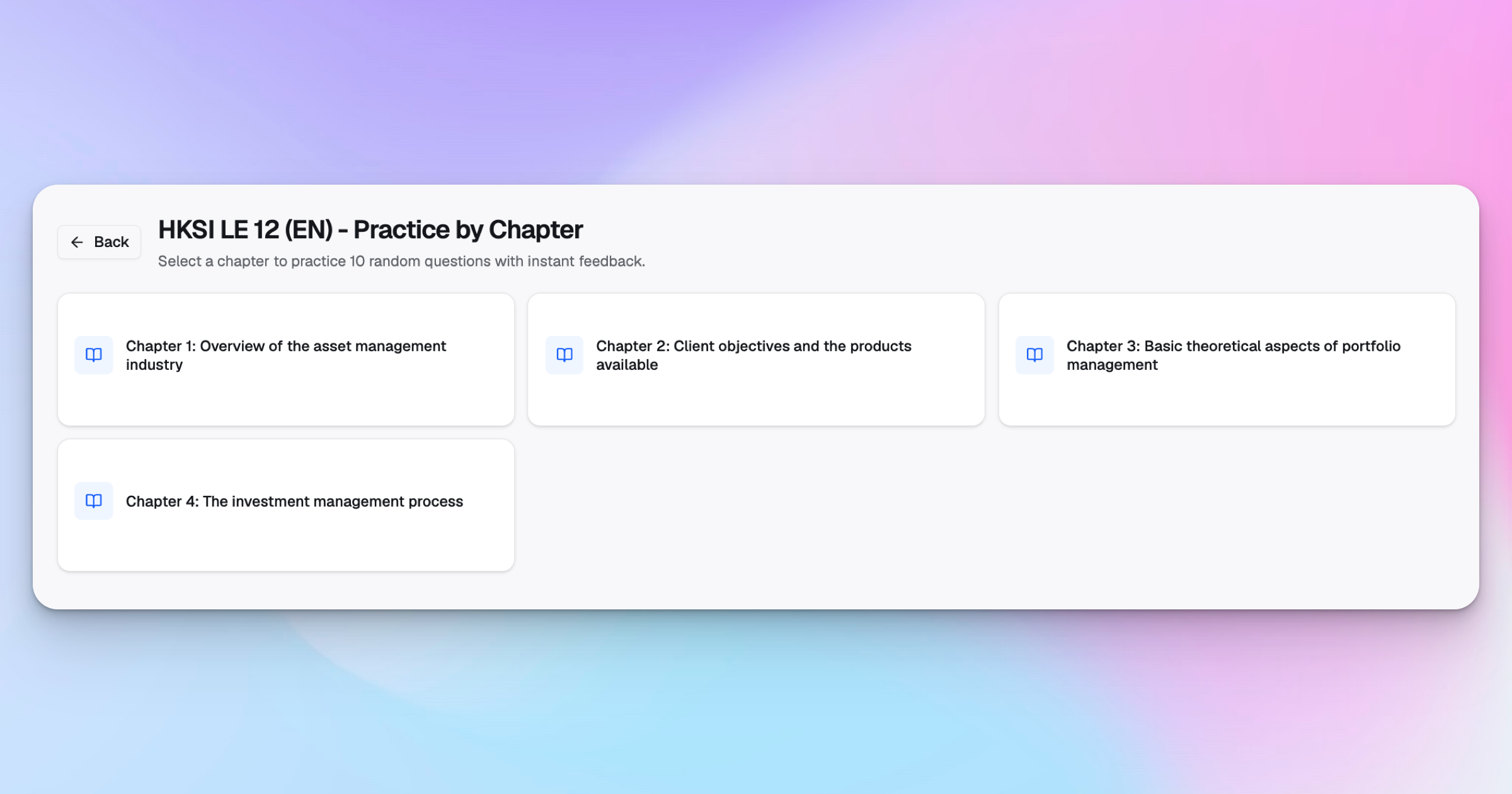
ExamPrep.hk's Practice by Chapter feature helps you focus on specific chapters and track your performance.
Chapter 4: The Investment Management Process
Question 5:
A fund manager decides to reduce the equity allocation within a portfolio ahead of an anticipated interest rate decision. This is a decision relating to:
- A: Aggressive asset allocation
- B: Tactical asset allocation
- C: Strategic asset allocation
- D: Passive asset allocation
Show Answer & Explanation
Answer: B
A short-term tilt in response to an anticipated near-term event, rather than a change to the portfolio's long-term target mix, is tactical asset allocation.
Why the other options are wrong
- A — "aggressive asset allocation" is not a standard asset allocation strategy.
- C — strategic asset allocation sets the long-term policy mix from the client's objectives. It doesn't react to a single rate decision.
- D — passive allocation (such as indexing) deliberately avoids market-timing calls like this one.
Key Concept: Strategic vs Tactical Asset Allocation
- Strategic (SAA): the long-term target mix, set from the client's return objectives, risk tolerance and constraints.
- Tactical (TAA): temporary deviations from that mix to profit from expected short-term market moves.
- Clue words: "ahead of", "anticipated" and "short-term" point to tactical; "long-term", "policy" and "objectives" point to strategic.
- Chapter 4 is the heaviest chapter (13 of 40 questions), so allocation questions like this are worth getting right.
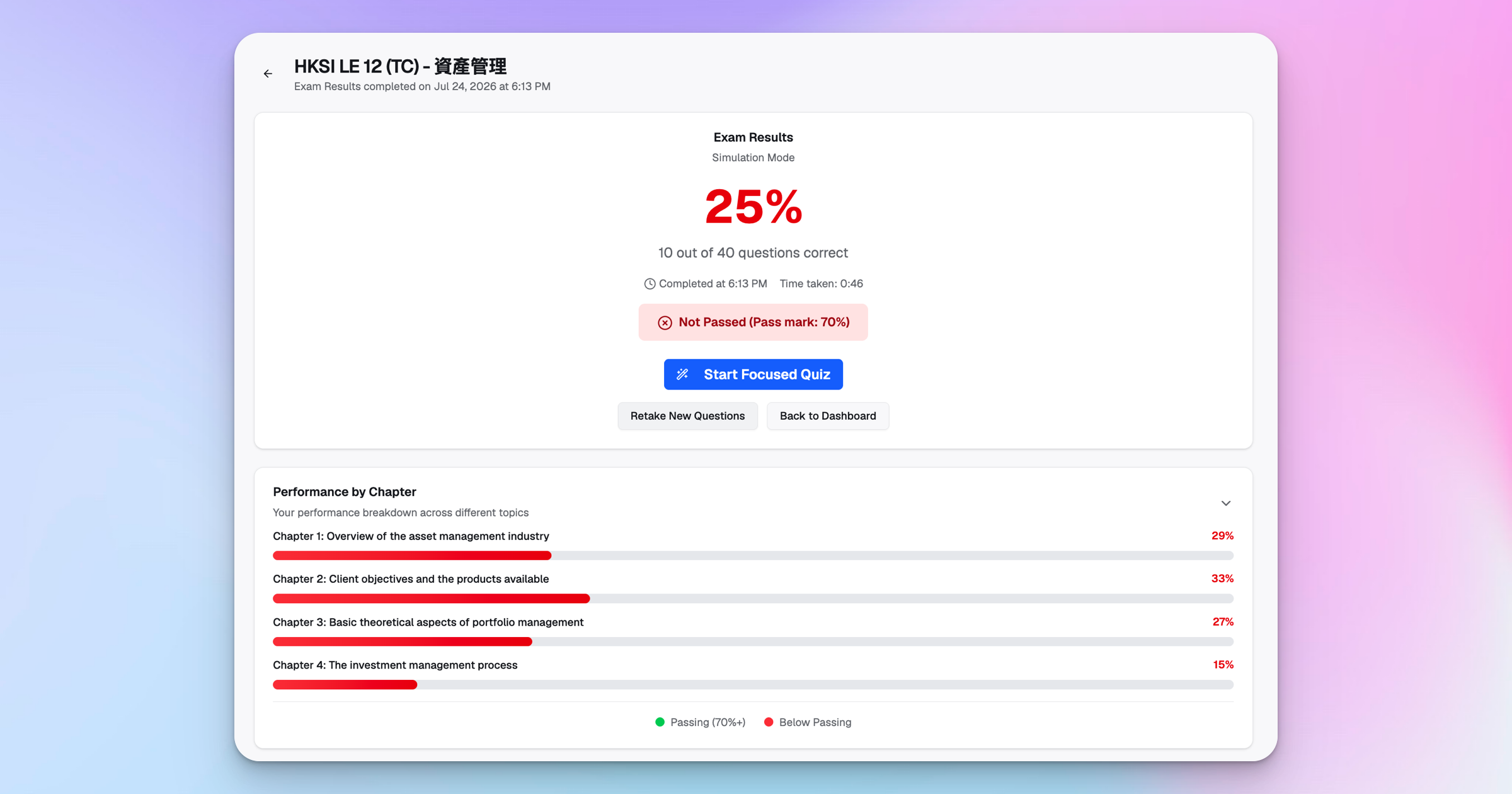
ExamPrep.hk's Performance by Chapter feature tracks your performance by chapter and highlights your strengths and weaknesses.
Where the Marks Are in HKSI Paper 12
| Chapter | Topic | Questions |
|---|---|---|
| Chapter 4 | The investment management process | 13 (32.5%) |
| Chapter 3 | Basic theoretical aspects of portfolio management | 11 (27.5%) |
| Chapter 2 | Client objectives and the products available | 9 (22.5%) |
| Chapter 1 | Overview of the asset management industry | 7 (17.5%) |
Chapters 3 and 4 together are 60% of the paper. If you score only 50% on Chapter 4, you need about 78–81% everywhere else to pass — see the full breakdown in our HKSI Paper 12 difficulty analysis.
How to Use These Questions Effectively
💡 Study Tips
- 1. Look underneath the label — questions like Question 3 reward asking what an asset really is, not what it's called.
- 2. Sense-check calculations — a premium bond must yield less than its coupon. A quick check catches most arithmetic slips.
- 3. Watch the clue words — "ahead of", "long-term", "same level of risk" usually decide Chapter 3 and 4 questions.
- 4. Practise under time pressure — 40 questions in 60 minutes leaves 1.5 minutes each.
What to Study Next
- HKSI Paper 12 Study Guide — a focused study plan and chapter breakdown
- HKSI Paper 12 Difficulty Analysis — why Chapter 4 decides most results
- Passing Score & Exam Format — the exam structure in full
- Register for Paper 12 — step-by-step booking guide
- Compare study resources — find the right tools
Want More Practice Questions?
These 5 questions are just a sample. ExamPrep.hk offers 500+ HKSI Paper 12 practice questions with:
- Detailed explanations for every question
- Chapter-by-chapter practice mode
- Performance tracking by chapter
- Full 40-question mock exams under timed conditions
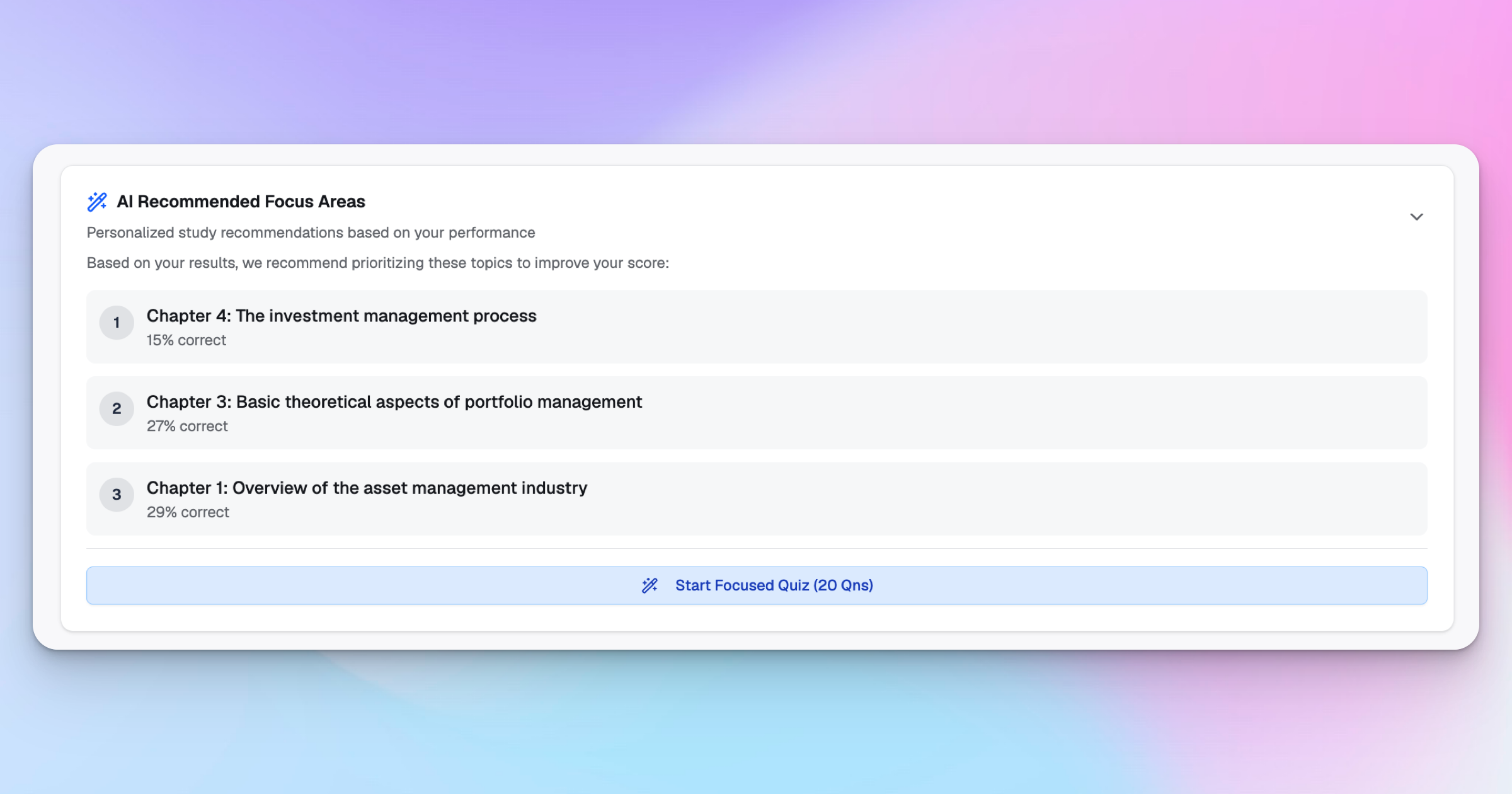
ExamPrep.hk's AI Focus Areas feature helps you focus your study time on your weakest areas.
HKSI Paper 12 Mock Questions — FAQ
Ready to Put This Strategy Into Action? 💯
Join thousands of successful candidates who have passed their HKSI Paper 12 exam using our proven study methods.