
Is IIQE Paper 5 Difficult? The Hardest IIQE Paper Explained
With a ~53% pass rate, Paper 5 is widely considered the hardest IIQE paper. Learn why technical financial terminology, complex ILAS concepts, and dual regulation make it so challenging.
Think you can breeze through IIQE Paper 5 because you've already passed Papers 1 or 3?
Think again. With a pass rate of approximately 53%, IIQE Paper 5 (Investment-Linked Long Term Insurance) holds the distinction of being the hardest IIQE paper. Nearly half of all candidates fail on their first attempt.
⚠️ Why Paper 5 Is the Hardest IIQE Paper
Unlike other IIQE papers that test insurance concepts, Paper 5 demands deep financial knowledge — bonds, equities, derivatives, fund structures — combined with mastery of technical terminology (Sharpe ratio, yield curves, NAV, coupon rates) and understanding of a dual regulatory framework (Insurance Authority + Securities and Futures Commission). It's essentially an insurance exam and an investment exam rolled into one.
IIQE Paper 5 Pass Rate: The Numbers
The pass rate for IIQE Paper 5 is approximately 53% — one of the lowest among all IIQE papers. This means roughly 1 in 2 candidates fail on their first attempt.
| Pass Rate | ~53% (one of the lowest among IIQE papers) |
| Passing Score | 70% (56/80 questions) |
| Questions | 80 MCQs in 120 minutes |
| Exam Fee | HK$390 (CSME) |
| Margin for Error | Only 24 wrong answers allowed |
With 80 questions and a 70% passing threshold, you can only afford to get 24 questions wrong. Given that 53 of those questions come from the two most technically demanding chapters, the margin for error is razor-thin.
How Does Paper 5 Compare to Other IIQE Papers?
| Feature | IIQE Paper 1 | IIQE Paper 2 | IIQE Paper 3 | IIQE Paper 5 |
|---|---|---|---|---|
| Subject | Principles & Practice | General Insurance | Long Term Insurance | Investment-Linked Insurance |
| Questions | 75 | 50 | 50 | 80 |
| Duration | 2 hours | 1 hr 15 min | 1 hr 15 min | 2 hours |
| Chapters | 7 | 5 | 5 | 5 |
| Pass Rate | Moderate | ~56% | ~51% | ~53% |
| Technical Depth | Moderate | Moderate | Moderate | Very High |
| Technical Terminology | Moderate | Moderate | Moderate | Very High |
Paper 5 stands out because it combines the volume of Paper 1 (80 questions) with technical complexity far exceeding any other IIQE paper.
The Three Reasons Paper 5 Is the Hardest
1. Technical Financial Concepts (Chapter 3)
Unlike other IIQE papers that focus on insurance principles, Paper 5 requires genuine investment knowledge. Chapter 3 alone carries 27 questions (33.75%) and covers:
- Debt Securities: Bond pricing, par value, coupon rates, yield curves, credit ratings
- Equities: Stock exchanges, market indexes, fundamental analysis, technical analysis, dividends
- Financial Derivatives: Forwards, futures, options, warrants — and how they work
- Investment Funds: Mutual funds, unit trusts, open-end vs closed-end funds, NAV
- Other Assets: Real estate, money market instruments, low liquidity investments
This is effectively a mini investment exam within an insurance qualification. If you've never studied finance, this chapter alone can be overwhelming.
2. ILAS Policy Mechanics & Sales Practice (Chapter 4)
Chapter 4 carries 27 questions (33.75%) and tests your understanding of how investment-linked policies actually work:
- Policy Structures: Single premium vs regular premium plans, and how they differ
- Types of Charges: Understanding the various fees that erode policy value over time
- Key Concepts: Premium application methods, top-ups, partial withdrawals, surrender value, death benefit
- Fund Structures: Unitised funds, deposit funds, switching between funds
- Sales Practice Regulations: Cooling-off periods, principal brochures, policy replacement rules, GL25 gifts guideline
The challenge here is the sheer volume of technical terms and regulatory requirements you need to memorise — from specific charge types to detailed customer protection rules under ILAS.
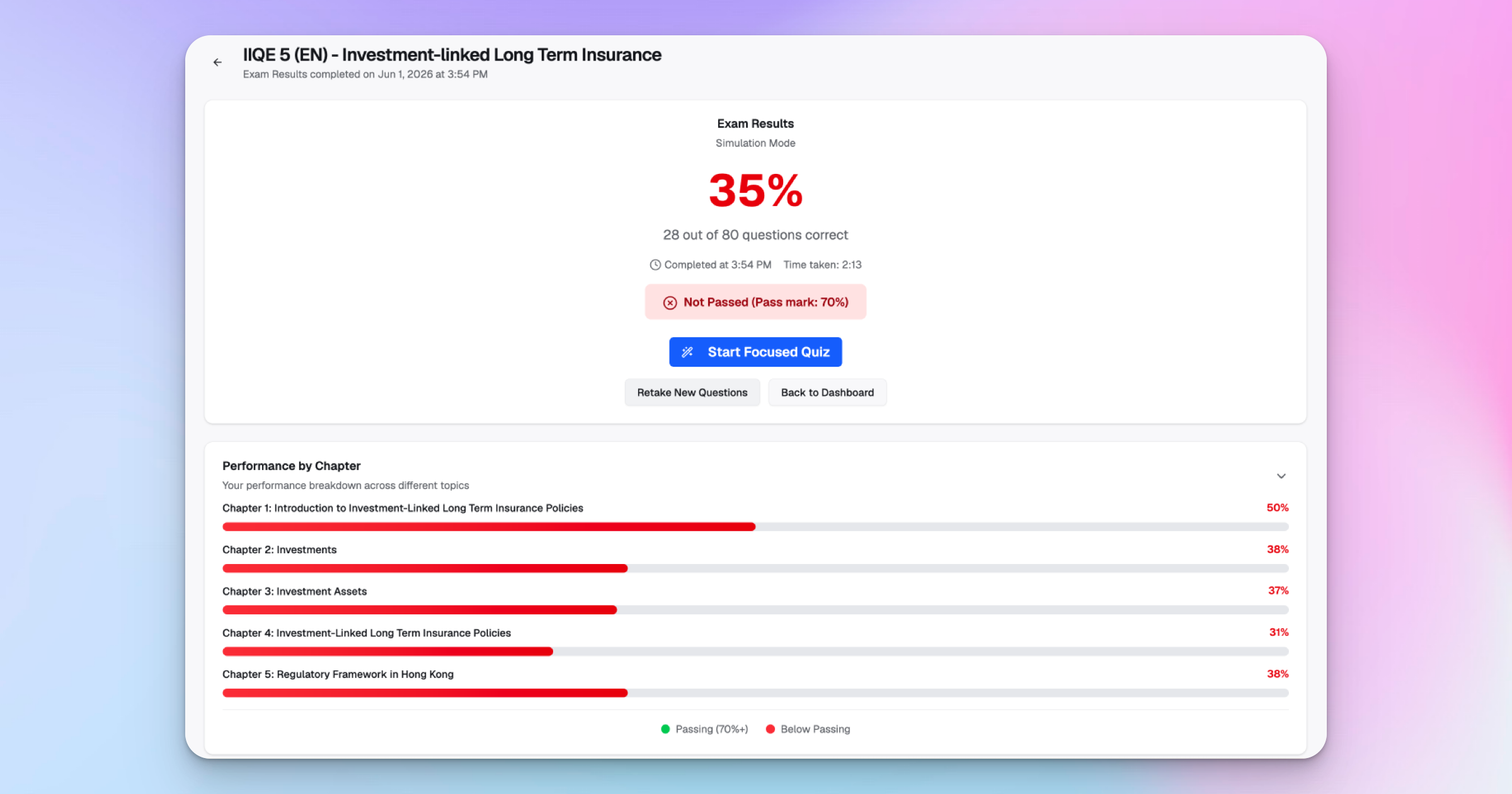
ExamPrep.hk tracks your performance by chapter so you can identify weak areas quickly.
3. Dual Regulatory Framework (Chapter 5)
Investment-linked insurance products sit at the intersection of two regulators:
- Insurance Authority (IA): Regulates the insurance component under the Insurance Ordinance
- Securities and Futures Commission (SFC): Regulates the investment component under the SFO
- Dual Compliance: Intermediaries may need both IA registration and SFC licensing
- Market Misconduct: AMLO, PDPO, and market misconduct provisions all apply
While Chapter 5 only carries 8 questions (10%), candidates who don't understand the regulatory overlap often lose easy marks here.
Chapter-by-Chapter Difficulty Breakdown
| Chapter | Topic | Weight | Difficulty |
|---|---|---|---|
| Ch 1 | Introduction to ILAS Policies | 2.5% | ⭐⭐ |
| Ch 2 | Investments (Risk, Economics, Markets) | 20% | ⭐⭐⭐ |
| Ch 3 | Investment Assets (Bonds, Equities, Derivatives, Funds) | 33.75% | ⭐⭐⭐⭐⭐ |
| Ch 4 | Investment-Linked Policies (ILAS Mechanics, Sales Practice) | 33.75% | ⭐⭐⭐⭐⭐ |
| Ch 5 | Regulatory Framework (IA, SFC, SFO) | 10% | ⭐⭐⭐ |
Chapter 3: Investment Assets — ⭐⭐⭐⭐⭐
This is arguably the hardest chapter in any IIQE paper. It requires understanding:
- How bonds are priced and how yield curves work
- Fundamental vs technical stock analysis
- How derivatives (options, futures, forwards) create leverage and risk
- Different fund structures and their fee implications
Why candidates struggle: Many insurance professionals have limited investment background. The financial concepts tested here go well beyond basic insurance knowledge.
Chapter 4: Investment-Linked Policies — ⭐⭐⭐⭐⭐
The second killer chapter tests deep understanding of ILAS policy mechanics and regulations:
- You must understand how ILAS charges erode policy value over time
- Know the differences between premium application methods, fund structures, and switching rules
- Detailed sales practice regulations (cooling-off period, principal brochure, GL25)
- Comparison of ILAS with guaranteed and with-profits policies
Why candidates struggle: The volume of technical terms and regulatory details is enormous — from specific charge types to customer protection requirements. You need to memorise precise definitions and timeframes.
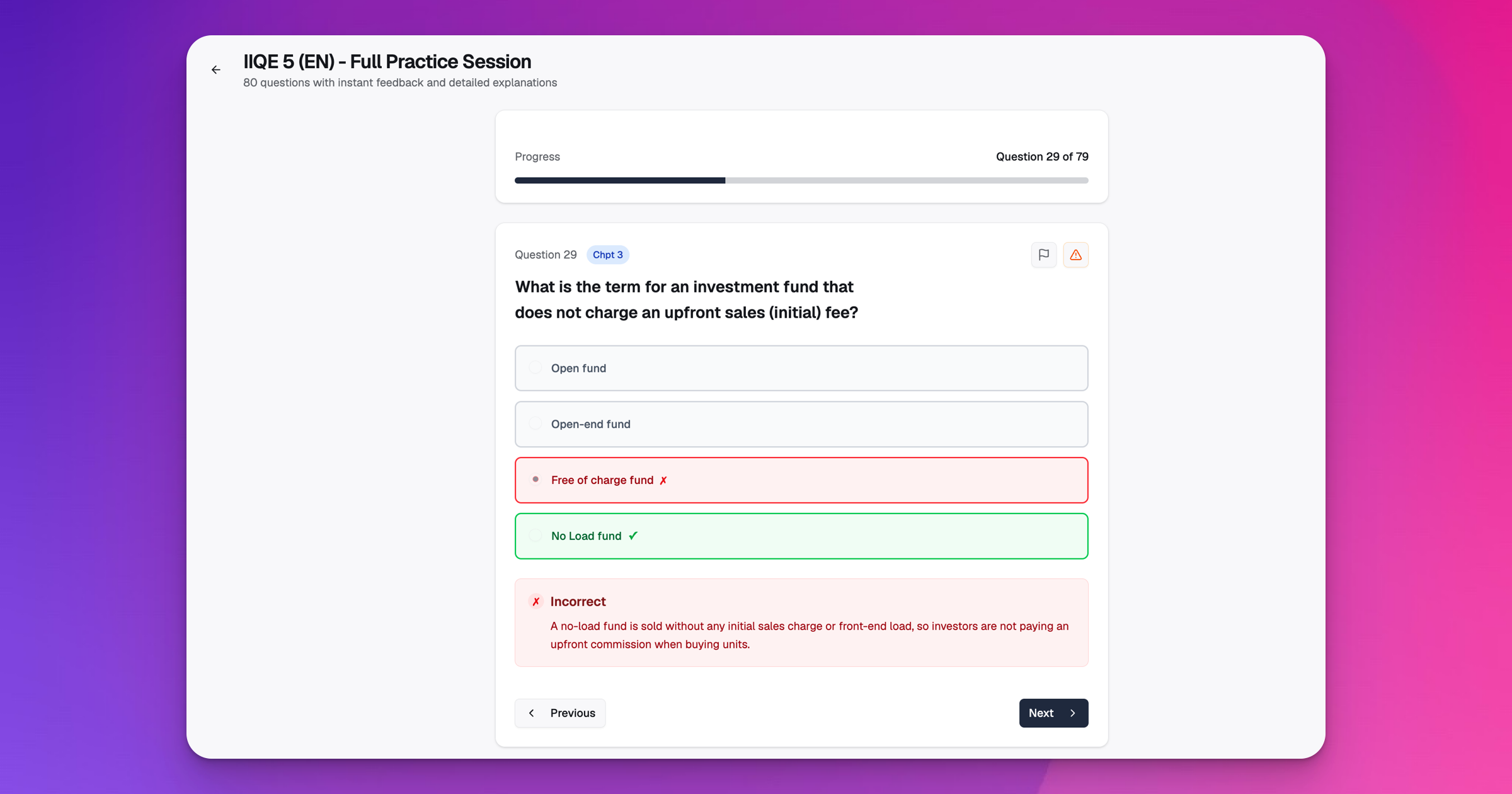
ExamPrep.hk's Instant Feedback feature explains the reasoning behind each answer — essential for mastering technical financial terminology.
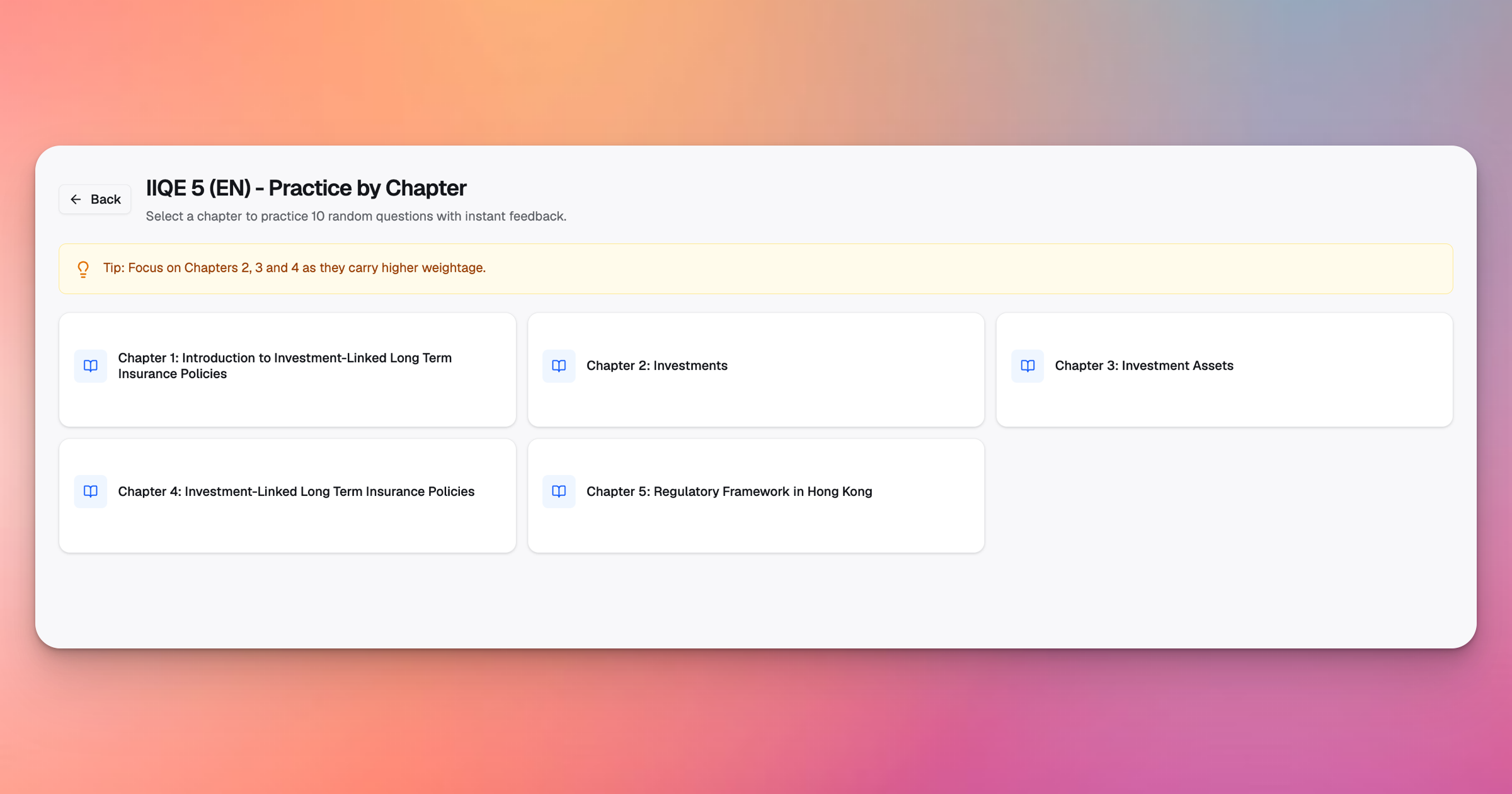
Focus your practice on the killer chapters with ExamPrep.hk's chapter-by-chapter mode.
Smart Study Strategies for IIQE Paper 5
Given the technical nature of Paper 5, generic study advice won't cut it. Here's what actually works:
1. Prioritise Chapters 3 and 4 (67.5% of the Exam)
These two chapters carry 54 out of 80 questions. Allocate at least 60-70% of your study time to mastering them.
2. Build Financial Foundations First
If you're new to investment concepts, don't jump straight into practice questions. First understand:
- How bonds and equities work
- Basic derivative mechanics
- Fund structures and NAV concepts
3. Master the Technical Terminology
Paper 5 is packed with financial terms that non-finance candidates find overwhelming. Make flashcards or summary sheets for key terms like:
- Sharpe ratio, yield curve, coupon rate, NAV, par value
- Forward vs futures vs options vs warrants
- Open-end vs closed-end funds, front-load vs back-load
- Premium application methods, surrender value, death benefit
4. Create Comparison Tables
Paper 5 frequently tests the differences between:
- ILAS vs traditional policies vs with-profits policies
- Open-end vs closed-end funds
- Forwards vs futures vs options
- Front-end vs back-end loads
5. Don't Neglect Regulation
Chapter 5 (10%) contains relatively "free marks" if you memorise:
- Cooling-off period rules (21 days)
- Principal brochure requirements
- SFC licensing categories
- Market misconduct types
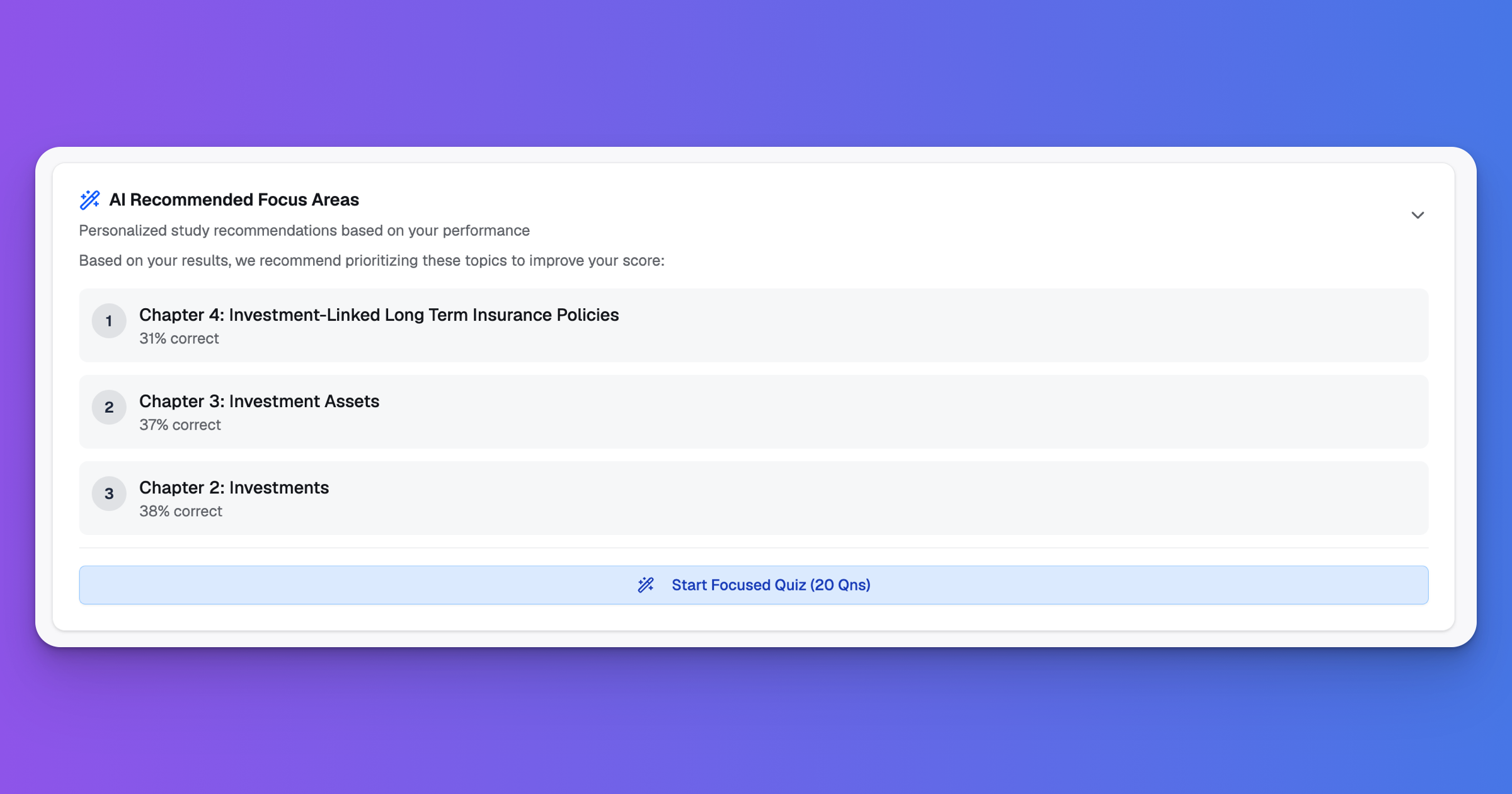
Let AI identify your weakest topics and create a personalised study plan.
Common Mistakes That Lead to Failure
- Underestimating the financial content — Paper 5 is NOT just another insurance paper. The investment component is substantial and technical.
- Not memorising key terms — Paper 5 tests precise definitions of financial concepts. Knowing the "gist" of a Sharpe ratio or yield curve isn't enough — you need to know the exact meaning.
- Confusing similar concepts — Forwards vs futures, open-end vs closed-end, front-load vs back-load. Know the precise differences.
- Ignoring sales practice regulations — Questions on cooling-off periods, GL25, and principal brochures are specific but predictable. Don't lose easy marks here.
- Reading without practising — Passive reading doesn't work for a terminology-heavy exam. You need to actively test your recall with practice questions.
Summary: Why Paper 5 Demands Respect
| Priority | Chapters | Weight |
|---|---|---|
| Critical | Ch 3, Ch 4 (Investment Assets & ILAS Policies) | 67.5% |
| High | Ch 2 (Investments & Economics) | 20% |
| Moderate | Ch 5 (Regulatory Framework) | 10% |
| Low | Ch 1 (Introduction) | 2.5% |
IIQE Paper 5 is the hardest for a reason: it combines volume (80 questions), technical depth (financial instruments and terminology that non-finance candidates find extremely challenging), and regulatory complexity (dual IA + SFC framework) into one demanding exam.
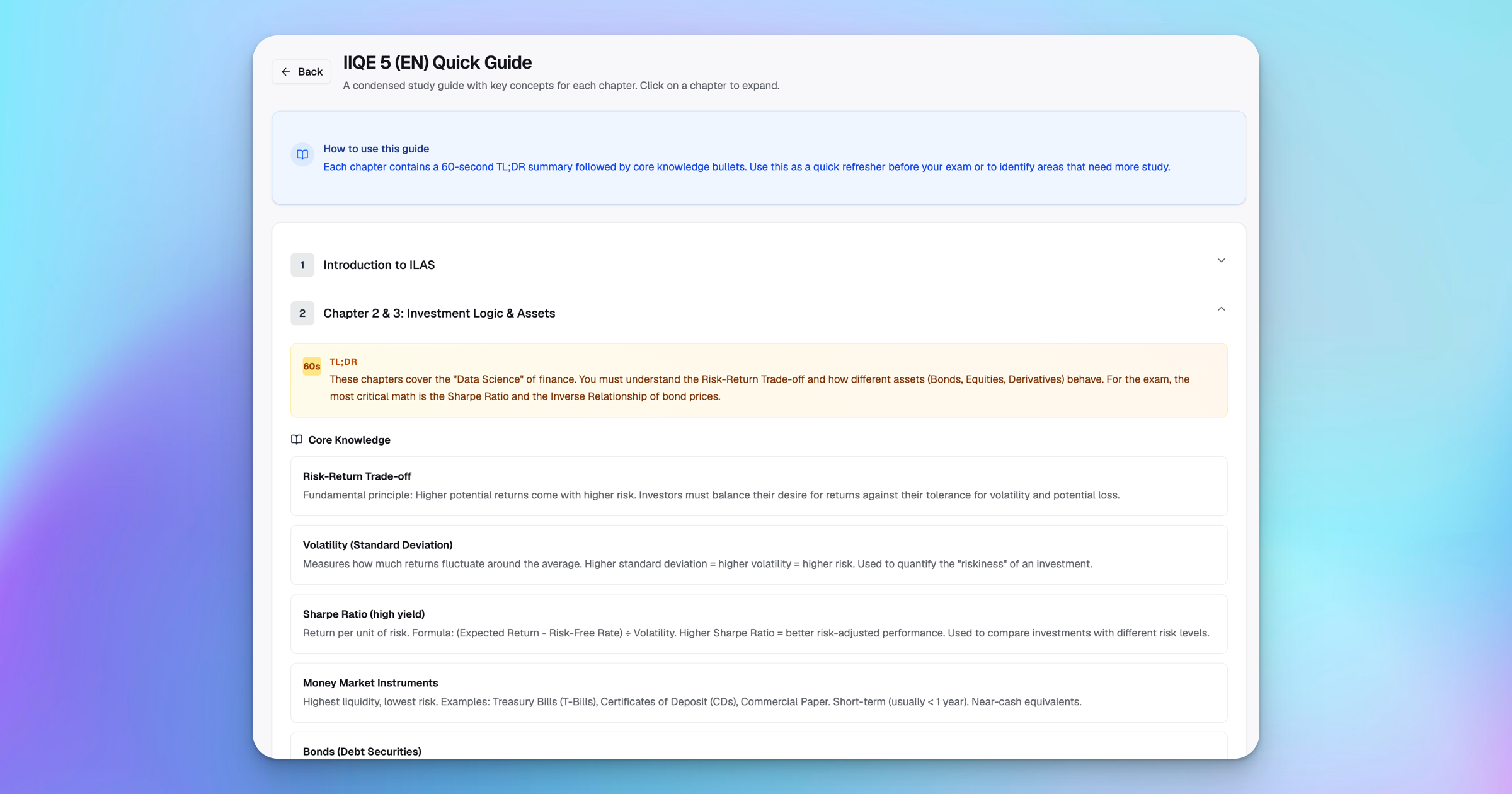
ExamPrep.hk's Quick Guide feature helps you quickly understand the key concepts of each chapter.
For a complete study plan, read our IIQE Paper 5 Study Guide. Ready to test your knowledge? Try our IIQE Paper 5 sample questions with answers.
Next Steps
- Understand the exact format and scoring in our Passing Score & Exam Format Guide
- Ready to book? Follow our step-by-step registration guide
- Compare study methods in our IIQE Paper 5 resource comparison
IIQE Paper 5 Difficulty FAQ
Ready to Put This Strategy Into Action? 💯
Join thousands of successful candidates who have passed their IIQE Paper 5 exam using our proven study methods.