
Free IIQE Paper 5 Mock Exam Questions & Answers (2026 Updated)
Practice with free IIQE Paper 5 sample questions covering investment-linked insurance, investment assets, fund charges, and regulatory framework. Includes answers and detailed explanations.
Want to know what IIQE Paper 5 questions actually look like?
The best way to prepare for any exam is to practice with realistic questions. In this guide, we share 5 free sample questions from each chapter of the Investment-Linked Long Term Insurance exam — complete with answers and detailed explanations.
Use these to test your knowledge and identify areas that need more study before sitting for the hardest IIQE paper.
📝 Quick Exam Reminder
- Total Questions: 80 MCQs
- Passing Score: 70% (56 correct answers)
- Time Limit: 2 hours (120 minutes)
- Format: Choose 1 correct answer from 4 options
- Pass Rate: ~53% (one of the lowest among IIQE papers)
(Want to understand the full exam structure first? Read our IIQE Paper 5 Passing Score & Format Guide.)
Sample Question 1: Introduction to Investment-Linked Insurance (Chapter 1)
Which types of underlying assets may an investment-linked life insurance policy be tied to?
A: Fixed income funds
B: Equity funds
C: Cash funds
D: All of the above
Click to reveal answer
✓ Correct Answer: D
Explanation: Investment-linked life insurance can link policy value to a range of fund choices, including fixed income, equity, and cash funds, depending on the product's available investment options.
Key Concept: Investment-Linked Insurance Fund Options
Understanding the range of underlying assets is fundamental to IIQE Paper 5:
- Fixed Income Funds: Invest in bonds and debt securities, offering more stable but typically lower returns
- Equity Funds: Invest in stocks and shares, offering higher growth potential but with greater volatility
- Cash Funds: Invest in money market instruments, providing capital preservation with modest returns
- Flexibility: Policyholders can typically choose and switch between fund options based on risk appetite
Sample Question 2: Investments (Chapter 2)
To assess conditions in the financial market, one should be familiar with key economic variables and indicators such as:
A: Economic product
B: Exchange rate
C: Corporate policy
D: Education level
Click to reveal answer
✓ Correct Answer: B
Explanation: Exchange rates are a core economic indicator that reflects currency value movements and can materially influence trade flows, inflation, and investment sentiment in financial markets.
Key Concept: Economic Indicators for Financial Markets
Chapter 2 requires familiarity with macroeconomic variables that drive markets:
- Exchange Rates: Affect import/export prices, corporate earnings, and foreign investment flows
- Interest Rates: Influence borrowing costs, bond prices, and equity valuations
- Inflation: Erodes purchasing power and affects real returns on investments
- GDP Growth: Signals overall economic health and corporate earnings potential
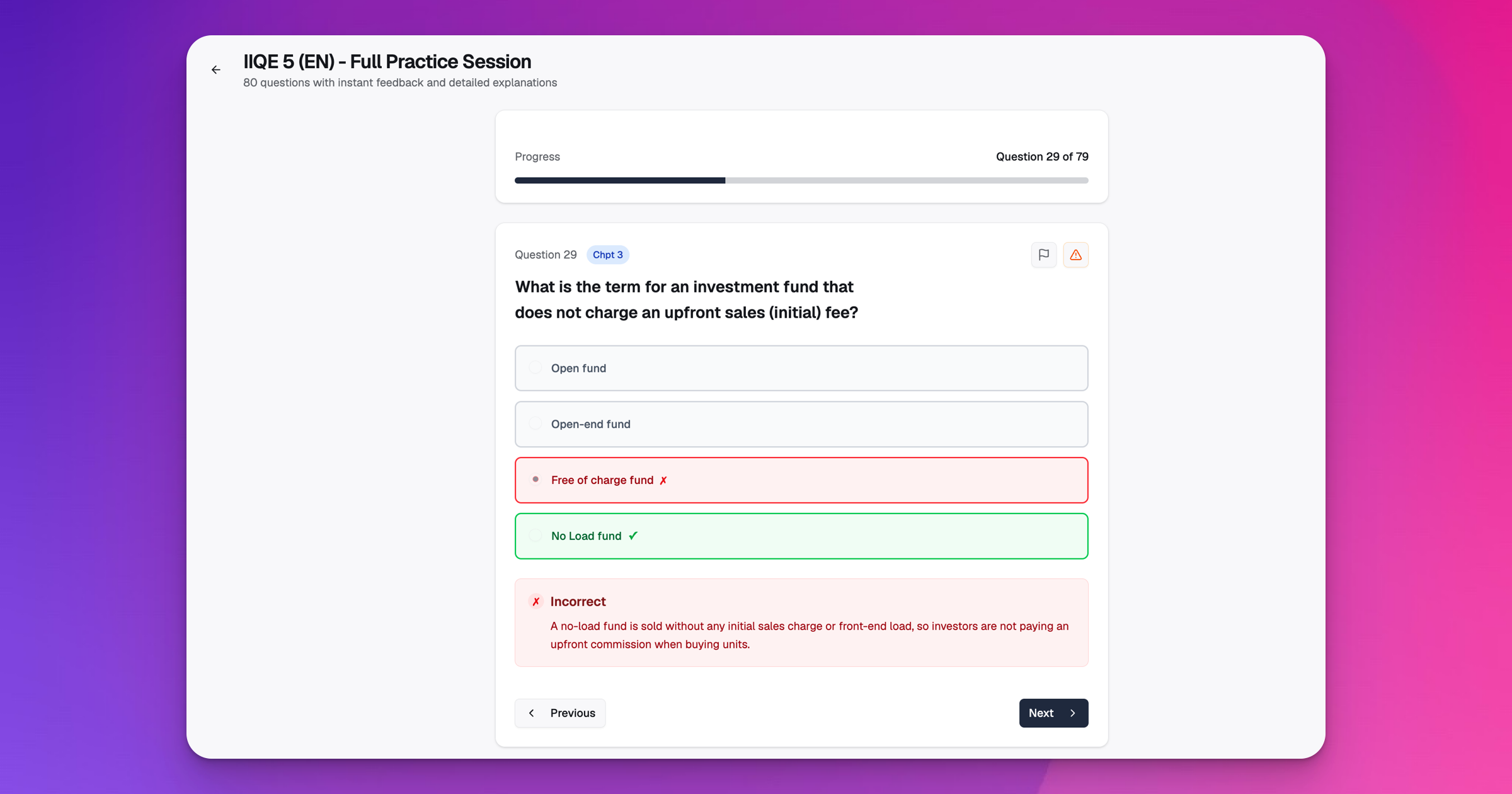
ExamPrep.hk provides instant feedback with detailed explanations for every question.
Sample Question 3: Investment Assets (Chapter 3)
Besides the management fee, which additional charge may apply when investing in a fund?
A: Sales fee/load
B: Option fee
C: Trust fee
D: All of the above
Click to reveal answer
✓ Correct Answer: A
Explanation: Fund investors may be charged a sales fee/load when buying into or redeeming units, in addition to the ongoing management fee.
Key Concept: Fund Charges and Fees
Understanding fund fee structures is critical for Chapter 3 — it carries 27 questions (33.75%):
- Management Fee: Ongoing annual charge for fund management, typically deducted from NAV
- Sales Fee/Load: One-time charge when purchasing (front-end load) or redeeming (back-end load) fund units
- Bid-Offer Spread: The difference between buying and selling price of units
- Impact on Returns: Higher charges reduce net investment returns — a key consideration for ILAS policyholders
Sample Question 4: Investment-Linked Policies (Chapter 4)
Which set of the following policy alterations may be available under both investment-linked policies and traditional (conventional) life insurance policies? I. premium holidays II. change of sum assured III. assignment of the policy IV. surrender
A: I, III, IV
B: I, II, IV
C: I, II, III
D: II, III, IV
Click to reveal answer
✓ Correct Answer: B
Explanation: Both types of life policies generally allow stopping premiums temporarily, adjusting the sum assured, and surrendering the policy, while assignment is not universally available across both in the same way.
Key Concept: Policy Alterations in ILAS vs Traditional Policies
Chapter 4 carries 27 questions (33.75%) and requires understanding the mechanics of ILAS:
- Premium Holidays: Available in both — allows temporary suspension of premium payments
- Change of Sum Assured: Both types may allow adjustment, subject to underwriting
- Surrender: Both types allow early termination, though ILAS surrender values depend on unit prices
- Assignment: More restricted and not uniformly available across both policy types
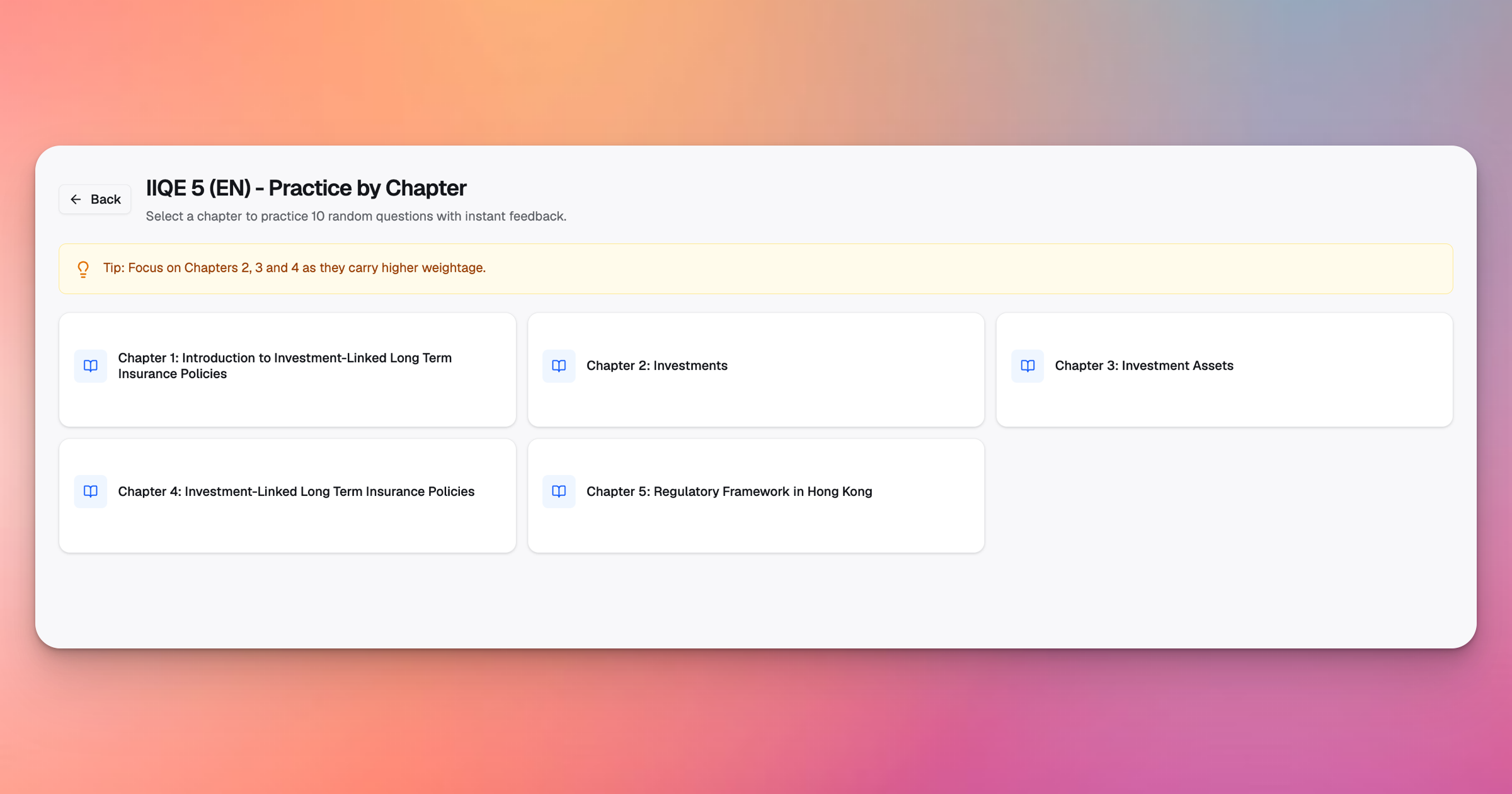
ExamPrep.hk lets you practise IIQE Paper 5 questions chapter-by-chapter to target your weak areas.
Sample Question 5: Regulatory Framework (Chapter 5)
Under Part XIII of the Securities and Futures Ordinance, civil liability may arise from certain forms of market misconduct, such as:
A: Not proactively disclosing material information
B: Careless selection of investment advisers
C: Price rigging
D: An inequitable pricing method
Click to reveal answer
✓ Correct Answer: C
Explanation: Part XIII covers specified market misconduct that can trigger civil liability, and manipulating prices (price rigging) falls within those prohibited misconduct categories.
Key Concept: Market Misconduct under the SFO
Chapter 5 covers the dual regulatory framework (IA + SFC) governing investment-linked insurance:
- Price Rigging: Artificially inflating or deflating securities prices — a prohibited market misconduct
- Insider Dealing: Trading on material non-public information
- Market Manipulation: Creating a false or misleading appearance of active trading
- Civil vs Criminal Liability: Part XIII deals with civil proceedings through the Market Misconduct Tribunal
🎯 Want More Practice Questions?
These 5 questions are just a sample. Our platform has 1,000+ IIQE Paper 5 questions with detailed explanations, chapter-by-chapter practice, and full mock exams that simulate the real test.
👉 Access Full Question Bank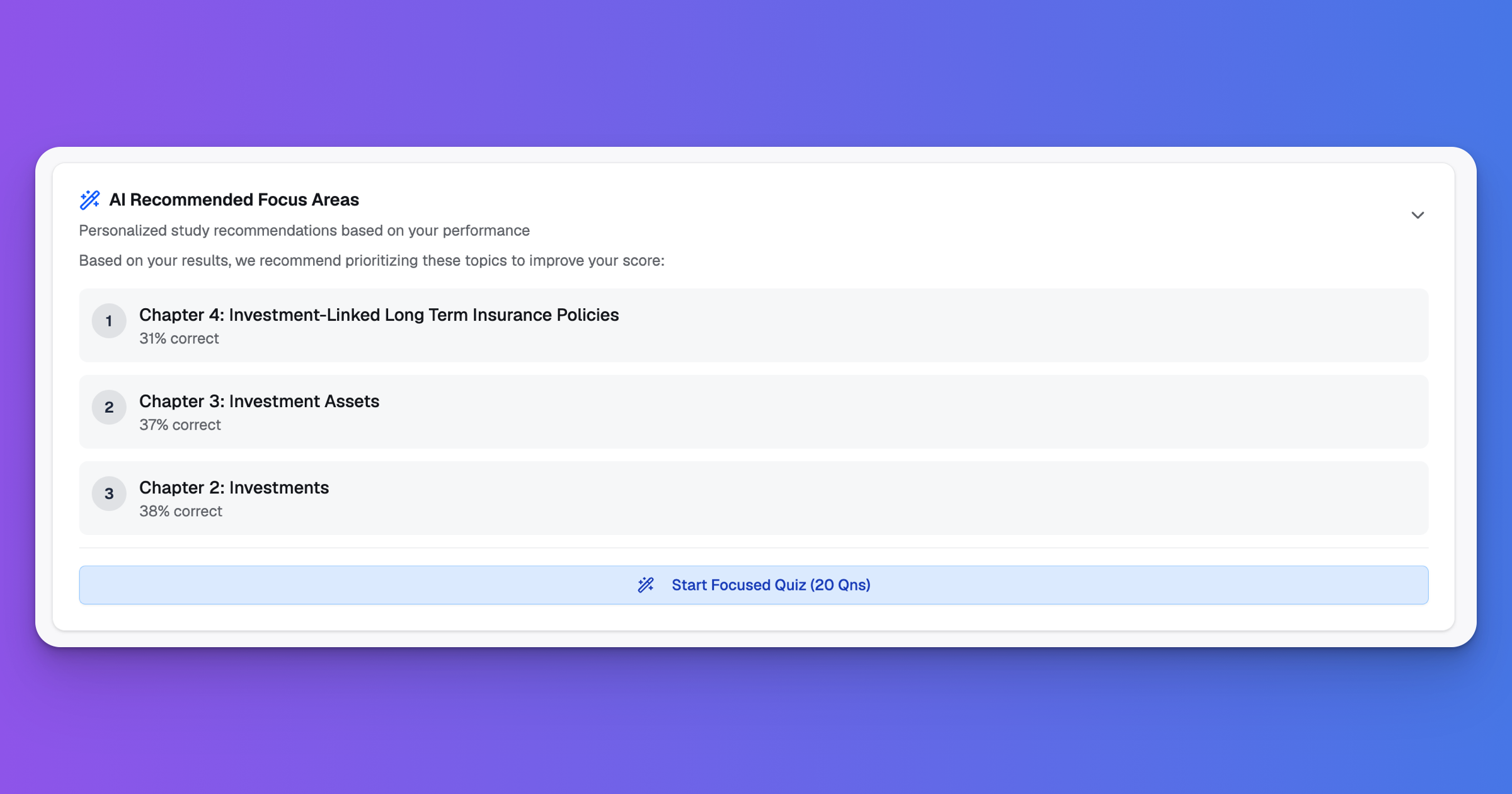
ExamPrep.hk's AI Focus Areas feature helps you focus your study time on your weakest areas.
Question Distribution by Chapter
Remember, IIQE Paper 5 has a very uneven distribution — Chapters 3 and 4 together account for 67.5% of the exam:
| Chapter | Topic | Est. Questions |
|---|---|---|
| Chapter 3 | Investment Assets | ~27 (33.75%) |
| Chapter 4 | Investment-Linked Policies | ~27 (33.75%) |
| Chapter 2 | Investments | ~16 (20%) |
| Chapter 5 | Regulatory Framework | ~8 (10%) |
| Chapter 1 | Introduction | ~2 (2.5%) |
Chapters 3 and 4 are the "killer chapters" for IIQE Paper 5. Focus your practice heavily on these two — but don't neglect the others. Learn exactly why these chapters are so challenging in our IIQE Paper 5 Difficulty Analysis.
Next Steps
Ready to continue your preparation?
- Read our Complete IIQE Paper 5 Study Guide for a proven study plan
- Check the Passing Score & Exam Format Guide to understand what you're aiming for
- Ready to book? Follow our IIQE Paper 5 registration guide
- Compare study methods in our resource comparison guide
- Start practicing with our full question bank for unlimited mock exams
IIQE Paper 5 Mock Exam FAQ
Ready to Put This Strategy Into Action? 💯
Join thousands of successful candidates who have passed their IIQE Paper 5 exam using our proven study methods.