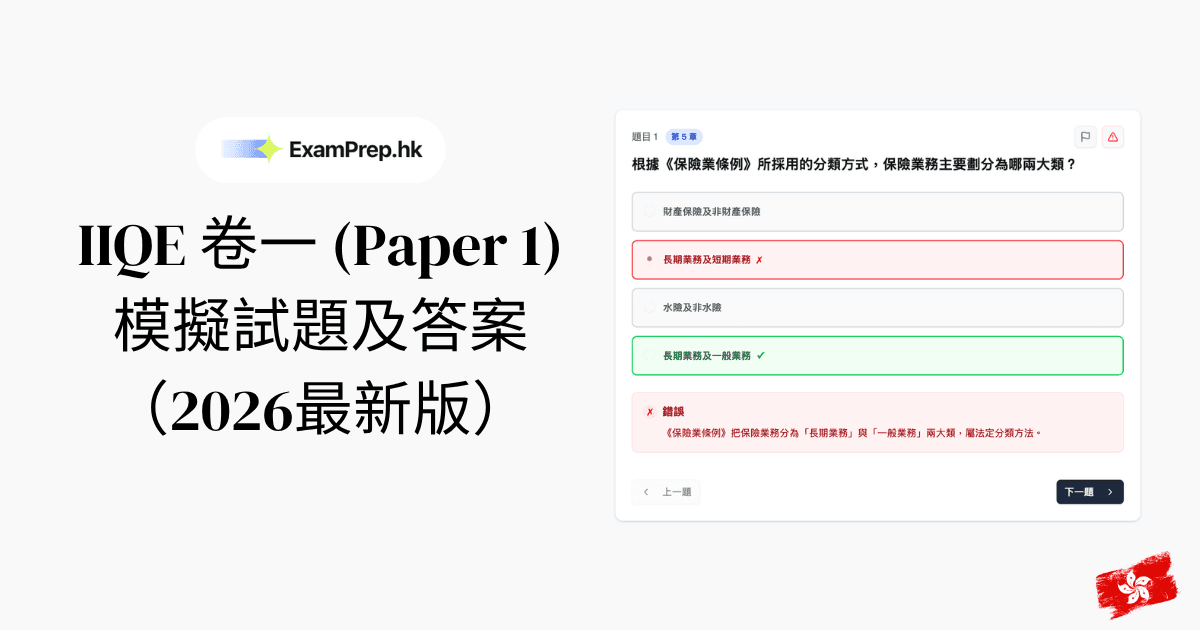
Free IIQE Paper 1 Mock Exam Questions & Sample Papers (2026)
Practice with free IIQE Paper 1 sample questions covering all 7 chapters. Includes answers and detailed explanations to help you prepare for the real exam.

Want to know what IIQE Paper 1 questions actually look like?
The best way to prepare for any exam is to practice with realistic questions. In this guide, we share 5 free sample questions from different chapters — complete with answers and detailed explanations.
Use these to test your knowledge and identify areas that need more study.
📝 Quick Exam Reminder
- Total Questions: 75 MCQs
- Passing Score: 70% (53 correct answers)
- Time Limit: 2 hours (120 minutes)
- Format: Choose 1 correct answer from 4 options
Sample Question 1: Risk and Insurance (Chapter 1)
When risks are categorized based on their underlying cause and resulting impact, they are divided into which types?
A: Particular risk and pure risk
B: Fundamental risk and pure risk
C: Particular risk and fundamental risk
D: Non fundamental risk and speculative risk
Click to reveal answer
✓ Correct Answer: C
Explanation: Classifying risk by cause and effect distinguishes between risks arising from individual events and those stemming from broader conditions affecting many people, which correspond to particular risk and fundamental risk.
Key Concept: Types of Risk
Understanding risk classification is fundamental to IIQE Paper 1:
- Particular Risk: Affects individuals or small groups (e.g., car accident, house fire)
- Fundamental Risk: Affects large populations (e.g., earthquake, economic recession)
- Pure Risk: Only possibility of loss or no loss (insurable)
- Speculative Risk: Possibility of gain, loss, or no change (not insurable)
Sample Question 2: Principles of Insurance (Chapter 3)
Regarding the principle of Utmost Good Faith, which statement below is NOT correct?
A: The duty requires proactive disclosure of relevant information
B: The obligation to disclose is not dependent on whether the other party asks for the information
C: Utmost Good Faith is rooted in common law, though it may be adjusted by contractual terms
D: An insurer is never capable of being liable for a breach of Utmost Good Faith
Click to reveal answer
✓ Correct Answer: D
Explanation: Both the insured and the insurer owe duties of Utmost Good Faith, so an insurer can breach this duty and be held responsible. Therefore, stating that an insurer can never be liable is incorrect.
Key Concept: Utmost Good Faith (Uberrima Fides)
This is one of the most tested principles in IIQE Paper 1. Remember:
- Both parties (insurer AND insured) must act in utmost good faith
- Disclosure must be proactive — you must volunteer material facts
- Breach by either party can void the contract
- Material facts are those that would influence a prudent underwriter
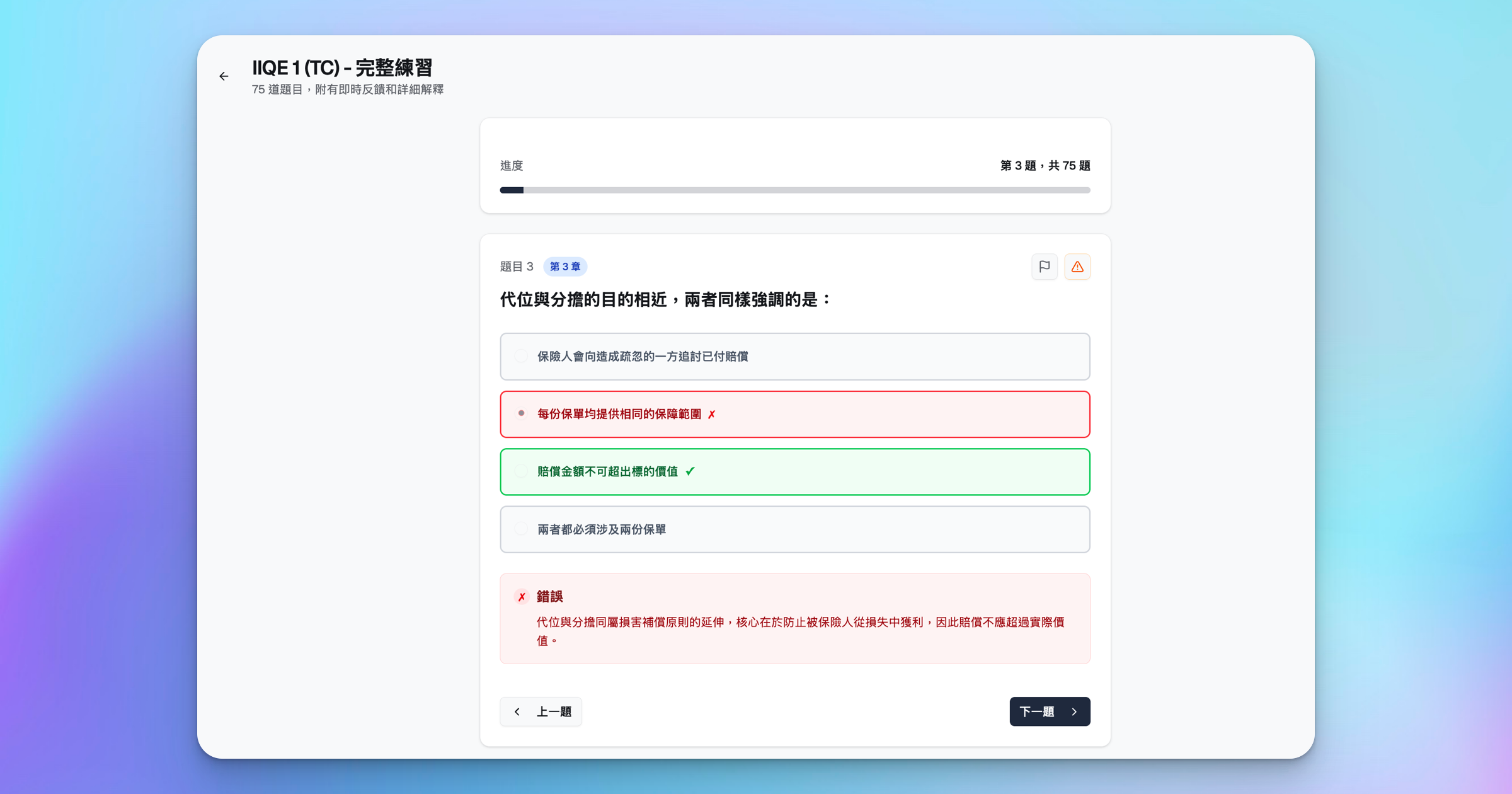
Pssst... if you're studying for your IIQE Paper 1 exam, you can use the ExamPrep.hk's e-learning platform to practice with realistic questions and get instant feedback and explanations to help you understand the concepts better.

ExamPrep.hk's Instant Feedback and Explanation feature helps you understand the concepts better.
Sample Question 3: Core Functions of Insurance Company (Chapter 4)
In a typical insurance company, the public relations department carries out various duties. Which of the following is NOT one of its functions?
A: Co-ordination of all external communications
B: Participation in many product researches
C: Dealing with media enquiries
D: Preparing press releases and copy for trade and other journals
Click to reveal answer
✓ Correct Answer: B
Explanation: Public relations mainly handles the company's communications and media-related materials, such as coordinating external messages and drafting press content. Product research is generally the responsibility of product development or marketing rather than public relations.
Key Concept: Insurance Company Departments
Know the core functions of each department:
- Underwriting: Risk assessment and policy pricing
- Claims: Processing and settling claims
- Marketing: Product development and promotion
- Public Relations: External communications and media
- Actuarial: Statistical analysis and premium calculations
Sample Question 4: Regulatory Framework (Chapter 6)
Where would you most commonly find the complete set of terms and conditions that make up an insurance contract documented in full?
A: Proposal/Application Forms
B: Policies
C: Proof of insurance
D: Show in the relevant insurance legislation
Click to reveal answer
✓ Correct Answer: B
Explanation: The policy document sets out the full contractual terms, including the coverage, exclusions, conditions, and obligations of both parties.
Key Concept: Insurance Documentation
Understand the purpose of each document:
- Proposal Form: Application for insurance — contains declarations and information provided by the applicant
- Policy: The complete contract — contains all terms, conditions, exclusions, and coverage details
- Certificate/Proof of Insurance: Evidence that insurance exists — summary document
- Endorsement: Amendment to an existing policy
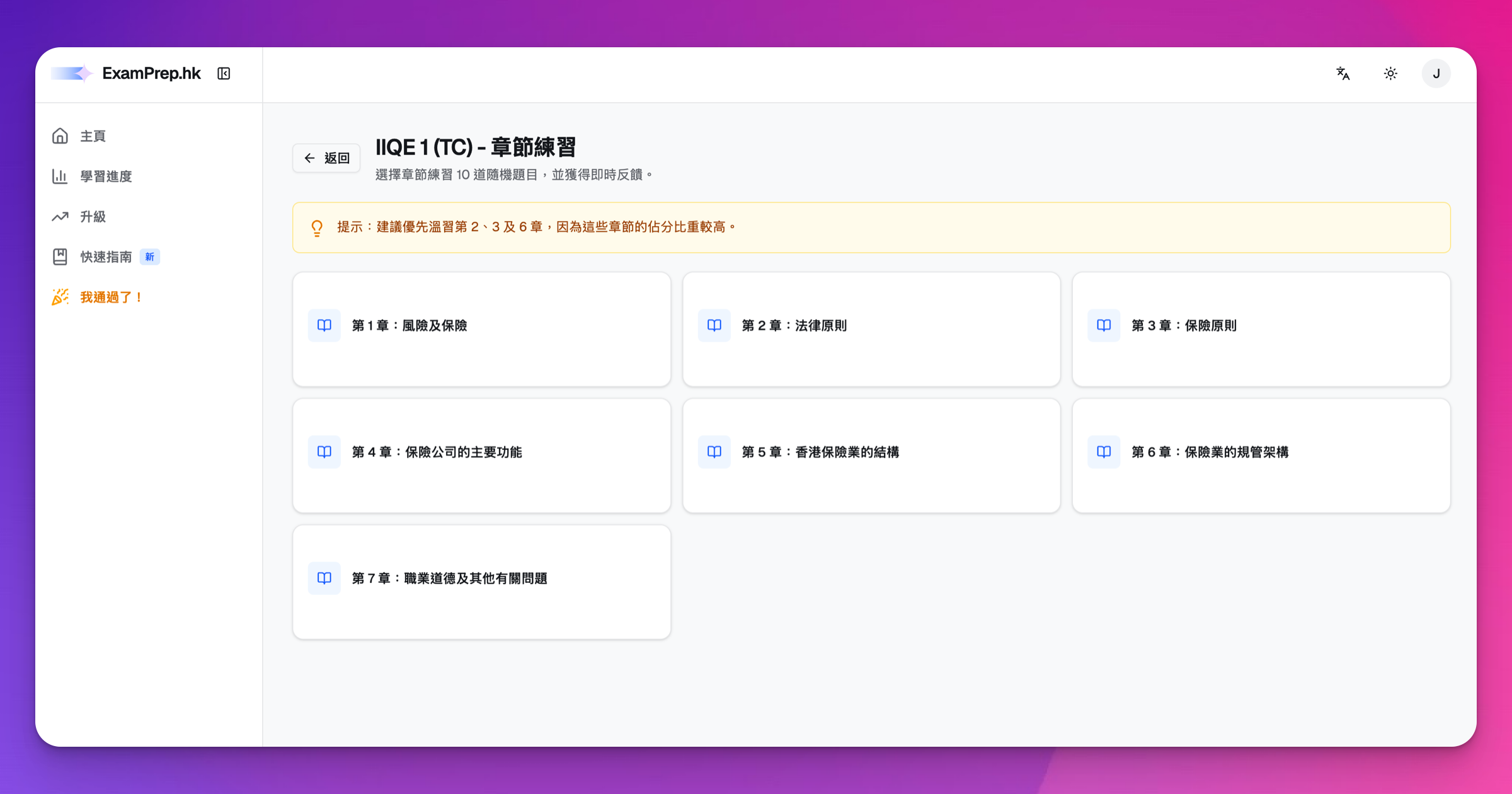
ExamPrep.hk's Practice by Chapter mode helps you focus on specific chapters and master the concepts.
Sample Question 5: Ethical Issues (Chapter 7)
Which statement below wrongly reflects the coverage of the Personal Data (Privacy) Ordinance?
A: It applies to both automated and manual processing
B: It covers both the public sector and the private sector
C: A statutory authority is established to supervise its enforcement
D: It applies to the private sector only, not the public sector
Click to reveal answer
✓ Correct Answer: D
Explanation: The Personal Data (Privacy) Ordinance applies to both public and private sector data users, so saying it excludes the public sector is incorrect.
Key Concept: Personal Data (Privacy) Ordinance
Key points about PDPO for the exam:
- Applies to both public and private sectors
- Covers both automated and manual data processing
- Enforced by the Privacy Commissioner for Personal Data
- Contains 6 Data Protection Principles (DPPs)
How to Use Mock Questions Effectively
Simply reading questions isn't enough. Here's how to maximise your practice:
- Time yourself — In the real exam, you have ~96 seconds per question
- Don't peek at answers — Commit to your choice before checking
- Understand the explanation — Don't just memorise answers; learn the underlying concept
- Track your weak areas — Note which chapters need more study
- Practice in exam conditions — No distractions, no breaks
🎯 Want More Practice Questions?
These 5 questions are just a sample. Our platform has 1,000+ IIQE Paper 1 questions with detailed explanations, chapter-by-chapter practice, and full mock exams that simulate the real test.
👉 Access Full Question Bank
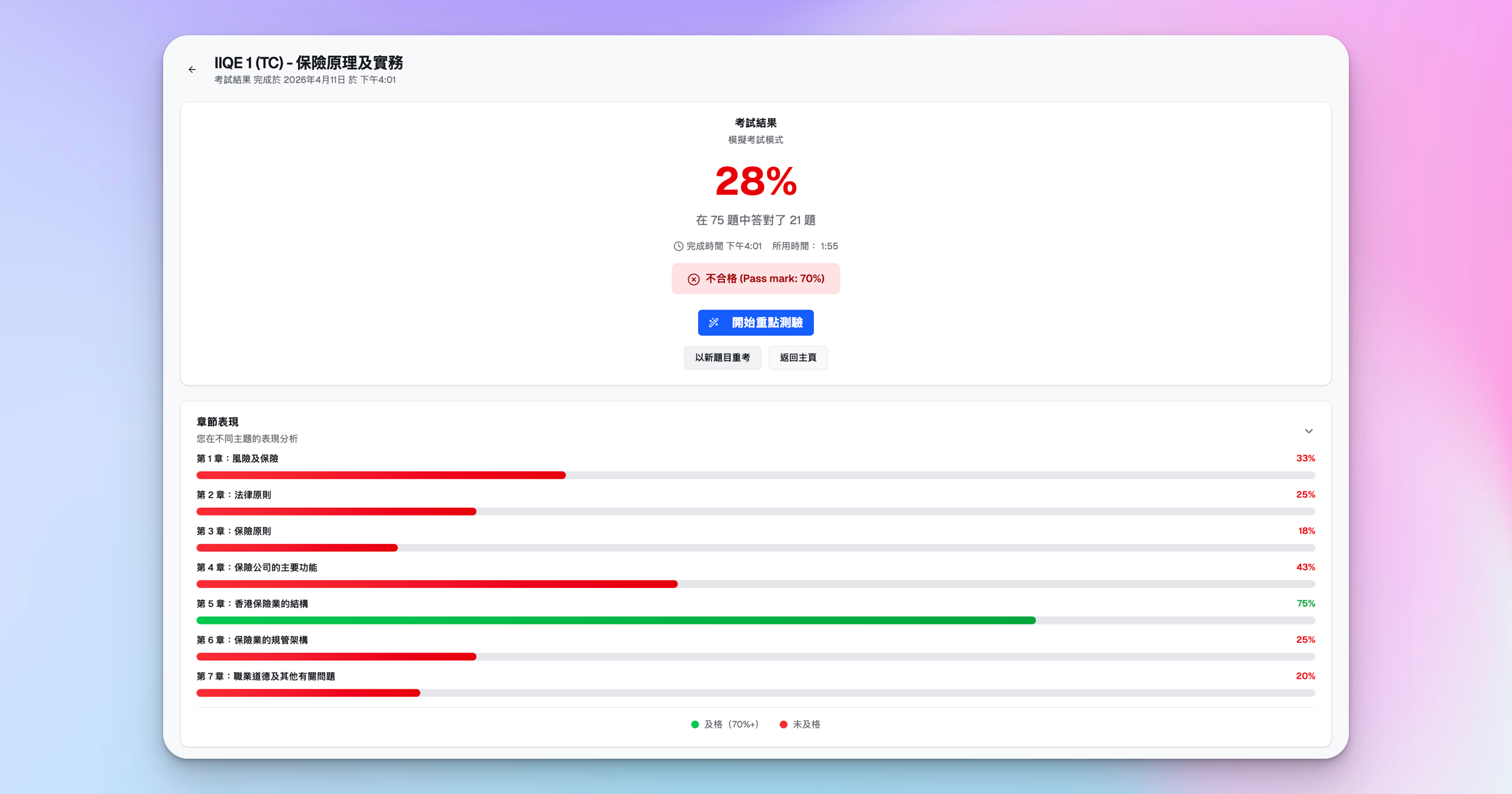
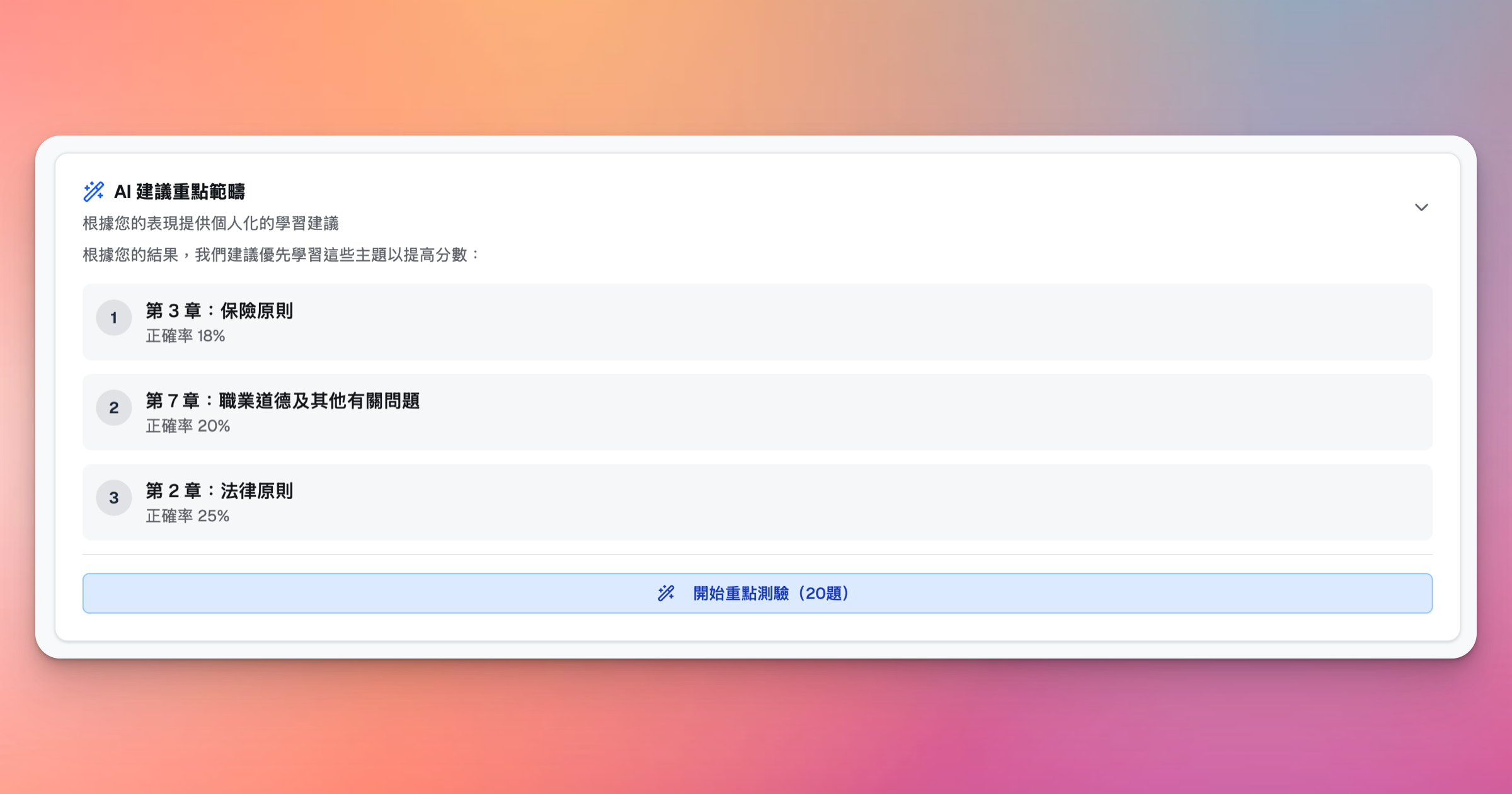
ExamPrep.hk's AI Focus Areas feature helps you focus your study time on your weakest areas.
Question Distribution by Chapter
Remember, not all chapters are weighted equally:
| Chapter | Topic | Est. Questions |
|---|---|---|
| Chapter 3 | Principles of Insurance | ~22 (30%) |
| Chapter 6 | Regulatory Framework | ~16 (21%) |
| Chapter 2 | Legal Principles | ~12 (16%) |
| Chapter 1 | Risk and Insurance | ~9 (12%) |
| Chapter 4 | Core Functions | ~7 (9%) |
| Chapter 7 | Ethical Issues | ~5 (7%) |
| Chapter 5 | HK Industry Structure | ~4 (5%) |
Focus your practice on Chapters 3, 6, and 2 — they make up 67% of the exam. Learn exactly what to study within each chapter in our IIQE Paper 1 Chapter Trap Guide.

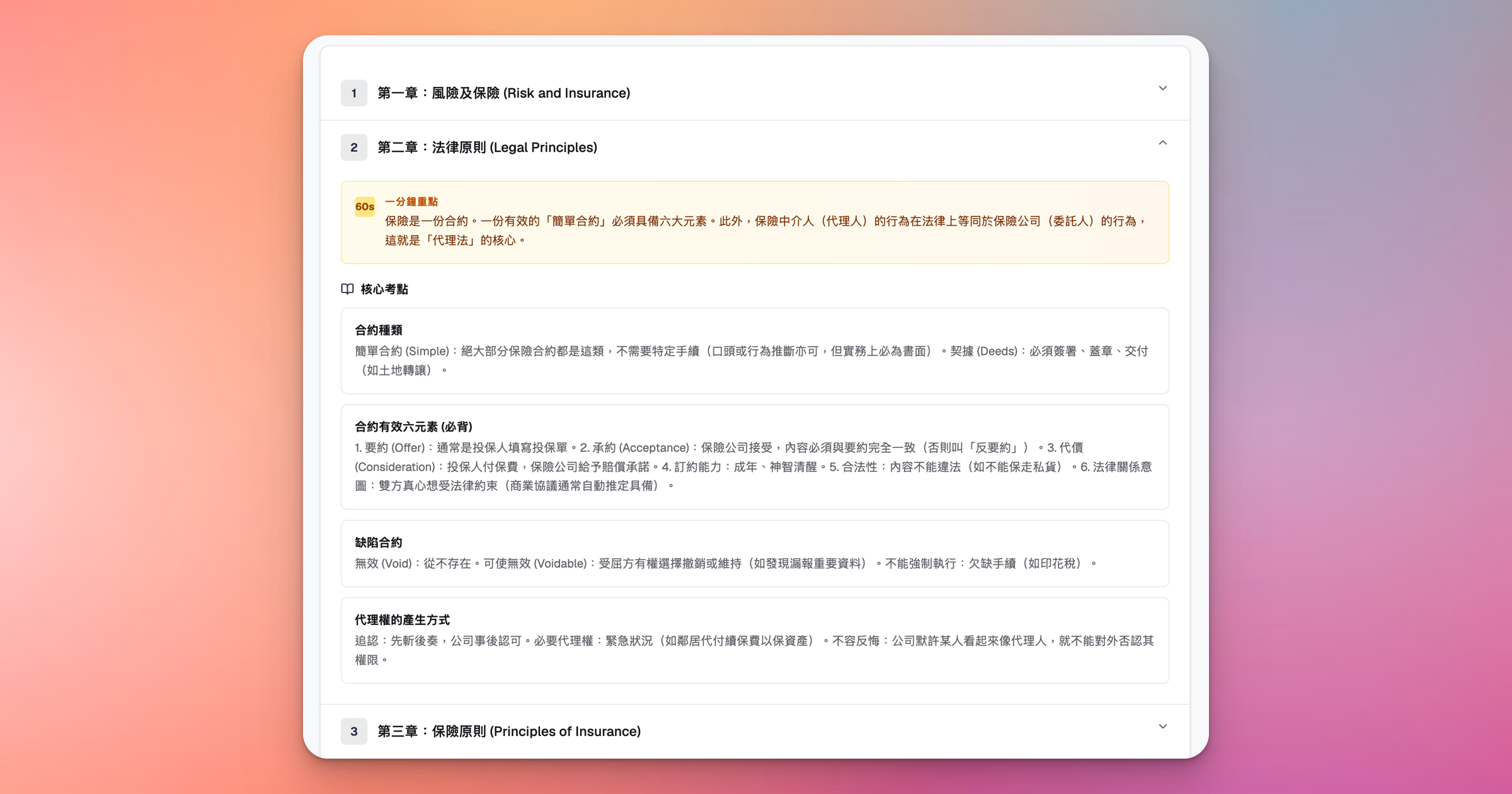
ExamPrep.hk's Quick Guide helps you break down key concepts into smaller, more manageable chunks.
Next Steps
Ready to continue your preparation?
- Read our Complete IIQE Paper 1 Study Guide for a proven 3-week study plan
- Check the Passing Score & Exam Format Guide to understand what you're aiming for
- Start practicing with our full question bank for unlimited mock exams