
Free IIQE Paper 2 Mock Exam Questions & Answers (2026 Updated)
Practice with free IIQE Paper 2 sample questions covering general insurance, underwriting, claims, and customer service. Includes answers and detailed explanations.
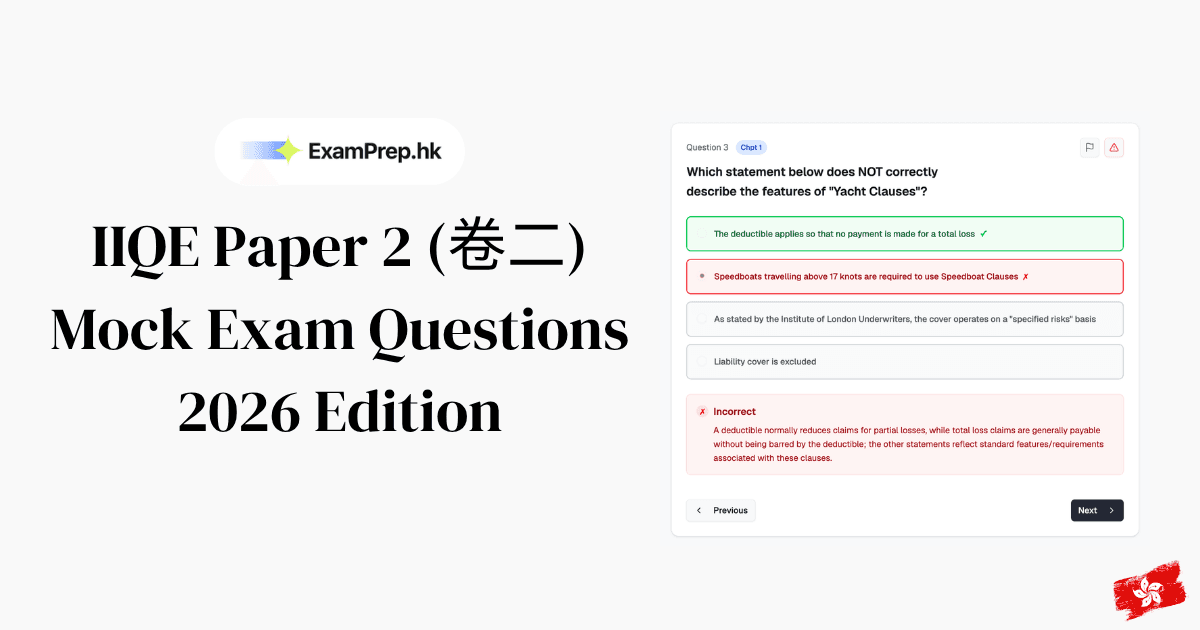
Want to know what IIQE Paper 2 questions actually look like?
The best way to prepare for any exam is to practise with realistic questions. In this guide, we share 5 free sample questions from different chapters — complete with answers and detailed explanations.
Use these to test your knowledge and identify areas that need more study.
📝 Quick Exam Reminder
- Total Questions: 50 MCQs
- Passing Score: 70% (35 correct answers)
- Time Limit: 1 hour 15 minutes (75 minutes)
- Format: Choose 1 correct answer from 4 options
(If you haven't registered for your exam yet, check our IIQE Paper 2 Registration Guide.)
Sample Question 1: Insurance Products (Chapter 1)
Motor insurance can be grouped into several categories. Which of the following does NOT fall under a standard motor insurance category?
A: Rental vehicle
B: Private vehicle
C: Motor cycle
D: Commercial vehicle
Click to reveal answer
✓ Correct Answer: A
Explanation: Motor insurance classifications typically cover private vehicles, motor cycles, and commercial vehicles, while rental vehicle describes a usage arrangement rather than a main category of motor insurance.
Key Concept: Motor Insurance Categories
Motor insurance is one of the most heavily tested topics in Chapter 1. Here's what you need to know:
- Private Vehicle: Cars used for personal/domestic purposes
- Commercial Vehicle: Goods vehicles, taxis, public light buses, and other vehicles used for business
- Motor Cycle: Two-wheeled motor vehicles with their own rating class
- Key Distinction: Categories are based on vehicle type and primary use, not rental or ownership arrangements
Sample Question 2: Insurance Products (Chapter 1)
Which statement below wrongly describes standard excesses?
A: They will always run alongside any voluntary excess
B: These excesses do not entitle the insured to any premium reduction
C: They apply to all policies within the same class
D: These excesses qualify for a discount off the standard premium
Click to reveal answer
✓ Correct Answer: D
Explanation: A standard excess is imposed by the insurer as a policy condition and generally does not earn any premium discount. Premium reductions are typically linked to choosing a higher voluntary excess instead.
Key Concept: Standard vs Voluntary Excess
Understanding the difference between excess types is critical:
- Standard Excess: Imposed by the insurer on all policies within a class — cannot be removed and does not reduce the premium
- Voluntary Excess: Chosen by the insured in exchange for a lower premium — a trade-off between out-of-pocket cost and savings on premiums
- Both Apply Together: If you have both, you pay the standard excess plus the voluntary excess on any claim
Pssst... if you're studying for your IIQE Paper 2 exam, you can use ExamPrep.hk's e-learning platform to practise with realistic questions and get instant feedback and explanations.
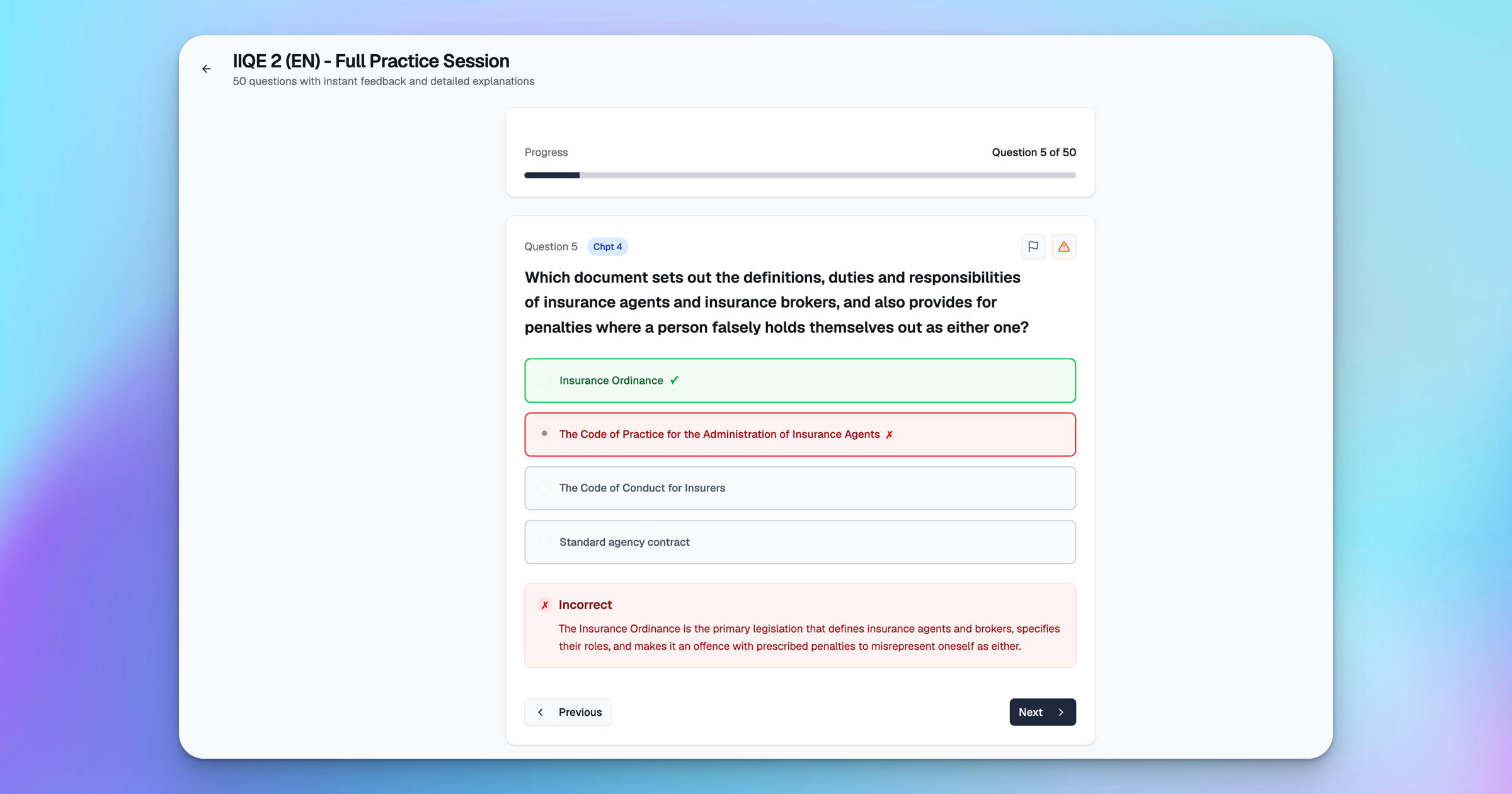
ExamPrep.hk's Instant Feedback and Explanation feature helps you understand the concepts better.
Sample Question 3: Underwriting and Policy Wording (Chapter 2)
In a standard general insurance policy document, which of the following terms would you typically find?
A: Arbitration
B: Claims
C: Cancellation
D: All of the above
Click to reveal answer
✓ Correct Answer: D
Explanation: General insurance policies commonly include provisions on dispute resolution, procedures for making claims, and the rights and process for cancellation.
Key Concept: Policy Document Structure
Know the standard components of a general insurance policy:
- Insuring Clause: Defines what is covered and the insurer's promise to pay
- Conditions: Obligations of both parties (e.g. duty to notify claims promptly)
- Exclusions: What is not covered under the policy
- Standard Provisions: Arbitration, cancellation, claims procedures, subrogation, and contribution
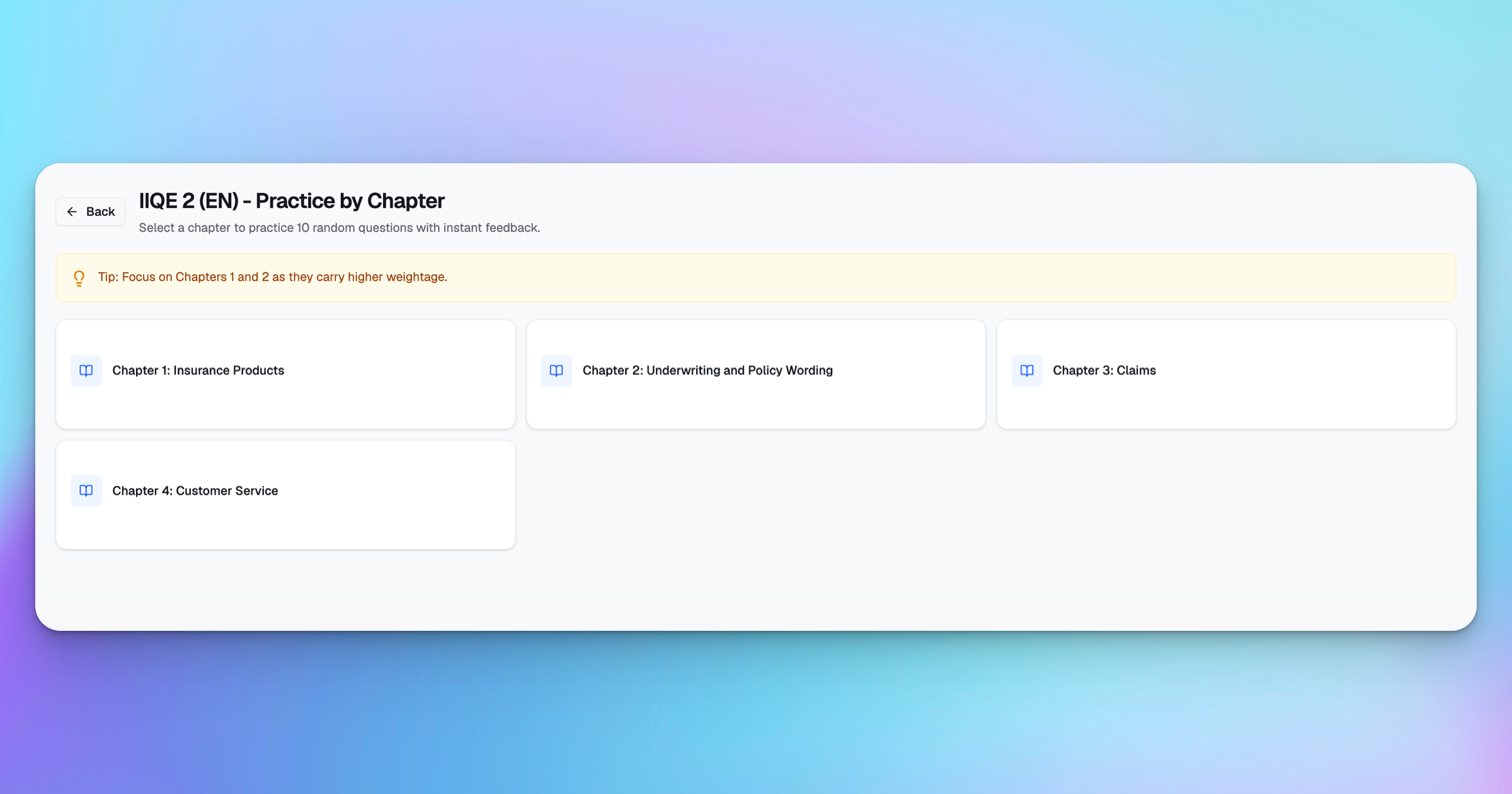
ExamPrep.hk's Practice by Chapter mode helps you focus on specific chapters and master the concepts.
Sample Question 4: Claims (Chapter 3)
Regarding the role and characteristics of loss adjusters, which THREE of the following statements are true? i. They are appointed by the insurer ii. They hold themselves out as specialists in the relevant field iii. Their remuneration is charged according to a prescribed scale iv. Their recommendations are binding on the insurer but not on the insured
A: i, ii, iii
B: i, ii, iv
C: ii, iii, iv
D: i, iii, iv
Click to reveal answer
✓ Correct Answer: A
Explanation: Loss adjusters are engaged by insurers as specialist claim investigators and their fees are commonly charged on an agreed scale. Their reports are advisory rather than legally binding on either party.
Key Concept: Loss Adjusters
Loss adjusters play a key role in the claims process:
- Appointed by: The insurer (not the insured)
- Role: Independent specialists who investigate and assess claims
- Fees: Charged on a prescribed scale basis
- Reports: Advisory only — not binding on the insurer or the insured
- Exam Tip: "Binding" is the trap word. Loss adjusters recommend; insurers decide.
Sample Question 5: Customer Service (Chapter 4)
Which document sets out the definitions, duties and responsibilities of insurance agents and insurance brokers, and also provides for penalties where a person falsely holds themselves out as either one?
A: Standard agency contract
B: The Code of Conduct for Insurers
C: Insurance Ordinance
D: The Code of Practice for the Administration of Insurance Agents
Click to reveal answer
✓ Correct Answer: C
Explanation: The Insurance Ordinance is the primary legislation that defines insurance agents and brokers, specifies their roles, and makes it an offence with prescribed penalties to misrepresent oneself as either.
Key Concept: Insurance Ordinance
Understanding the regulatory hierarchy is essential for Chapter 4:
- Insurance Ordinance: Primary legislation — defines roles, duties, penalties, and statutory requirements
- Codes of Conduct: Industry self-regulatory guidelines — not law, but enforceable by professional bodies
- Standard Agency Contracts: Commercial agreements between insurers and agents — not legislation
- Exam Tip: When a question mentions "penalties" or "offence", the answer is almost always the Insurance Ordinance
How to Use Mock Questions Effectively
Simply reading questions isn't enough. Here's how to maximise your practice:
- Time yourself — In the real exam, you have ~90 seconds per question
- Don't peek at answers — Commit to your choice before checking
- Understand the explanation — Don't just memorise answers; learn the underlying concept
- Track your weak areas — Note which chapters need more study
- Practise in exam conditions — No distractions, no breaks
🎯 Want More Practice Questions?
These 5 questions are just a sample. Our platform has 1,000+ IIQE Paper 2 questions with detailed explanations, chapter-by-chapter practice, and full mock exams that simulate the real test.
👉 Access Full Question Bank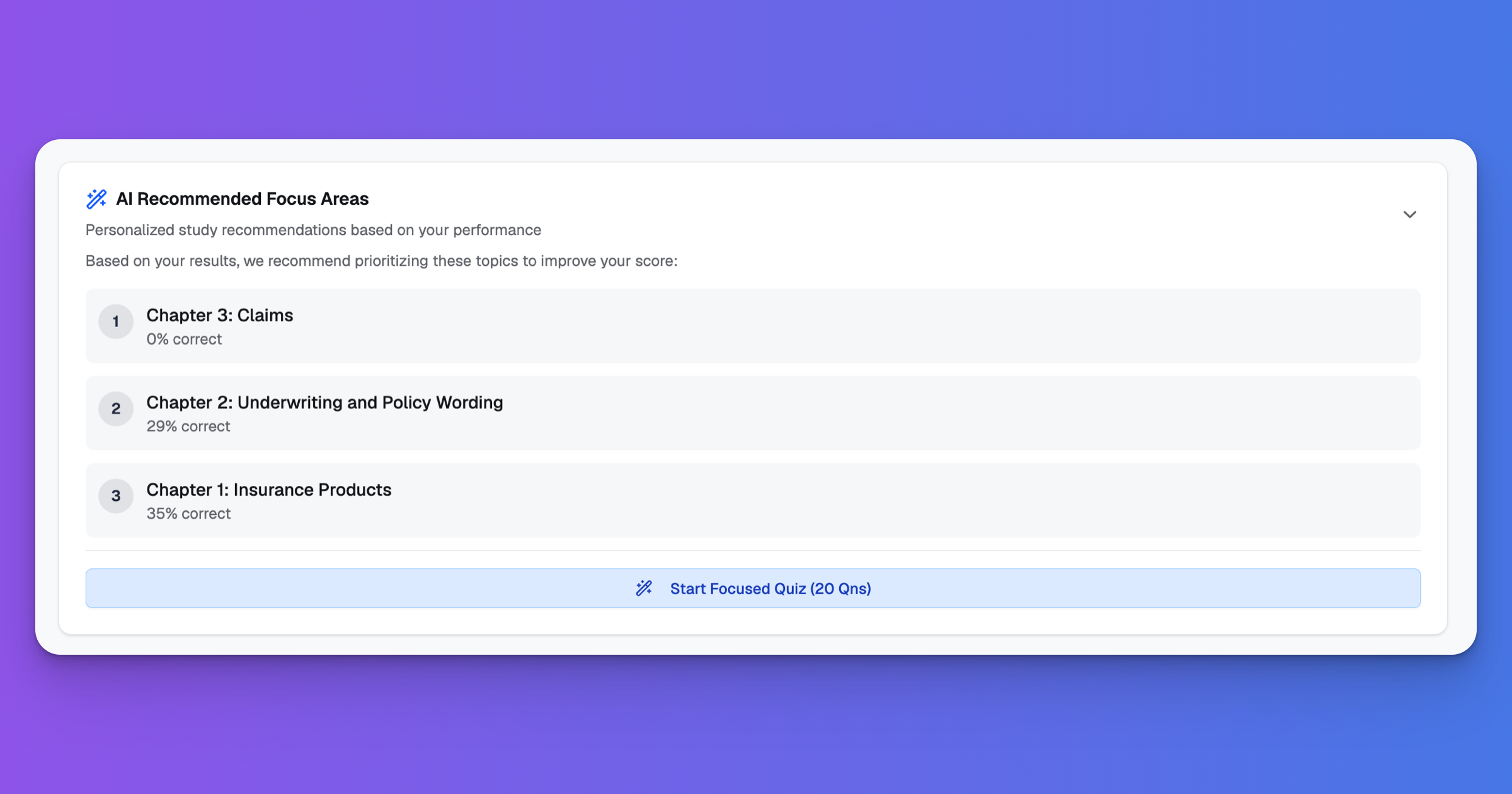
ExamPrep.hk's AI Focus Areas feature helps you focus your study time on your weakest areas.
Question Distribution by Chapter
Remember, IIQE Paper 2 is dominated by the first two chapters:
| Chapter | Topic | Est. Questions |
|---|---|---|
| Chapter 1 | Insurance Products | ~23 (46%) |
| Chapter 2 | Underwriting and Policy Wording | ~17 (34%) |
| Chapter 3 | Claims | ~5 (10%) |
| Chapter 4 | Customer Service | ~5 (10%) |
⚠️ Key Insight: Chapters 1 and 2 together make up 80% of the exam (40 out of 50 questions). Master these two chapters and you're most of the way to passing. Learn more in our IIQE Paper 2 Difficulty Analysis.
Next Steps
Ready to continue your preparation?
- Read our Complete IIQE Paper 2 Study Guide for a proven study plan
- Check the Passing Score & Exam Format Guide to understand what you're aiming for
- Ready to book? Follow our IIQE Paper 2 Registration Guide
- Compare study methods in our resource comparison guide
- Understand the challenge in our IIQE Paper 2 Difficulty Analysis
IIQE Paper 2 Mock Exam FAQ
Ready to Put This Strategy Into Action? 💯
Join thousands of successful candidates who have passed their IIQE Paper 2 exam using our proven study methods.